Viewing chapter After Language (23 quotes)
“Nonverbal communication is an elaborate secret code that is written nowhere, known by none, and understood by all.”
Edward Sapir, Anthropologist (1884-1939)
Year: 1939
Chapter:
After Language
In the computer age, speech yields to macrocosmic gesticulation or the direct interface of total cultures. The silent movies began this move.
Counterblast (1969), p 13
Year: 1969
Chapter:
Body Language
An immediate simulation of consciousness would by-pass speech in a kind of massive extrasensory perception, just as global thermostats could by-pass those extensions of skin and body that we call houses. Such an extension of the process of consciousness by electric simulation may easily occur in the 1960s.
Understanding Media, 1964, MIT/Routledge p 130
Year: 1964
[Someday we may see] …a kind of computerized ESP with consciousness as the corporate content of the environment – and eventually, maybe even a small portable computer, about the size of a hearing aid, that would process our private experience the way dreams do now.
From a lecture at Spencer Memorial Church in NYC in spring of 1965, reported in “The Talk of the Town,” The New Yorker, May 15, 1965
Year: 1965
Chapters:
Computer | Corporate Consciousness | Extending Consciousness | From Tribal to Literate | Occult | Predictions | Present [The]
While bemoaning the decline of literacy and the obsolescence of the book, the literati have typically ignored the imminence of the decline in speech itself. The individual word, as a store of information and feeling, is already yielding to macroscopic gesticulation.
War and Peace in the Global Village, 1968, p. 90-91.
Year: 1968
Statement without syntax or verbalization was really statement by gesture, by mime, and by g_e_s_t_a_l_t_. This new dimension opened for human inspection by poets like Baudelaire and Rimbaud l_e_ _p_a_y_s_a_g_e_ _i_n_t_ér_i_e_u_r_, or the countries of the mind.
Understanding Media, 1964, MIT/Routledge edition, p 201
Year: 1964
Chapters:
Body Language | Photography
Electric technology does not need words any more than the digital computer needs numbers
Understanding Media, 1964, MIT/Routledge edition, p 80
Year: 1964
Chapters:
Computer | Electric, Electronic
…if you have difficulty envisioning something as trivial as the imminent end of elections, you’ll be totally unprepared to cope with the prospect of the forthcoming demise of spoken language and its replacement by a global consciousness
PLAYBOY: Are you talking about global telepathy?
McLUHAN: Precisely. Already, computers offer the potential of instantaneous translation of any code or language into any other code or language. If a data feedback is possible through the computer, why not a feed forward of thought whereby a world consciousness links into a world computer? Via the computer, we could logically proceed from translating languages to bypassing them entirely in favor of an integral cosmic unconsciousness somewhat similar to the collective unconscious envisioned by Bergson.
Playboy Interview (1969), in The Essential McLuhan (1995), p 262
Year: 1969
Chapter:
Predictions

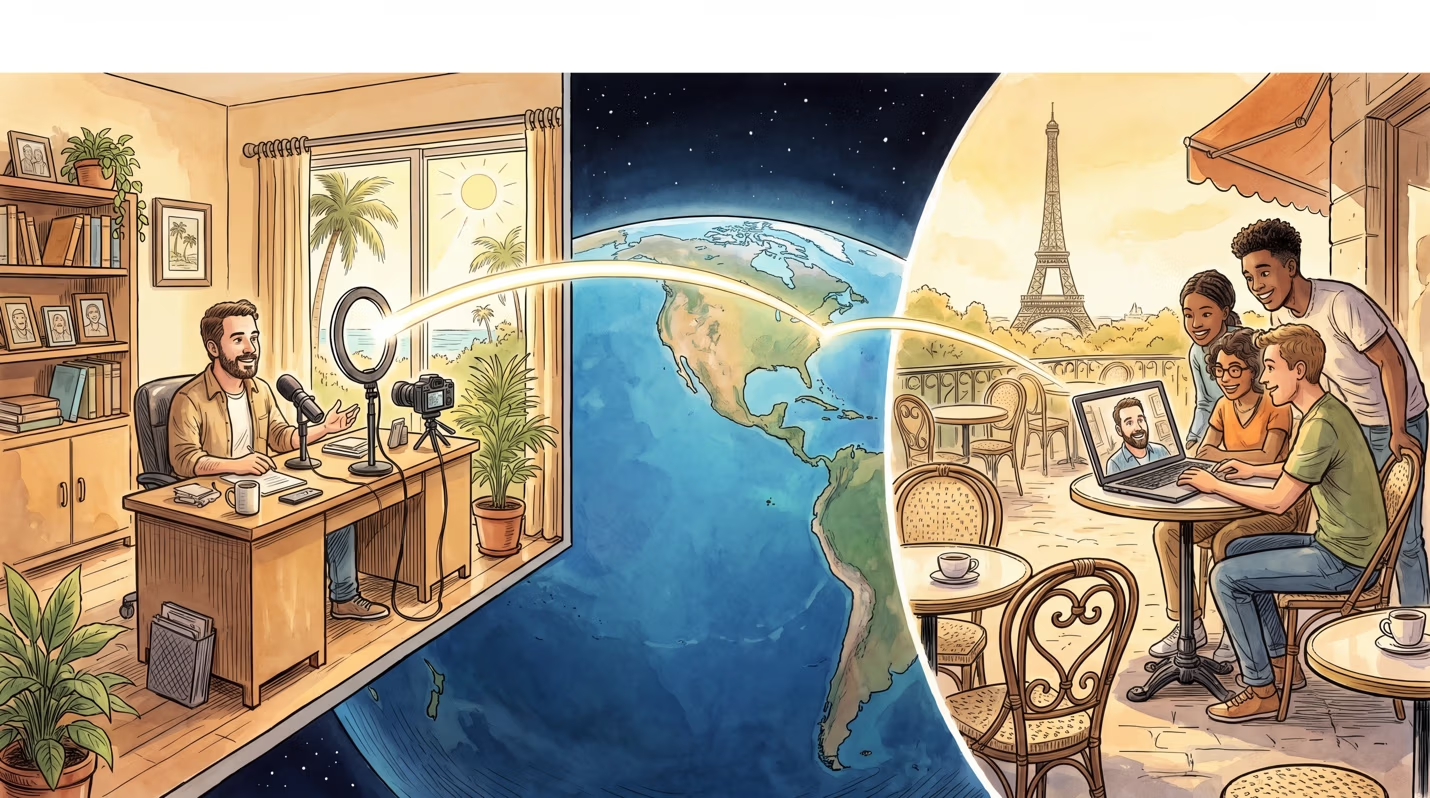
Today computers hold out the promise of a means of instant translation of any code or language into any other code or language. The computer, in short, promises by technology a Pentecostal condition of universal understanding and unity. The next logical steps would seem to be, not to translate, but to by-pass language in favor of a general cosmic consciousness which might be very like the collective unconscious dreamt of by Bergson.
Understanding Media, 1964, MIT/Routledge edition, p 80
Year: 1964
When applied to new forms of electronic-messaging, such as teletext and videotext, [the computer] quickly converts sequential alphanumeric texts into multi-level signs and aphorisms, encouraging ideographic summation, like hieroglyphics.
The Global Village with Bruce Powers, (1989), p 103
Year: 1989
Chapter:
Aphorism
While bemoaning the decline of literacy and the obsolescence of the book, the literari have typically ignored the immanence of the decline of speech itself. The individual word, as a store of information and feeling, is already yielding to macrocscopic gesticulation.
War and Peace in the Global Village (1968), pp 90-91
Year: 1968
In the age of the photograph, language takes on a graphic or iconic character, whose “meaning” belongs very little to the semantic universe, and not at all to the republic of letters.
Understanding Media (1964), MIT/ROUTLEDGE edition, p 196
Year: 1964
Chapter:
Cartoons, Comics
The language of visual forms is, therefore, one which lies to hand as an unused Esperanto at everybody’s command.
“The Media Fit the Battle of Jericho” in Explorations 6 (1956), in Essential McLuhan (1995), p 300
Year: 1956
Statement without syntax or verbalization was really statement by gesture, by mime, and by g_e_s_t_a_l_t_. This new dimension opened for human inspection by poets like Baudelaire and Rimbaud l_e_ _p_a_y_s_a_g_e_ _i_n_t_é_r_i_e_u_r_,_or the countries of the mind.
Understanding Media, 1964, MIT/Routledge edition, p 201
Year: 1964
Chapters:
Body Language | Photography
…the possibility of a non-verbal language of macroscopic gesticulation, an interface of entire cultures.
Letter to I.A. Richards, July 12, 1968, in Letters (1987), p 355
Year: 1968
Chapters:
Body Language | Cartoons, Comics
The future of language presents the possibility of a world without words, a wordless, intuitive world, like a technological expression of the action of consciousness. E.S.P.
“The Invisible Environment: The Future of an Erosion”, Perspecta, Vol.11, (1967), p 167, reprinted in On the Nature of Media, (2016), p 124
Year: 1967
If our new media constitute so complete a range of expressiveness as both to enhance and almost to supplant speech itself, then we have moved into the period of post-literacy.
“The Post-Literate Man”, 1973, Cycle 7: Essays, Short Stories, Poems for Freshman English, ed. by James Burl Hogins and Robert Earl Yaber, p 230
Year: 1973
Chapter:
Postliteracy
The bankruptcy of speech is proclaimed by the multiplication of letters: N.R.A.s, W.P.A., O.C.D., etc.
“Education of Free Men in Democracy: the Liberal Arts,” St. Louis University Studies in honor of St. Thomas Aquinas, Vol. 1, 1947, p 48
Year: 1947
An immediate simulation of consciousness would by-pass speech in a kind of massive extrasensory perception, just as global thermostats could by-pass those extensions of skin and body that we call houses. Such an extension of the process of consciousness by electric simulation may easily occur in the 1960s.
Understanding Media, 1964, MIT/Routledge edition p 130
Year: 1964
Charles Chaplin assembled a mask made up of bookkeeper, music hall entertainer, gallant and romantic searcher, then with genius added a touch of Pavolva… His footwork he acquired from the Ballet Russe. This touch transformed all the other components of his image, creating an overall effect of artistic spirituality and lent great power to the crass everyday features of his mask. None of the components in his mask correspond to anything that was the private C. Chaplin. Rather he chose carefully…just those items which gave him maximum corporate appeal.
“Public and Private Sectors” (1964), pp 5-6
Year: 1964
Languages are stuttering extensions of our five senses, in varying ratios and wavelengths. An immediate simulation of consciousness would by-pass speech in a kind of massive extrasensory perception, just as global thermostats could by-pass those extensions of skin and body that we call houses. Such an extension of the process of consciousness by electric simulation may easily occur in the 1960s.
Understanding Media, 1964, MIT/Routledge edition, p 130
Year: 1964
Our new electric technology that extends our nerves in a global embrace has large implications for the future of language. Electric technology doesn’t need words any more than the digital computer needs numbers. Electricity points the way to an extension of the process of consciousness itself, on a world scale, and without any verbalization whatever.
Understanding Media, 1964, MIT/Routledge edition, p 80
Year: 1964
The Chinese never had an alphabet, but their ideograms are pictorial translations of human gestures and relationships. As our press has become more pictorial our whole culture has become more sympathetic to Chinese art and expression. So that the very features of our culture which have intruded disruptively into the East have also brought us a basis for approaching their kind of communication.
“New Media and Political Change”, in International Journal, Vol.7, No. 3, Summer (1952) p 192
Year: 1952
An immediate simulation of consciousness would by-pass speech in a kind of massive extrasensory perception, just as global thermostats could by-pass those extensions of skin and body that we call houses. Such an extension of the process of consciousness by electric simulation may easily occur in the 1960s
Understanding Media, 1964, MIT/Routledge edition, p 130
Year: 1964