Viewing chapter Catholic Church (20 quotes)
Baptismal certificate: Rev. Alvin R. Kutchera baptized Marshall McLuhan on March 24, 1937.
.
Year: .
Chapter:
Catholic Church
The role of the Catholic humanist is to cultivate a more than ordinary reverence for the past, for tradition, while exploring every present development for what it reveals about man that the past has not revealed.
“Catholic Humanism and Modern Letters” The McAuley Lectures: Christian Humanism in Letters, Saint Joseph College, West Hartford Connecticut,(1954),p 54, reprinted in The Medium and the Light (1999), p 158
Year: 1954
Clearly, the present-day Thomists have much to learn from Newman’s procedure [of conversing with secular culture]. They are painfully in the position of lacking that general culture, vitalized by a genuine community, which alone confers relevance. Gilson and Maritain do belong to a community in which a general awareness of our age at all its points is cultivated. Yet both of these men have evaded (or for lack of time and faculty have done nothing [for]) the application of Thomistic principles in the area of Freud, Fraser and Malinowski —psychology and anthropology. These are the areas of most intense contemporary awareness and they have not found their Newman. For example, in his discussions of poetic Maritain has never ventured into the question of taste. Yet this is the major nexus of educational discussion.
Letter to Walter J. Ong, S.J., May 18, 1946, in Letters of Marshall McLuhan (1987), p 187
Year: 1946
The measure of our [Catholics’] unawareness and irrelevance can be taken from the fact that no Thomist has so far seen fit to expound St. Thomas’s theory of communication by way of providing modern insight into our problems.
“Heart of Darkness,” unpublished review of Melville’s Quarrel with God (1952), typescript, p 8
Year: 1952
It [the coming transformation of culture] is formed as a vast global resonant unity. It ignores all forms of specialization, all fragmentation, all logic. Faced with this invasion, Greco-Roman culture cannot resist and it is in the process of rapidly falling apart, abruptly and suddenly, so much so that we faced an unbelievable crisis. The Church is watching its cultural infrastructure crumble beneath its feet. When everything happens at the speed of light — at electric speed — the Greco-Roman world gives way. Doubtless the Church was always built for this civilization, but there is nothing in the new technology to sustain it. Of course, there will be a strong reaction when we catch our breath, but for now our young have been conquered by this electric world.
“Keys to the Electronic Revolution: First Conversation with Pierre Babin” (1977) in The Medium and the Light, 1999, p 50
Year: 1977
For if the Catholic is the champion of rational principles and individual reason how can he understand primitive man who is embedded in a world of magical irrationalities and collective consciousness?
“Catholic Humanism and Modern Letters” The McAuley Lectures: Christian Humanism in Letters, Saint Joseph College, West Hartford Connecticut,(1954),p 49, reprinted in The Medium and the Light (1999), p 153
Year: 1954
Chapter:
Corporate Consciousness
[When discussing the possibility of the Church “abandoning itself without question to electric mentality”]
Technically speaking, the age in which we live is certainly favourable to an Antichrist. Just think: each person can instantly be tuned to a “new Christ” and mistake him for the real Christ. At such times it becomes crucial to hear properly and to tune yourself in to the right frequency.
From “Tomorrow’s Church: Fourth Conversation with Pierre Babin” In The Medium and the Light (1999), p. 209
Year: 1999
Chapters:
He’s Doubtful | Warnings
At the speed of light you cannot have executives. You cannot have hierarchy. The job yields to roles and a role consists of multiple jobs Institutionally, I would say, the Church is always out of place. Culturally as well. Sometimes way ahead; sometimes way behind.”
"Our Only Hope Is Apocalypse" in The Medium and the Light, p 57
Chapter:
Speedups
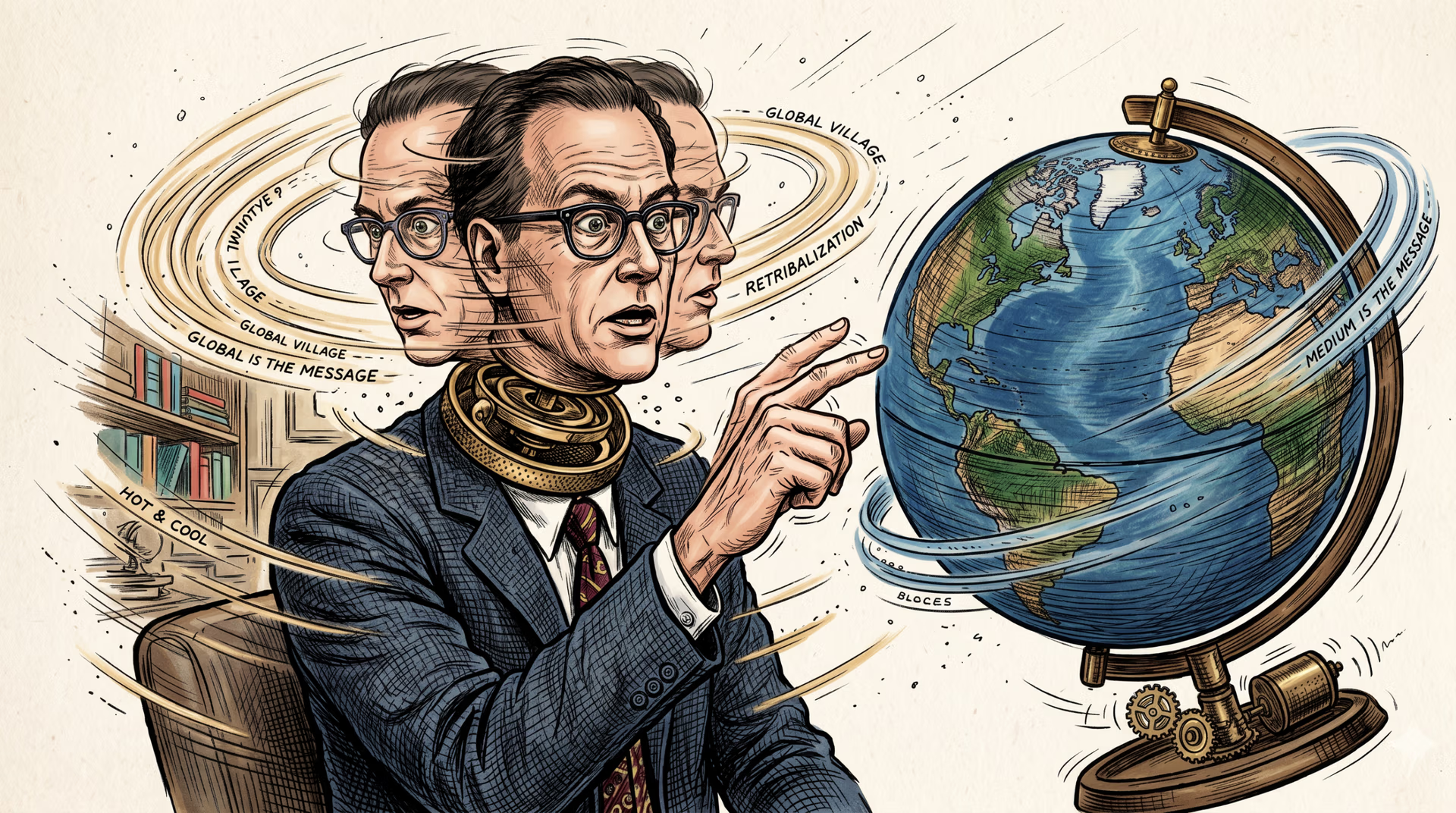
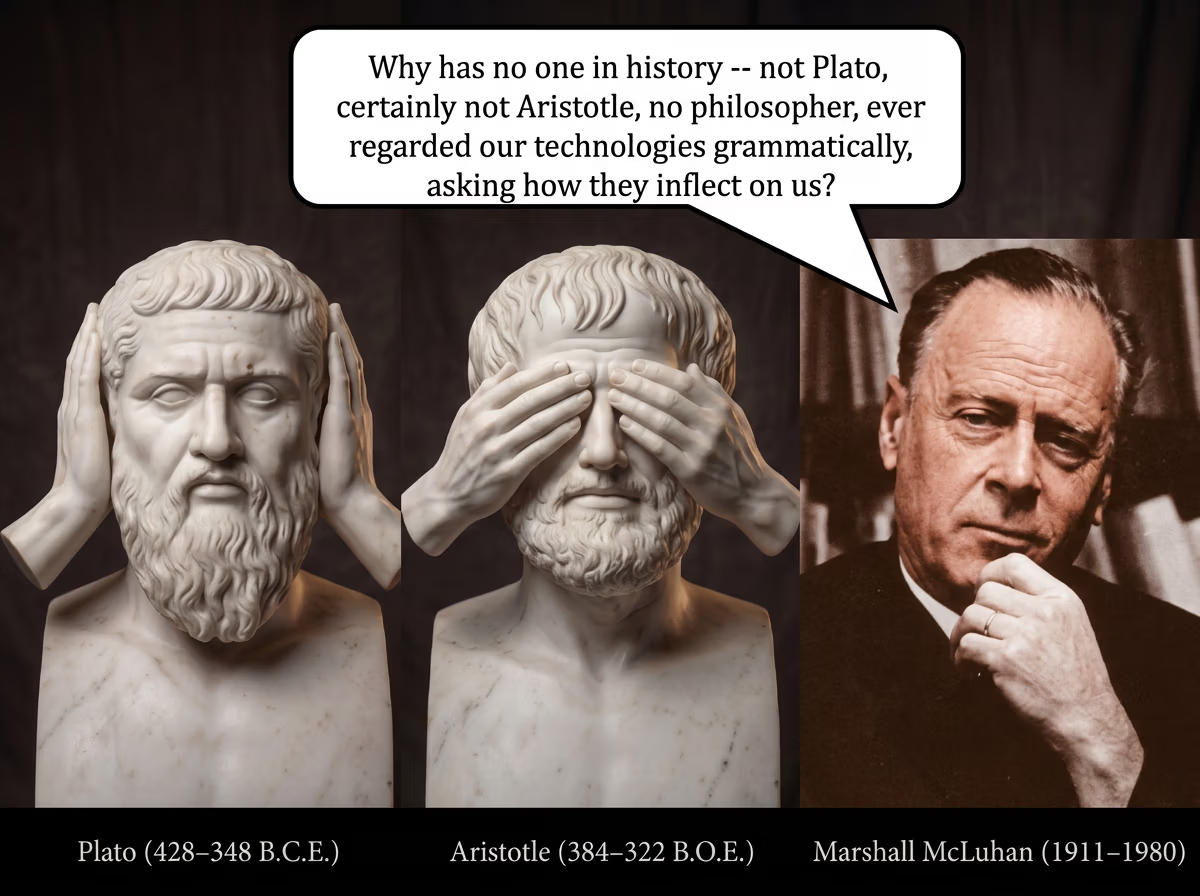
"In Jesus Christ, there is no distance or separation between the medium and the message. It is the one case where we can say that the medium and the message are fully one and the same."
The Medium and the Light: Reflections on Religion. edited by Eric McLuhan (1999), p. 103
Year: 1999
The secular mind by and large has always approached art and aesthetics as religion and magic. So it does today. Hence the violent quarrels and exclusive coteries of the art world. Art and poetry are regarded as private religions, secret escape hatches from the sunken submarine or the unguided missile of existence. The Catholic alone can laugh at these antics. He alone need not be deceived by such qualms or pretensions. And what the esoteric cultist proffers as magic he can accept as a simple shaping of natural experience.
“Catholic Humanism and Modern Letters” The McAuley Lectures: Christian Humanism in Letters, Saint Joseph College, West Hartford Connecticut,(1954),p 54, reprinted in The Medium and the Light (1999), p 159
Year: 1954
Perhaps the besetting Catholic danger is to live with the truth until one is not concerned to look at it. We know it so well that we “couldn’t care less.”
“Catholic Humanism and Modern Letters” The McAuley Lectures: Christian Humanism in Letters, Saint Joseph College, West Hartford Connecticut,(1954),p 65, reprinted in The Medium and the Light (1999), p 172
Year: 1954
Chapter:
Religion
Liturgy on television affords every opportunity for full participation. It is possible to join one's intention to participate in the fullest extent, just as fully as in any church... Electric man has no ego and depends totally on close involvement with others. Similarly, electric liturgy would have no ego but a collective personality instead... The trouble with Christianity is that it has never had a theory of communication and a confrontation is fast developing between... the mystical body of the church and the electric environment.
"RC Church Should Accept Televised Liturgy as Valid Fulfilment of Sunday Mass: McLuhan," in The St. Catherine's Standard, Saturday, June 2, 1973
Year: 1973
In an instantaneous world there is no past, because all the pasts are present, and there is no time pattern since everything is always now… Thus, ecumenism is a pattern which now extends to every form of political and social life on the planet. It is not something that characterizes the Church as such.
Contribution to Spectrum of Catholic Attitudes (1969), p 138
Year: 1969
Chapter:
Religion
Real news is bad news. Since the press lives on advertising, and all advertising is good news, it takes a lot of bad news to sell all this good news. Even the good news of the gospel can only be sold by hellfire. Vatican II made a very big mistake in this matter, as in other matters.
Letter to Pierre Elliott Trudeau January 24, 1969, in Letters of Marshall McLuhan (1987), p 362
Year: 1969
Under electric conditions, participation is inevitable. The visual monopoly is over; visual organisation is over. Nothing “visuable” is twentieth century (IU make no value judgments here). In the Catholic Church, the new liturgy is an attempt to accommodate to electric forms. The Church is the only institution capable of coping with the situation and is not very keen on it.
“The De-Romanization of the American Catholic Church” (1970), in The Medium and the Light (1999), p 55
Year: 1970
…in the new quantum mechanics, the term interface implies a resonant interval in which there are no connections in matter as understood in the new physics, but there is a perpetual resonating interval, between particles, or among particles, and this resonance is the interface and it is in this interval of resonance that the action takes place, it leads on to those basic matters about our own world of the drop out, because the dropout is a person who experiences the need to set up more space between himself and things, he wants more room, he wants an interface, he wants a kind of resonant dialogue, he wants to rap, to chat and empathize with everybody about everything and this constitutes an interface of change. In dialogue people undergo change, it isn't just the passing of gossip back and forth, but it's a kind of interrelating by which people feel they are change, they are getting with it, they are getting involved, they are participating. All of these things that seems to me profoundly relate to the Rosary and to the church and the mystical body which is also amazingly, instant, surround, interface at source of change, renewal and of endless source of nourishment to everybody.
“A Matter Of Faith”, Part 1, TV episode of Father Peyton's Family Theatre (1972); Youtube; transcript: 8.26
Year: 1972
Chapter:
Dialogue
In Jesus Christ, there is no distance or separation between the medium and the message. It is the one case where we can say that the medium and the message are fully one and the same.
“Religion and Youth: Second Conversation with Pierre Babin” (1977), in The Medium and the Light (1999), p 103
Year: 1977
It is no accident that the Christian church, dedicated to propaganda and propagation, adopted Graeco-Roman phonetic literacy from the earliest days. The impact of alphabetic literacy is strong enough not only to break the tribal bond, but to create individualized (left-hemisphere) consciousness as well. Phonetic literacy--our alphabet--alone has this power.
Laws of Media: The New Science with Eric McLuhan, (1988), p 74-75
Year: 1988
In the global village, how stupid to celebrate Mass in the vernacular!
Originally said at the Elsinore Conference, later quoted by Claude Bissell, in Who Was Marshall McLuhan? (1994), p 285
Year: 1994
Vatican II was the burial of this kind of individualism in the newly created swamp of electronic togetherness and total involvement, as in a skin-flick where everybody gets inside one skin.
“Look Forward to Seeing You Again: The Correspondence of Pierre Elliott Trudeau and Marshall McLuhan” (1968-1980), edited by Elaine B. Kahn, 2017, p 108
Year: 1968
The Catholic Church does not depend on human wisdom or human strategies for survival. All the best intentions in the world can't destroy the Catholic Church! It is indestructible, even as a human institution. It may once again undergo a terrible persecution and so on. But that's probably what it needs.
“Futurechurch: Edward Wakin interviews Marshall McLuhan”, in U.S. Catholic Magazine, Vol 42 N1 January, (1977), p 6
Year: 1977