Viewing chapter Celebrity and Fame (9 quotes)
“The very scholars and journalists who had praised him in the 1960s tried to bury him in the 1970s, questioning the validity of his complex theories. ‘A superstar', he laments today, ‘is just another word for a sitting duck.’” Barbara Rowes
Writer, “If the Media Didn't Get Marshall McLuhan's Message in the '60s, Another Is on the Way”, People Magazine, Vol. 6, no. 12, September 20, 1976; p 4 of the interview transcript
Year: 1976
Chapter:
Celebrity and Fame
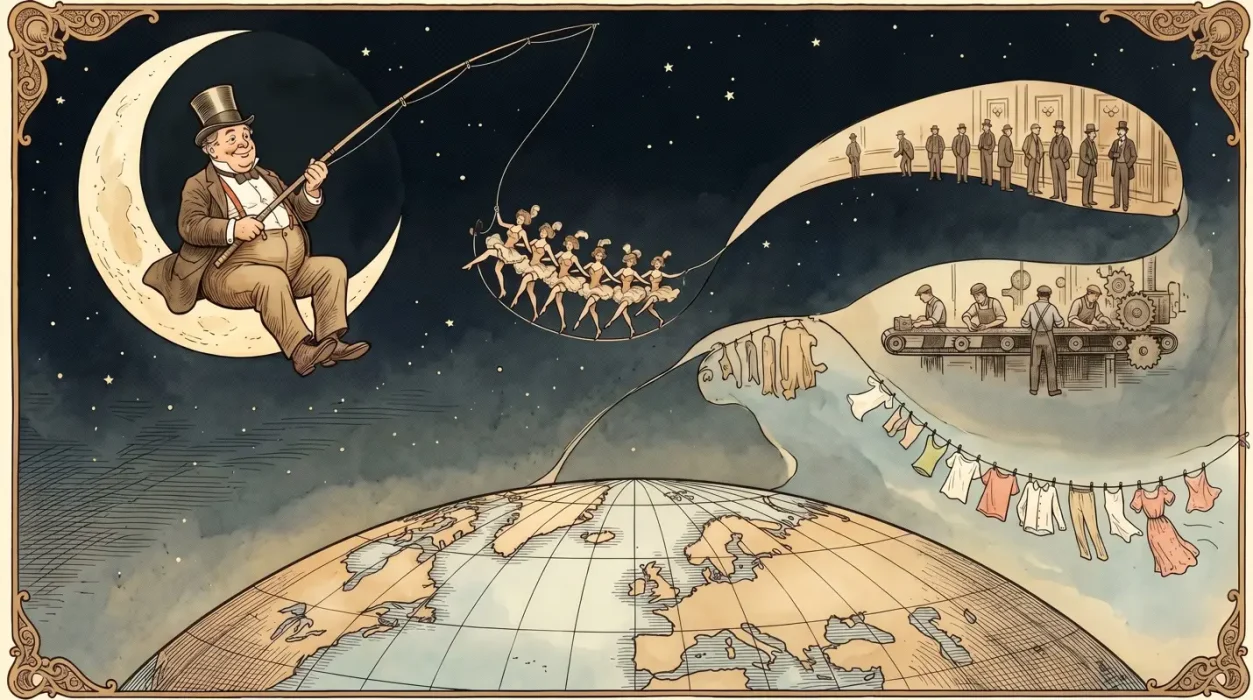
…when distinguished foreigners come to America they naturally seek the company of movie stars rather than of the wealthy. The stars have a personal symbolic relation to the currents of national life which the remote and anonymous figures of celestial finance do not. The stars are distinct individuals wearing human masks that represent some aspect of the collective dream. But the rich are dim and obscure, sharing the states and make-up of the very people above whom they have risen, and yet deprived of the satisfactions of mass solidarity in an egalitarian society.
The Mechanical Bride, (1951), p 56
Year: 1951
The more that is publicly recorded about the actual existence of any person, the more he is diminished in his private existence. Like any public entertainer, he becomes his admirers or his recordings. By a commodious vicus of recirculation, this flips us back to the Electric Circus, in which music is no longer for listening to but merging with.
“Reversal of the Overheated Image”, Playboy, December 1968, p 245
Year: 1968
Chapters:
Chiasmus, Flips, Reversals | McLuhanisms & Zingers
You ask of Tom Wolfe. He is a Virginian. A Ph.D. in English from Yale. Saw him a good deal in San Francisco last summer. Shall send you his piece on me. We have been in Life at length – the whole family. Also in Fortune, Newsweek, Time, Vogue and the rest. Suddenly I’m a bestseller pet of the College crowds. Must get out some more while the mood lasts.
Letter to John Wain, March 26, 1966, quoted in Wain’s memoir, Dear Shadows (1986)
Year: 1966
In business, as in society, "getting on" may mean getting out. There is no "ahead" in a world that is an echo chamber of instantaneous celebrity.
Understanding Media, (1964) MIT/Routledge, p 264
Year: 1964
When one comes into the public domain one becomes a thing and everyone does that thing except oneself.
Letter to Richard Berg, August 1, 1969 [LAC]
Year: 1969
Any individual who manipulates the public for his private good may also feel the cleansing power of publicity.
Understanding Media (1964), MIT/Routledge edition, p 216
Year: 1964
Chapter:
Print
[Figures of popular culture] exist not so much in themselves but as types of collective life felt and perceived through a mass medium. L'il Abner, Bob Hope, Donald Duck, and Marilyn Monroe become points of collective awareness and communication for an entire society. And as technology increasingly undertakes to submit the entire planet as well as the contents of consciousness to the purposes of man's factive intelligence it behooves us to consider the whole process of magical transformation involved in the media acutely and extensively.
“Sight, Sound and the Fury”, in The Commonweal (1954), p 9
Year: 1954
Chapters:
Extending Consciousness | Media Study






Newscasters and actors alike report the frequency with which they are approached by people who feel they've met them before. Joanne Woodward in an interview was asked what was the difference between being a movie star and a TV actress. She replied: "When I was in the movies I heard people say, ‘There goes Joanne Woodward.’ Now they say, ‘There goes somebody I think I know.’”
Understanding Media (1964), MIT/Routledge edition, pp 317-318
Year: 1964
Nobody who represents a considerable proportion of the community can be given a great deal of public coverage without garnering a great deal of public acclaim at the same time.
“Mr. Nixon and the Dropout Strategy” (1973), in New York Times, Jul 29, 1973, p E13
Year: 1973