Viewing chapter Computer (70 quotes)
The programming of computers calls for levels of human awareness about media and ourselves such as we do not yet possess.
"The Dare and Feeding of Communication Innovation", Conference on 8mm Sound Film and Education, Dinner Speech, November 8, 1961, Teachers College, Columbia University, p 4
Year: 1961
The shift in our sense ratios brought about by exteriorizations of our senses is not a situation before which we need be helpless. Computers can now be programmed for every possible variety of sense ratio. We can then read off exactly what would be the resulting cultural assumptions in the arts and sciences, of such a new specific ratio as was produced by TV, for example.
The Gutenberg Galaxy: The Making of Typographic Man, (1962), p 183
Year: 1962
Today computers hold out the promise of a means of instant translation of any code or language into any other code or language. The computer, in short, promises by technology a Pentecostal condition of universal understanding and unity. The next logical steps would seem to be, not to translate, but to by-pass language in favor of a general cosmic consciousness which might be very like the collective unconscious dreamt of by Bergson.
Understanding Media, 1964, MIT/Routledge edition, p 80
Year: 1964
Chapters:
After Language | Corporate Consciousness | Extending Consciousness | Language | Predictions
This is the real use of the computer, not to expedite marketing or solve technical problems but to speed the process of discovery and orchestrate terrestrial—and eventually galactic—environments and energies. Psychic communal integration, made possible at last by the electronic media, could create the universality of consciousness foreseen by Dante when he predicted that men would continue as no more than broken fragments until they were unified into an inclusive consciousness.
Playboy interview (1969), in Essential McLuhan (UK edition, 1997), p 253
Year: 1969
Chapter:
Discovery
The entire use of yes-no bit programming is from the alphabetic modes of Western civilization. But many people look to the computer to bypass present forms of human action and limitation. Yet, even the written and printed word, it might be argued, has helped us to surpass ordinary human scale.
“The Future of the Book” (1972), in Understanding Me (2003), p 176
Year: 1972
Chapters:
Alphabet | Human Scale
This strange gap between the specialist, visual world and the integral, auditory world needs to be better understood today above all, for it contains the key to an understanding of what automation and cybernetics imply.
“Cybernation and Culture” (1966), pp 97-98
Year: 1966
…electricity is sheer information that, in actual practice, illuminates all it touches. Any process that approaches instant interrelation of a total field tends to raise itself to the level of conscious awareness, so that computers seem to " think." In fact, they are highly specialized at present, and quite lacking in the full process of interrelation that makes for consciousness. Obviously, they can be made to simulate the process of consciousness, just as our electric global networks now begin to simulate the condition of our central nervous system. But a conscious computer would still be one that was an extension of our consciousness, as a telescope is an extension of our eyes, or as a ventriloquist's dummy is an extension of the ventriloquist.
Understanding Media (1964), MIT/Routledge edition, p 351
Year: 1964
Instead of going out and buying a packaged book of which there have been five thousand copies printed, you will go to the telephone, describe your interests, your needs, your problems, and say you're working on a history of Egyptian arithmetic. You know a bit of Sanskrit, you're qualified in German, and you're a good mathematician, and they say it will be right over. And they at once xerox, with the help of computers from the libraries of the world, all the latest material just for you personally, not as something to be put out on a bookshelf. They send you the package as a direct personal service. This is where we're heading under electronic information conditions. Products increasingly are becoming services.
“Predicting Interactive Communication via the Internet”, TV Appearance on This Hour Has Seven Days, CBC-TV with Robert Fulford (1966), in McLuhan Speaks Transcript, p 3, reprinted in Understanding Me (2003), p 101
Year: 1966
When computers are properly used, in fact, they are almost certain to increase individual diversity. A worldwide network of computers will make all of mankind's factual knowledge available to students everywhere in a matter of minutes or seconds. Then, the human brain will not have to serve as a repository of specific facts, and the uses of memory will shift in the new education, breaking the timeworn, rigid chains of memory may have greater priority than forging new links. New materials may be learned just as were the great myths of past cultures-as fully integrated systems that resonate on several levels and share the qualities of poetry and song.” - “The world communications net, the all-involving linkage of electric circuitry, will grow and become more sensitive. It will also develop new modes of feedback so that communication can become dialogue instead of monologue. It will breach the wall between "in" and "out" of school. It will join all people everywhere. When this has happened, we may at last realize that our place of learning is the world itself, the entire planet we live on. The little red schoolhouse is already well on its way toward becoming the little round schoolhouse.
“The Future of Education” with George Leonard, Look Magazine. Feb. 21, 1967, pp. 23-25.
Year: 1967
Ultima Laputa: Where Men Are Faceless Tentacles of Computers
The new Utopians [as described in a 1965 book of that title by Robert Boguslaw] are concerned with non-people and with people substitutes. Their planning is done with computer hardware, system procedures, functional analysis, and heuristics.. . . The theoretical and practical solutions they seek call increasingly for decreases in the number and in the scope of responsibility of human beings within the operating structures of their new machine systems.
Take Today with Barrington Nevitt, 1972, p 129
Year: 1972
Chapter:
Warnings
In the computer age we are once more totally involved in our roles. In the electric age the "job of work" yields to dedication and commitment, as in the tribe.
Understanding Media, 1964, MIT/Routledge edition, p 138
Year: 1964
Chapters:
Involvement | Roles
It may be worth mentioning the structural features of analogy since with the computer there has risen the possibility of extending consciousness itself as a technological environment
“Innovation Is Obsolete”, in Evergreen Review, Vol. 15, No. 90, June (1971), p 48
Year: 1971
Having extended or translated our central nervous system into the electromagnetic technology, it is but a further stage to transfer our consciousness to the computer world as well. Then, at least, we shall be able to program consciousness in such wise that it cannot be numbed nor distracted by the Narcissus illusions of the entertainment world that beset mankind when he encounters himself extended in his own gimmickry.
Understanding Media (1964), MIT/Routledge edition, pages 60-61
Year: 1964
Chapter:
Extending Consciousness
The pattern of computer technology is very much like the pattern of the corporate image in business and the learning process in education. It is a pattern that fuses knowledge with work, and making with knowing.
“Public and Private Sectors in the Electronic Age”, 1964, p 8
Year: 1964
ULTIMATE TWO-BIT WITTEDNESS
WHEN MORE AND MORE IS DONE WITH LESS AND LESS
The new man of two words, a hippie: "Hi! Bi!"
In The Social Impact of Cybernetics, Robert Theobald predicts that
"computer systems, not men, will first realize humanity's old dream of a
universal language, and the subtleties and nuances of human thought will
risk being mediated through the restricted and standardized symbols of
computer communication." All "scientific" and "economic" measurements of human psychic and social processes are rooted in human preferences.
Take Today with Barrington Nevitt, 1972, p 112
Year: 1972
Instead of tending towards a vast Alexandrian library the world has become a computer, an electronic brain, exactly as in an infantile piece of science fiction. And as our senses have gone outside us, Big Brother goes inside. So, unless aware of this dynamic, we shall at once move into a phase of panic terrors, exactly befitting a small world of tribal drums, total interdependence, and superimposed co-existence”.
The Gutenberg Galaxy: The Making of Typographic Man, 1962, p 32
Year: 1962
…computers will demonstrate that [mankind] can afford nothing short of the best, which is to make spaceship earth a successful environment for man.. . . Our greatest problem is the educational problem of getting man to realize in time what his problems are, and what the most effective priorities may be.
Take Today with Barrington Nevitt, 1972, pp 118-119
Year: 1972
McLUHAN Automation and cybernation can play an essential role in smoothing the transition to the new society.
PLAYBOY: How?
McLUHAN: The computer can be used to direct a network of global thermostats to pattern life in ways that will optimize human awareness. Already, it’s technologically feasible to employ the computer to program societies in beneficial ways.
PLAYBOY: How do you program an entire society—beneficially or otherwise?
McLUHAN: There’s nothing at all difficult about putting computers in the position where they will be able to conduct carefully orchestrated programming of the sensory life of whole populations. I know it sounds rather science-fictional, but if you understood cybernetics you’d realize we could do it today. The computer could program the media to determine the given messages a people should hear in terms of their over-all needs, creating a total media experience absorbed and patterned by all the senses. We could program five hours less of TV in Italy to promote the reading of newspapers during an election, or lay on an additional 25 hours of TV in Venezuela to cool down the tribal temperature raised by radio the preceding month. By such orchestrated interplay of all media, whole cultures could now be programed in order to improve and stabilize their emotional climate, just as we are beginning to learn how to maintain equilibrium among the world’s competing economies.
PLAYBOY: How does such environmental programing, however enlightened in intent, differ from Pavlovian brainwashing?
McLUHAN: Your question reflects the usual panic of people confronted with unexplored technologies. I’m not saying such panic isn’t justified, or that such environmental programing couldn’t be brainwashing, or far worse—merely that such reactions are useless and distracting. Though I think the programing of societies could actually be conducted quite constructively and humanistically, I don’t want to be in the position of a Hiroshima physicist extolling the potential of nuclear energy in the first days of August 1945. But an understanding of media’s effects constitutes a civil defense against media fallout. The alarm of so many people, however, at the prospect of corporate programming’s creation of a complete service environment on this planet is rather like fearing that a municipal lighting system will deprive the individual of the right to adjust each light to his own favorite level of intensity. Computer technology can—and doubtless will—program entire environments to fulfill the social needs and sensory preferences of communities and nations. The content of that programming, however, depends on the nature of future societies—but that is in our own hands.
Playboy Interview,1969, reprinted in Essential McLuhan (1997, UK edition), pages 254-255
Year: 1969
Chapter:
Programming the Environment
When this circuit learns your job, what are you going to do?
The Medium is the Massage (1967), p 20
Year: 1967
The computer is by all odds the most extraordinary of all the technological clothing ever devised my man, since it is the extension of our central nervous system.
War and Peace in the Global Village with Jerome Agel and Quentin Fiore (1968), p 35
Year: 1968
The more the data banks record about each one of us, the less we exist.
From Cliché to Archetype with Wilfred Watson (1970), p 13
Year: 1970
Chapter:
McLuhanisms & Zingers
Today's executive is called upon not only to cope with standard accounting procedures but also to know when to use statistical methods, operations research, cost-benefits analysis, budget plans, computer programs, and general systems science. System designers are constantly developing new techniques for reducing more and more industrial production and human organization processes to bits, the ultimate yes or not-yes choices of Computers. Computers can do better than ever what needn't be done at all. Making sense is still a human monopoly. Computers need only programmed instructions and codified inputs to handle sequential data and analysis to yield information more rapidly than people. But no computer "know-how" can transform breakdowns into breakthroughs without human insight. Knowing what to do is still a human monopoly. Only people can make sense by dislocating unfamiliar situations
into meaning.
Take Today with Barrington Nevitt, 1972, p 109
Year: 1972
The computer dooms the techniques of accountancy in banking, even as it concludes the regime of stock exchanges. Nobody has ever studied the effects of the fast spin put on the economy of the 1920s by radio.
“The Man Who Came to Listen” (1970), in On the Nature of Media (2016), p 183
Year: 1970
Whereas computer programmers try to reduce the infinite variety of the world to the two-bit wit of their machines, “artists” like James Joyce can create universes of resonant meaning out of two words: the “orb urbs” and the “urb orbs.”
“The Argument: Causality in the Electric World”, in Technology and Culture, Vol.14, No. 1, January (1973) p 13, reprinted in McLuhan Unbound # 3, (2005), p 22
Year: 1973
[The] computer… [is] the only technology that lives on, and produces, the same material.
“All the Stage Is a World In Which There Is No Audience”, in Innis Herald, Vol. 11, number 5, April, 1978, p 24
Any process that approaches instant interrelation of a total field tends to raise itself to the level of conscious awareness, so that computers seem to "think". In fact, they are highly specialized at present, and quite lacking in the full process of interrelation that makes for consciousness.
Understanding Media (1964), MIT/Routledge edition, p 351
Year: 1964
The really great privilege of the elites of the future will be to erase the computer information about them and assume their private identities again.
Advertisement for the Dewline Newsletter, 1969
Year: 1969
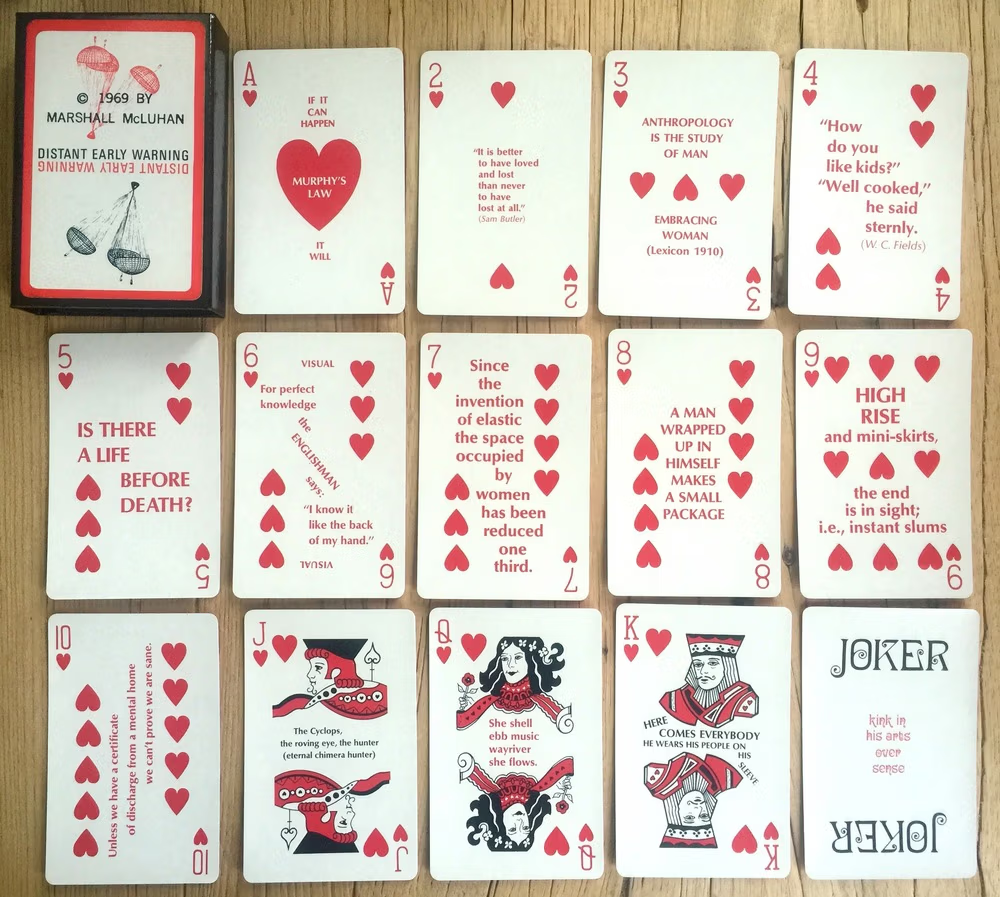
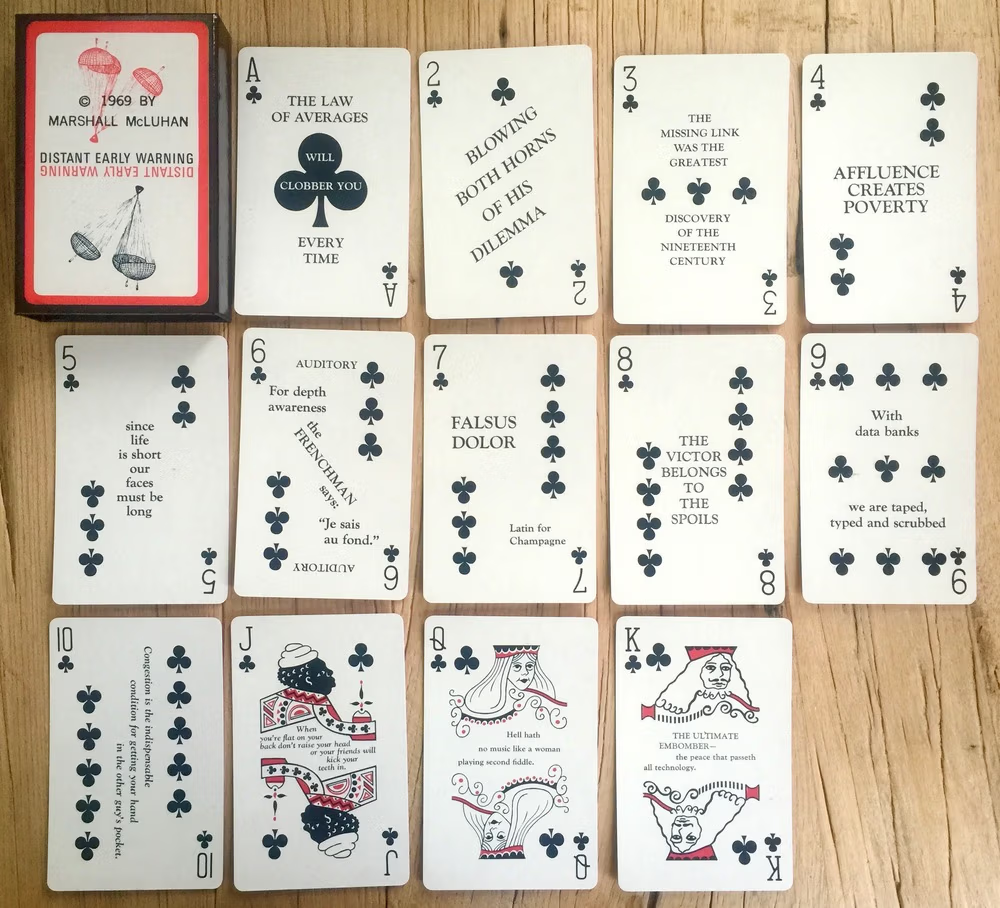
With data banks we are taped typed and scrubbed.
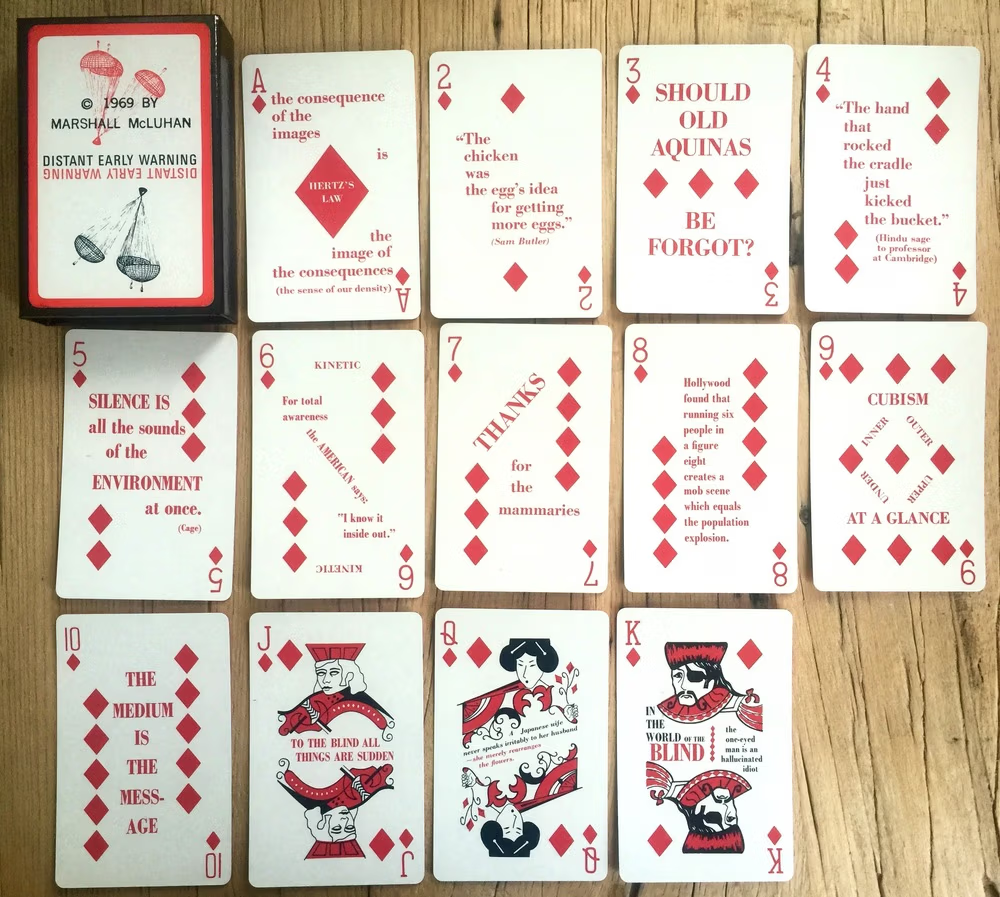
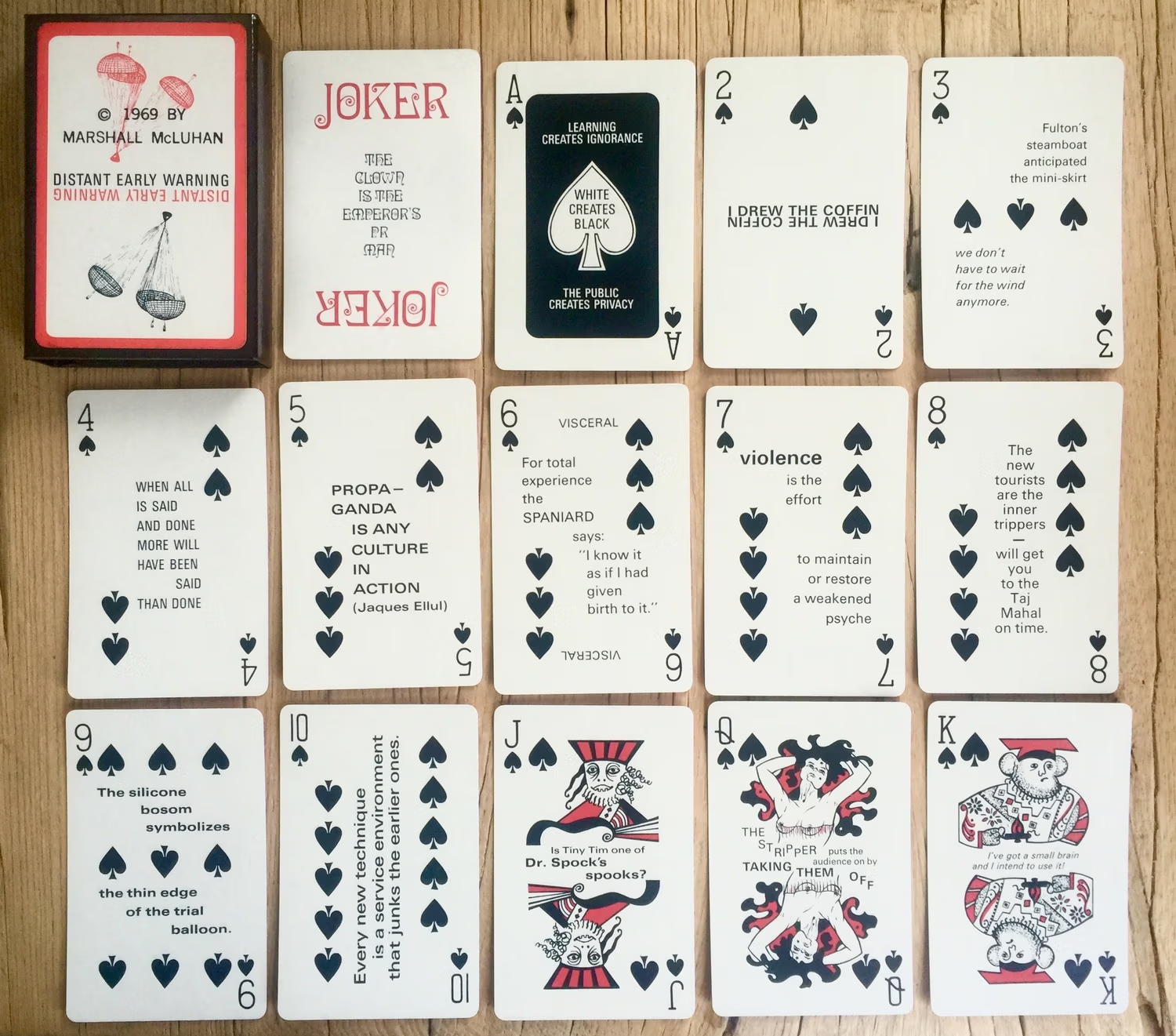
Card from the Dewline Newsletter deck of cards (1969): 9 of Clubs
Year: 1969
The computer is able to take over the whole mechanical age. Everything that was done under mechanical conditions can be computerized with relative ease, and that includes our educational system.
“Diebold Discussion Forum with McLuhan and Mike Wallace” (1966), p 16
Year: 1966
The more that data banks record about each one of us, the less we exist.
From Cliché to Archetype with Wilfred Watson (1970), p 13
Year: 1970
Chapter:
McLuhanisms & Zingers
It [the computer] is, as compared with the older machines, the difference between an oboe in an orchestra and the same tone on an electronic music instrument.”
Understanding Media (1964), MIT/Routledge edition, p 357
Year: 1964
…the next immediate step technologically is the extension of consciousness.
Letter to John I. Snyder Jr., August 4, 1963, in Letters of Marshall McLuhan (1987), p 290
Year: 1963
Chapter:
Predictions
The next medium, whatever it is--it may be the satellite environment or the extension of consciousness--will include television as its content, not as its environment, and will transform television into an art form; but this process whereby every new technology creates an environment that translates the old or preceding technology into an art form, or into something exceedingly noticeable, affords so many fascinating examples I can only mention a few.
“The Invisible Environment: The Future of an Erosion”, Perspecta, Vol.11, (1967), p 164, reprinted in On the Nature of Media, (2016), p 110
Year: 1967
Chapter:
Predictions
The older, traditional ideas of private, isolated thoughts and actions— the patterns of mechanistic technologies—are very seriously threatened by new methods of instantaneous electric information retrieval, by the electrically computerized dossier bank—that one big gossip column that is unforgiving, unforgetful and from which there is no redemption, no erasure of early "mistakes."
The Medium Is the Massage (1967), p 12
Year: 1967
Chapters:
Privacy | Surveillance
A computer as a research and communication instrument could enhance retrieval, obsolesce mass library organization, retrieve the individual’s encyclopedic function and flip it into a private line to specially tailored data of a saleable sort.
The Global Village with Bruce Powers (1989), p 143
Year: 1989
Chapter:
Next Medium [The]
In terms of, say, a computer technology we are heading for cottage economies, where the most important industrial activities can be carried on in any individual little shack anywhere on the globe. That is, the most important designs and the most important activities can be programmed by individuals in the most remote areas. In that sense, Christianity in a centralized, administrative, bureaucratic form is certainly irrelevant.
“Electric Consciousness and the Church” (Marshall McLuhan with Herbert Hoskins, 1970), in Marshall McLuhan: The Man and His Message (1989), p 165
Year: 1970
The condition of "weightlessness," that biologists say promises a physical immortality, may be paralleled by the condition of speechlessness that could confer a perpetuity of collective harmony and peace.
Understanding Media (1964), MIT/Routledge edition, p 80
Year: 1964
The computer, in short, promises by technology a Pentecostal condition of universal understanding and unity. The next logical steps would seem to be, not to translate, but to bypass language in favor of a general cosmic consciousness which might be very like the collective unconscious dreamt of by Bergson.
Understanding Media (1964), MIT/Routledge edition, p 80
Year: 1964
Chapters:
After Language | Corporate Consciousness | Dropout | Extending Consciousness | Language | Living Unity | Predictions
Cybernation seems to be taking us out of the visual world of classified data back into the tribal world of integral patterns and corporate awareness.
“Cybernetics and Human Culture” (1964), in Understanding Me (2003), p 50
Year: 1964
Chapter:
Retribalizing
As man succeeds in translating his central nervous system into electronic circuitry, he stands on the threshold of outering his consciousness into the computer. Consciousness, as we have discussed in a previous chapter, may be thought of as a projection to the outside of an inner synesthesia, corresponding generally with that ancient definition of common sense.
The Global Village with Bruce Powers (1989), p 94
Year: 1989
If the day comes when it is possible to program computers in figure-ground rather than in lineal patterns, then there will be a means of coping with environments holistically rather than by fragmentation and quantitative analysis. Currently, computer programming is done sequentially in the left hemisphere style, that is, by dealing with figures minus their grounds. That limitation is a legacy of our phonetic alphabet which 2500 years ago gave us the power of dealing analytically with figure minus ground.
“The Social Impact of the Computer” (1979), unpublished typescript, pp 8-9
Year: 1979
The real job of the computer in the future is not going to have anything to do with retrieval. It’s going to have to do with pure discovery, because we use our memories for many purposes, mostly unconscious. When you can recall things at a very high speed they take on a new mythic and structural meaning that is quite alien to ordinary perception. So the computer… has, in spite of itself… revealed the knowledge of the mythic pattern, structures and profiles, all of which are quite excitedly loaded with discovery.
“Diebold Discussion Forum” with McLuhan and Mike Wallace (1966), published version, pp 8-9
Year: 1966
[Ours] is a world in which the creative imagination of the artist is now need by the men who handle the computers.
“Media Alchemy in Art and Society” (1958), p 67
Year: 1958
The future masters of technology will have to be lighthearted and intelligent. The machine readily masters the grim and the dumb.
Counterblast (1969), p 55
Year: 1969
Chapter:
Playfulness
Lewis Carroll pointed out that as large-scale maps get more and more detailed and extensive, they would tend to blanket agriculture and rouse the protest of farmers. So why not use the actual earth as a map of itself? We have reached a similar point of data gathering when each stick of gum we reach for is acutely noted by some computer that translates out least gesture into a new probability curve.
Understanding Media (1964), MIT/Routledge edition, pp 51-52
Year: 1964
A worldwide network of computers will make all of mankind’s factual knowledge available to students everywhere in a matter of minutes or seconds. Then, the human brain will not have to serve as a repository of specific facts, and the uses of memory will shift. In the new education, breaking timeworn, rigid chains of memory may have greater priority than forging new links. New materials may be learned just as were the great myths of past cultures – as fully integrated systems that resonate on several levels and share the qualities of poetry and song.
“Learning in the Global Village”, in Radical School Reform. Visions: The School in Society (1969), p 111, “Learning in the Global Village” with. George B. Leonard (1969), reprinted from 1967-MarshalI_McLuhan_and_George B Leonard, originally in Look, titled "The Future of Education: The Class of 1989 ".
Year: 1969
Chapters:
Memory | Predictions
The urb orbs, the family retribalizes and the computer represents the imminent return of cottage economies. It will soon be easy to run the largest businesses from one's kitchen.
Letter to Mrs. Jamie Shalleck (1970), in Letters of Marshall McLuhan (1987), p 2
Year: 1970
While artists like James Joyce can make a resonating universe with two words, computer programmers try to match universes of human knowledge and perception to the two-bit wit of their machines.
Take Today: The Executive as Dropout with Barrington Nevitt (1972), p 110
Year: 1972
The computer is the first component of that hybrid of video-related technologies which will move us toward a world consciousness. It steps up the velocity of logical sequential calculations to the speed of light, reducing numbers to body count by touch. When pushed to its limits, the product of the computer reverses into simultaneous pattern recognition (acoustic space), eroding or bypassing mechanical processes in all sequential operations. It brings back the Pythagorean occult embodied in the idea that "numbers are all"; and at the same time it dissolves hierarchy in favor of decentralization. Any business corporation requiring the use of computers for communication and record-keeping will have no other alternative but to decentralize.”
“Global Robotism: The Dissatisfactions”, in The Global Village with Bruce Powers (1989), p 103
Year: 1989
Now, any new technology is also given the job of doing the old technology's work at first, and in the case of automation, the first jobs of automation have all been the old jobs, like card catalogues, retrieval systems, and so on. This has to do only with the old technology of the nineteenth century classification systems.
“Diebold Discussion Forum” with McLuhan and Mike Wallace (1966), p 8
Year: 1966
The programming of computers calls for levels of human awareness about media and ourselves such as we do not yet possess.
The Care And Feeding Of Communication Innovation, Conference on 8mm Sound Film and Education Dinner Speech, Teachers College Columbia University , November 8, 1961, p 4
This strange gap between the specialist, visual world and the integral, auditory world needs to be better understood today above all, for it contains the key to an understanding of what automation and cybernetics imply.
“Cybernation and Culture” (1966), pp 97-98
Year: 1966
[Someday we may see] …a kind of computerized ESP, with consciousness as the corporate content of the environment – and eventually, maybe even a small portable computer, about the size of a hearing aid, that would process our private experience through the corporate experience, the way dreams do now.
From a lecture at Spencer Memorial Church in NYC in spring of 1965, reported in “The Talk of the Town,” The New Yorker, May 15, 1965, p 44
Year: 1965
Obviously, they can be made to simulate the process of consciousness, just as our electric global networks now begin to simulate the condition of our central nervous system. But a conscious computer would still be one that was an extension of our consciousness, as a telescope is an extension of our eyes, or as a ventriloquist's dummy is an extension of the ventriloquist.
Understanding Media, 1964, MIT/Routledge edition, p 351
Year: 1964
Chapters:
Consciousness | Dropout | Extending Consciousness | Living Unity | Mastering Technology | Predictions
This extension of consciousness has already begun with the computer and has been anticipated in our obsession with ESP and occult awareness.
Take Today with Barrington Nevitt, 1972, p 14
Year: 1972
Chapters:
Extending Consciousness | Oft-Cited Quotes
Programmers of computers are still using the old print technology – storage. Computers are being asked to do things that belong to the old technology. The real job of the computer is not retrieval but discovery. Like the human memory, the process of recall is an act of discovery.
The Hot and Cool Interview, 1967, reprinted in Essays Media Research (1997), p 71
Year: 1967
One might ask how many parts of the body are extended in a single computer, quite apart from the computer circuit itself which is an extension of our central nervous system.
“Social Impact of the Computer,” 1978, pages 9b and 10 of typescript of a speech he was to deliver at the World Convention on Payment Systems and Electronic Funds Transfer, MonteCarlo, 20-23 March, 1979. Typescript, p 3
Year: 1978
Chapter:
Questions He Asks
Electric circuits put our central nervous system outside us, into a new information
environment, and this environmental ground in turn alters all the pre-existing technologies The ground in any structure tends to be the hidden and changeable feature. In electric environments, it is the foundations that are always in a state of flux!
“Social Impact of the Computer,” 1978, pages 9b and 10 of typescript of a speech he delivered at the World Convention on Payment Systems and Electronic Funds Transfer, MonteCarlo, Monaco, 20-23 March, 1979.
Year: 1978
The computer is a new technology which has been set to the task of accelerating a variety of older jobs in the course of which it transforms and metamorphoses them. Thus at present the computer is part of that new information environment of electric and acoustic simultaneity via radio and TV. This new environment has the paradoxical effect of retrieving 'third-world’ non-alphabetic organization patterns in the very heart of the industrial world. It is relevant to note that the new information environment of electric information automatically gives dominance to the right hemisphere, just as the dominance of the left hemisphere had come from the huge environment of sequential hardware services brought on by Gutenberg typography and industrial lineality.
“Social Impact of the Computer,” 1979, pages 9b and 10 of typescript of a speech he delivered at the World Convention on Payment Systems and Electronic Funds Transfer, MonteCarlo, 20-23 March, 1979.
Year: 1979
Electric technology does not need words any more than the digital computer needs numbers
Understanding Media, 1964, MIT/Routledge edition, p 80
Year: 1964
Chapters:
After Language | Electric, Electronic
McLUHAN Automation and cybernation can play an essential role in smoothing the transition to the new society.
PLAYBOY: How?
McLUHAN: The computer can be used to direct a network of global thermostats to pattern life in ways that will optimize human awareness. Already, it’s technologically feasible to employ the computer to program societies in beneficial ways.
PLAYBOY: How do you program an entire society—beneficially or otherwise?
McLUHAN: There’s nothing at all difficult about putting computers in the position where they will be able to conduct carefully orchestrated programming of the sensory life of whole populations. I know it sounds rather science-fictional, but if you understood
cybernetics you’d realize we could do it today. The computer could program the media to determine the given messages a people should hear in terms of their over-all needs, creating a total media experience absorbed and patterned by all the senses. We could
program five hours less of TV in Italy to promote the reading of newspapers during an election, or lay on an additional 25 hours of TV in Venezuela to cool down the tribal temperature raised by radio the preceding month. By such orchestrated interplay of all media, whole cultures could now be programed in order to improve and stabilize their emotional climate, just as we are beginning to learn how to maintain equilibrium among the world’s competing economies.
PLAYBOY: How does such environmental programing, however enlightened in intent, differ from Pavlovian brainwashing?
McLUHAN: Your question reflects the usual panic of people confronted with unexplored technologies. I’m not saying such panic isn’t justified, or that such environmental programing couldn’t be brainwashing, or far worse—merely that such reactions are useless and distracting. Though I think the programing of societies could actually be conducted quite constructively and humanistically, I don’t want to be in the position of a Hiroshima physicist extolling the potential of nuclear energy in the first days of August 1945. But an understanding of media’s effects constitutes a civil defense against media fallout. The alarm of so many people, however, at the prospect of corporate programing’s creation of a complete service environment on this planet is rather like fearing that a municipal lighting system will deprive the individual of the right to adjust each light to his own favorite level of intensity. Computer technology can—and doubtless will—program entire environments to fulfill the social needs and sensory preferences of communities and nations. The content of that programing, however, depends on the nature of future societies—but that is in our own hands.
Playboy Interview,1969, reprinted in Essential McLuhan (1997, UK edition), pages 254-255
Year: 1969
Chapter:
Programming the Environment
[Data processing] will, of necessity, produce a new kind of tribal man in the original corporate, or group, sense; the kind of person who has survived the excesses of left-hemisphere thinking and who will have retained his respect for the group awareness of the right hemisphere. But such a mutation will take at least a quarter of a century. He or she will be the psychic precursor of the twenty-first century ethos, which will be largely lived imaginatively on the planet’s surface and in outer space.
The Global Village with Bruce Powers, 1989, p 92
Year: 1989
Chapters:
Future | Retribalizing
[Harrried engineer:] “You tell me what it is you say the computer can’t do and I’ll build you one that will do it.
Computer tetrad in the widely distributed first-draft Laws of the Media with Eric McLuhan, 1975, p 261
Year: 1975
The electric tape succeeds the assembly line.
Understanding Media, 1964, MIT/Routledge edition, p 58
Year: 1964
" Come into my parlor," said the computer to the specialist. Anybody who wants to be taken over by a computer should just specialize.
“The Medium Is the Massage”, (1966), p, 20 reprinted in Understanding Me (2002), p 80
Year: 1966
Chapters:
McLuhanisms & Zingers | Specialism
The “egghead” type of intellectual authority is frequently challenged in the business creed, where it is claimed that “the businessman’s practical wisdom is superior to the academician’s unworldly theorizing. And so it went until the computer reversed the priorities of experience and knowledge.
Take Today with Barrington Nevitt, 1972, p 49
Year: 1972
There is no privacy and no private parts. In a world in which we are all ingesting and digesting one another there can be no obscenity or pornography or decency. Such is the law of electric media which stretch the nerves to form a global membrane of enclosure.
“Notes on Burroughs” (1964) in Media Research (1997), p 89
Year: 1964
The possibility of programming evolution by deliberate means is wide open in the age of the computer, but it also involves a much greater responsibility than any previous age dreamt of.
The Museum as Large-Room Pinball Machine, Marshall McLuhan, Harley Parker, and Museum Professionals, 1967, full transcript of a seminar at the City Museum of New York, October 9-10, 1967, edited by William Buxton, published by U. of Alberta Press, 2026, p 80
Year: 1967
Chapters:
Environment | Evolution
When the pressure of living in a world of data creates the need for integral awareness, overload leads to pattern recognition. You can only specialize just so much, then you have to go integral again.
The Museum as Large-Room Pinball Machine, Marshall McLuhan, Harley Parker, and Museum Professionals, 1967, full transcript of a seminar at the City Museum of New York, October, 1967, edited by William Buxton, published by U. of Alberta Press, 2026, p 87
Year: 1967
Our new computer world is an extension of our nervous system into a total environment, not just around the planets but around the cosmos. What the muse of the computer will be, heaven knows. But the muses are the human faculties, mental, spiritual, sensory, extended out into the environment. A museum is then, presumably, a collection of all of them into a kind of consciousness.
The Museum as Large-Room Pinball Machine, Marshall McLuhan, Harley Parker, and Museum Professionals, 1967, full transcript of a seminar at the City Museum of New York, October, 1967, edited by William Buxton, published by U. of Alberta Press, 2026, p 104
Year: 1967
Chapters:
Extension Theory | Museum