Viewing chapter Discarnate (53 quotes)
What is very little understood about the electronic age is that it angelizes man, disembodies him. Turns him into software.
“Marshall McLuhan with A.F. Knowles”, in York University Instruction Video, 1971
Year: 1971
The implication of discarnate, disembodied existence in an information world is one for which our educational system has not quite prepared us.
Man and Media,” lecture delivered at York University, Toronto, (1979), in Understanding Me (2003), p 288
Year: 1979
And, while your voice is there, you and the people you speak to are here, at the same time. Electric man has no bodily being, he is literally discarnate. But a discarnate world, like the one we now live in, is a tremendous menace to an incarnate Church, and its theologians haven't even deemed it worthwhile to examine the fact.
“Keys to the Electronic Revolution”, Conversation with Pierre Babin (1977), in The Medium And The Light (1999), p 50
Year: 1977
When you are on the air you are, in a way, everywhere at once. Electric man is a "super angel." When you are on the telephone you have no body.
“Keys to the Electronic Revolution” Pierre Babin interview (1977), in The Medium and the Light (1999), p 50
Year: 1977
The sender goes on the air and is instantaneously everywhere without a body. Electricity creates the angelic or discarnate being of electronic man, who has no body.
“Man and Media,” lecture delivered at York University, Toronto, (1979), in Understanding Me (2003), p 288
Year: 1979
Toynbee (A Study of History) noted the tendency to do more and more with less and less: Etherealization. This is the epitome, the reversal whereby there is no hardware any more.
The Laws of Media, with Eric McLuhan, original draft (1975), p 251
Year: 1975
The simultaneity of electric communication, also characteristic of our nervous system, makes each of us present and accessible to every other person in the world. To a large degree our co-presence everywhere at once in the electric age is a fact of passive, rather than active, experience. Actively, we are more likely to have this awareness when reading the newspaper or watching a TV show.
Understanding Media (1964), MIT/Routledge edition, pp 248-249
Year: 1964
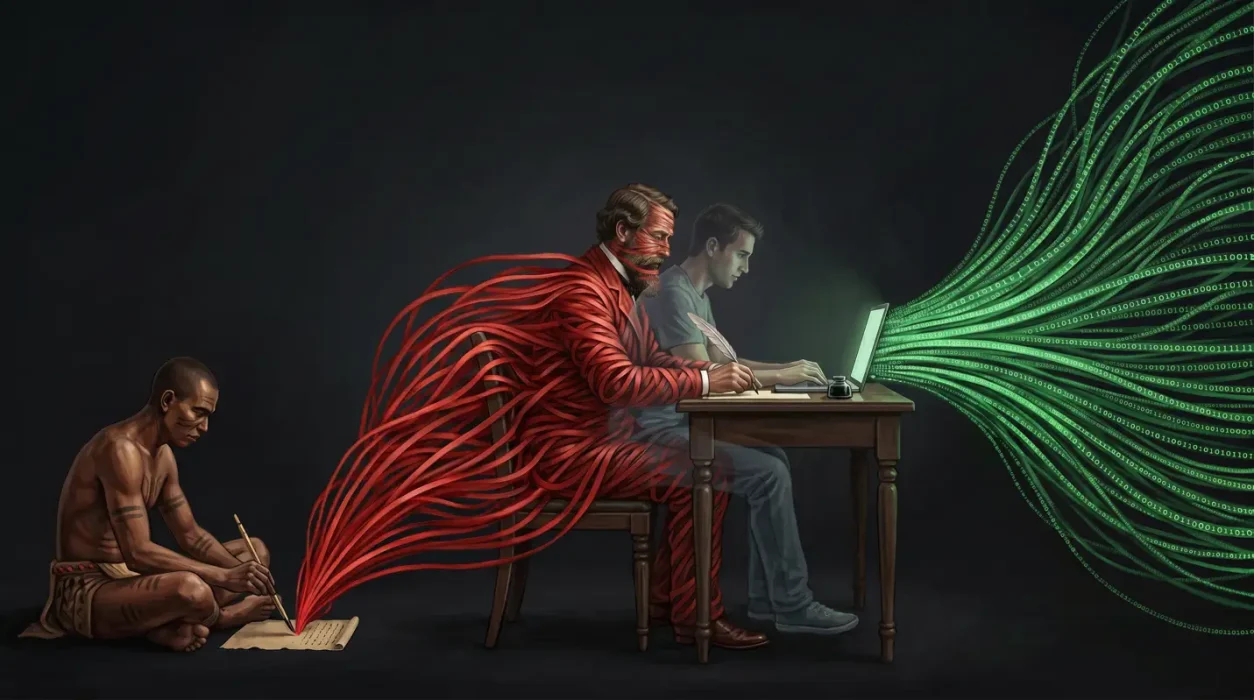

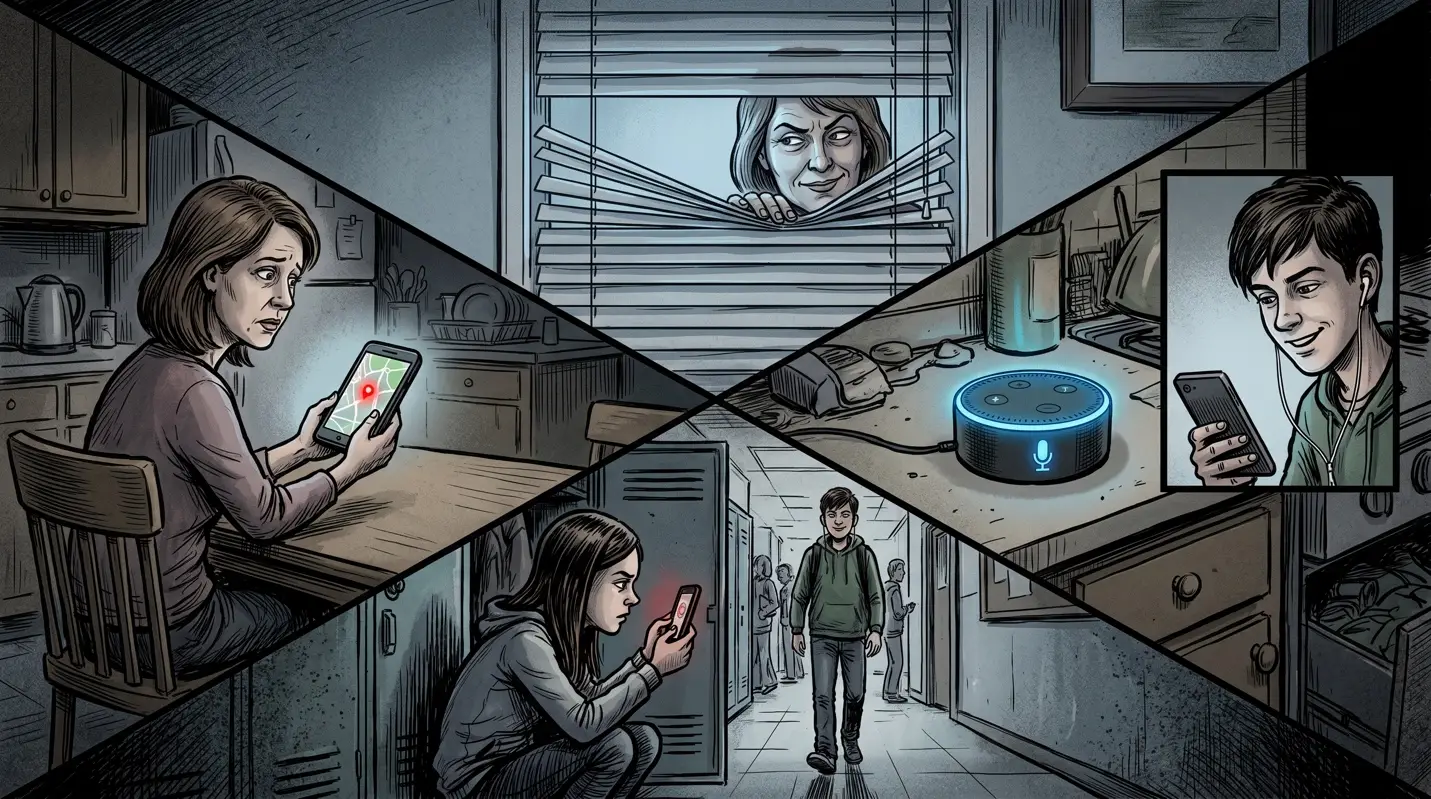

Invading privacy, in fact, just ignoring it, everybody has become porous. They let the light and the message go right through us, by the way, at this moment, we are on the air, and on the air. We do not have any physical body. When you're on the telephone, or on the radio, or on TV, you don't have a physical body; you're just an image on the air. When you don't have a physical body; you're a discarnate being, you have a very different relation to the world around you, and this, I think, has been one of the big effects of the electric age. It has deprived people, really, of their private identity.
Marshall McLuhan in Conversation with Mike McManus”, TVO, September 19, 1977, 06:57
Year: 1977
This is just a note to follow up on the matter of electronic man as discarnate. I had noted that discarnate man has no private identity and no relation to Natural Law but, on the other hand, he retains, and perhaps intensifies, his relation to “supernatural” Law. This inclines him to totalitarian regimes, and to the acceptance of the State as God. In other words, a major sickness of our time is focused right here.
Letter to Rev. Pierre Babin, May 13, 1978
Year: 1978
At the speed of light, minus the physical body, man is discarnate and discarnate man is not related to natural law.
"The Rise and Fall of Nature”, in The Antigonish Review, number 62-63 (1985), p 99.
Year: 1985
"Online or on the air, minus your physical bodies, you put on the corporate body, you wear all mankind as your skin. Under these conditions, a merely private sensibility would be a pure liability."
Eric McLuhan
Sensus Communis (2015), p 90
Year: 2015
Electronic man has no body so he puts nostalgia in its place.
Quoted by Stewart Brand in “McLuhan’s Last Words,” New Scientist, January 29, 1981
Year: 1981
Since, however, discarnate man has no relation to natural law (or to Western lineality), his impulse is towards anarchy and lawlessness. Minus his body, the user of telephone or radio or TV also is minus his private identity, an effect that is becoming increasingly evident.
Laws of Media: The New Science with Eric McLuhan, (1988), p 72
Year: 1988
By this line of thought, [audio-visual] education continues media violence against the numbed nervous system, adds to the experience of losing one’s body in the electronic media environment, and promotes loss of identity.
“What television is doing to us--and why: The eye as ear TV on the brain Marshall McLuhan on 'violent media' “, The Washington Post, May 15, (1977). P H1 …This is likely not the source. Need to look at article a 2nd time. Lawrence Has copy.
Year: 1977
When you are "on the air," you are everywhere at once. This is a power beyond that of the angels, according to Thomas Aquinas, for they can only be in one place at a time.
“The End of the Work Ethic” (1972), in Understanding Me (2003), p 201
Year: 1972
When you are on the air you are simultaneously here and in many other places in a manner that is discarnate and angelic, to say the least.
“At the Moment of Sputnik” (1974), in The Man and His Message, (1989), p 79
Year: 1974
That is, TV has much greater power to impose its assumptions than the movie does. As an entirely electric medium, TV also has much greater power to transport us and to transform our awareness. There is, as it were, an angelic dimension in electric media, lacking even to the movie.
“Roles, Masks and Performances” (1971), in McLuhan Unbound (2017), p 22
Year: 1971
Thus electronic man tends toward the disembodied or discarnate condition of "angel". I suggest that the incarnational Church has need to confront this new discarnate state of the laity under electronic conditions.
Letter to Clare Boothe Luce, July 6, 1973, in Letters of Marshall McLuhan, p 479
Year: 1973
When people are on the telephone or on the air, they have no physical bodies but are translated into abstract images. Their old physical beings are entirely irrelevant to the new situations. The discarnate user of electric media bypasses all former spatial restrictions and is present in many places simultaneously as a disembodied intelligence.
Laws of Media: The New Science with Eric McLuhan, (1988), p 72
Year: 1988
And A.T.W. Simeons has discussed at length how disruptive the second nature has been to the first. Made discarnate by our electric information media, the West is furiously at work retrieving its obsolesced organic first nature in a spectrum of new aesthetic modes, from feminism to phenomenology.
Laws of Media: The New Science with Eric McLuhan, (1988), p 116
Year: 1988
Languages are not programs but environments which are hidden from the young learner, and to which, like fish to water, he relates synesthetically, using all his faculties at once. After childhood the senses specialize via the channels of dominant technologies and social weaponries.
Letter to The Listener, October 8, 1971, in Letters of Marshall McLuhan (1987), p 443
Year: 1971
The images of mankind have become the most basic thing about them. And they’re all software, disembodied.
David Sohn interviews McLuhan, 1978, p 23
Year: 1978
Politically, discarnate man may have an image, but not a physical body.
Letter to Pierre Elliot Trudeau, February 24, 1977, in Letters of Marshall McLuhan (1988), p 528
Year: 1977
I think I have mentioned on other occasions that electronic man is discarnate and therefore a mass man, or one minus any private identity. For the electronic man the classic doctrine about the cognitive agent is either meaningless or unacceptable.
“To Larry Henderson, May 24th, 1978”, in Letters of Marshall McLuhan (1988), p 539
Year: 1978
On the telephone, or on the air, man is in every sense discarnate, existing as an abstract image, a figure without a body.
“To Clare Boothe Luce, 5th April, 1979”, in Letters of Marshall McLuhan (1988), p 543
Year: 1979
When discarnate, man has no identity, and is not subject to natural law. In fact he has no basis for morals of any sort.
“To Clare Boothe Luce, April 5, 1979”, in Letters of Marshall McLuhan (1988), p 543
Year: 1979
Discarnate man is not compatible with an incarnate Church. I would welcome your thoughts concerning a possible response to this situation.
“To Clare Boothe Luce, 5th April, 1979”, in Letters of Marshall McLuhan (1988), p 543
Year: 1979
Such trends as 'No-fault divorce' and 'No-fault auto insurance' are strong indications of this discarnate or disembodied condition.
“Living At The Speed Of Light,” 1979 Transcript, p 5
Year: 1979
Discarnate man is as weightless as an astronaut but can move much faster. He loses his sense of private identity because electronic perceptions are not related to place.
The Global Village with Bruce Powers (1989), p 97
Year: 1989
The effect of not having a body for most of the services in our information environment has significance which nobody has looked into at all. I would venture off-hand to say that people without bodies tend to be very weak in private identity. That a private identity tends to form in an interfacing of social surrounding. But minus a body, the social interfacing, or encounters, are very weak. Again, it is very difficult to explain why the subject has never been studied.
“Radio, Jobs, Role-Playing”, title given to an undated, recorded Monday Night Seminar circa 1969-1972, Transcript: 6:56
Year: 1969
The other side of the image is that it tends to become fantasy (discontinuous "flash") under the discarnate conditions of TV-viewing, that is, the audience wishing to be there floating in the electronic void rather than being fixed at home.
The Global Village with Bruce Powers (1989), p 101
Year: 1989
Having no fixed place in society, terrorists are discarnate; they have trouble recognizing reality. TV, as a maker of fantasy, reinforces that feeling of disembodiment. A terrorist will kill you to see if you are real. The satellite will distribute terrorist paranoia around the world in living color to match each acceleratingly disruptive event.
The Global Village with Bruce Powers (1989), p 115
Year: 1989
The satellite turns the user into discarnate information.
The Global Village with Bruce Powers (1989), p 117
Year: 1989
That is, the major social effect of the telephone is to remove the identity of the caller. If he is not identified or chooses not to identify himself, he loses touch with a geographic location and a social function. He becomes truly discarnate and, in that psychic sense, uncontrollable—a phone poltergeist, as it were, who occasionally produces the obscene phone call.
The Global Village with Bruce Powers (1989), p 123
Year: 1989
Since "human scale" is indispensable for human satisfactions, the future of the press must inevitably retain this dimension. At present, electric speed may already have violated human scale, tending as it does to transport man instantly everywhere.
“At The Moment of Sputnik” (1974), in The Man And His Message (1989), p 79
Year: 1974
Any medium presents a figure whose ground is always hidden, or subliminal. In the case of TV, as of the telephone and radio, the subliminal ground could be called the discarnate or disembodied user.
“A Last Look at the Tube” (1978) in The Man and His Message (1989), p 70
Year: 1978
Discarnate man, deprived of his physical body, is also deprive of his relationship to Natural Law and physical laws. As a discarnate intelligence, he is as weightless as an astronaut, but able to move very much faster. Minus the physical mesh of Natural Laws, the user of electronic services is largely deprived of his private identity. The TV experience is an inner trip, and is as addictive as any known drug.
“A Last Look at the Tube” (1978) in The Man and His Message (1989), p 197
Year: 1978
The discarnate TV user lives in a world between fantasy and dream, and is in a typically hypnotic state which is the ultimate form and level of participation.
“A Last Look at the Tube” (1978) in The Man And His Message (1989), p 197
Year: 1978
Electronic or discarnate man is automatically committed to the primacy of the right hemisphere.
“A Last Look at the Tube” (1978) in The Man And His Message (1989), p 198
Year: 1978
Chapter:
Hemispheres of the Brain
If discarnate man has a very weak awareness of private identity and has been relieved of all commitments to law and morals, he has also moved steadily toward involvement in the occult, on one hand, and loyalty to the superstate as a substitute for the supernatural on the other hand.
“A Last Look at the Tube” (1978) in The Man And His Message (1989), p 199
Year: 1978
When loyalty to Natural Law declines, the supernatural remains as an anchorage for discarnate man; and the supernatural can even take the form of the sort of mega machines of the state that Mumford talks about as existing in Mesopotamia and Egypt some five thousand years ago.
“A Last Look at the Tube” (1978) in The Man And His Message (1989), p 199
Year: 1978
When the viewer himself becomes a kind of discarnate information pattern, the saturation of that pattern by an electric environment of similar patterns gives us the world of the contemporary TV user.
“A Last Look at the Tube” (1978) in The Man And His Message (1989), p 200
Year: 1978
Chapter:
Television
If the caller is not identified or chooses not to identify himself, he loses touch with a geographic location and a social function. He becomes truly discarnate and, in that psychic sense, uncontrollable-a phone poltergeist who occasionally produces the obscene phone call.
“Ma Bell Minus the Nantucket Gam: Or the Impact of High-Speed Data Transmission” with Bruce Powers, in Journal of Communication, Vol. 31, No. 3, 1981, p 195
Year: 1981
In the age of the tactile-oriented skin-diver, this hard shiny carapace is one of the blackest marks against the motorcar. It is for motorized man that the shopping plazas have emerged. They are strange islands that make the pedestrian feel friendless and disembodied. The car bugs him.
Understanding Media (1964), MIT/Routledge edition, p 225
Year: 1964
This is to say that when you are "on the telephone," or "on the air," you do not have a physical body. In these media, the sender is sent, and is instantaneously present everywhere. The disembodied user extends to all those who are recipients of electric information.
“A Last Look at the Tube” (1978), in The Man And His Message (1989), p 197
Year: 1978
Communication media of the future will accentuate the extensions of our nervous systems, which can be disembodied and made totally collective. New population patterns will fuel the shift from smokestack industries to a marketing-information economy, primarily in the U.S. and Europe.
The Global Village with Bruce Powers (1988), p 83
Year: 1988
Telephone: b) Erodes the body as hardware; creates the disembodied consciousness.
Laws of Media: The New Science with Eric McLuhan, (1988), p 176
Year: 1988
Thus the people of the Magnetic City are angels, literally. Good or bad, disembodied intelligences. Lewis seems to have grasped this, perhaps as early as The Enemy of the Stars?
Letter to Sheila Watson, February 17, 1971, in Letters of Marshall McLuhan (1987), p 424
Year: 1971
Whereas hardware communication is a kind of transportation which centralizes organizational on every part of a structure. That is why the executive drops out of the old organization-chart patterns at electric speed. At electric speed, which is the speed of light, we are disembodied beings. On the phone, or "on the air", we are instantly present, but minus our bodies.
Letter to Pierre Elliot Trudeau, February 24, 1977, in Letters of Marshall McLuhan (1987), p 528
Year: 1977
The theology of discarnate man, I should think, is going to be extremely transcendental and gnostic. It's not going to have much place for the human being as an incarnate spirit. Perhaps this may be behind the present swing toward abortion and the idea of euthanasia. (Why should we have people around when they're of no use?)
“Interview with Marshall McLuhan”, in The Review of Books and Religion, Volume 3, No.9, pp.2 and 15, Mid-June, 1974, p 2
Year: 1974
…when you go on the telephone, you are transformed, you become instantly available to your friend in Chicago, or he becomes here instantly to talk to us in Toronto, you can talk to Tokyo and to Chicago and to New York simultaneous and this gives you a sort of dimension of an angel, an almost preternatural being, a disembodied spirit. In the electric age man, becomes a kind of disembodied spirit, I don't think our institutions have any way of coping with this new dimension of man, the angelic discarnate man of the electric age, who is always in the presence of all the other men in the world.
“Father Peyton’s Family Theatre (1972)”, Televised interview by Father Patrick Peyton, Transcript, p 3
Year: 1972
There is no lack of evidence of both physical and metaphysical violence as a response to this situation. T.S. Eliot has a line which seems to indicate awareness of the discarnate state of electronic man: "We all go into the silent funeral; nobody's funeral, for there is nobody to bury”.
Letter to Clare Boothe Luce, April 5, 1979, in Letters of Marshall McLuhan (1987), p 543
Year: 1979
Chapter:
Eliot, T.S.
Bell Telephone perfected at great cost, over a billion dollars, the videophone. They found out nobody wanted to pick up a telephone and find themselves everywhere. The moment you pick up a videophone you're everywhere.
“Videography Interview”, in Cinema Canada (1976), p 66
Year: 1976