Viewing chapter Electric, Electronic (73 quotes)
…the electronic age in which we stand as the primitives of an undeveloped and unknown culture…
Marshall McLuhan
Speech to the Learned Societies Canada Conference in Montreal, June, 1961
Year: 1961
Chapters:
Dropout | Electric, Electronic | He’s Hopeful | Living Unity | McLuhanisms & Zingers | Retribalizing | Today’s Transition
The new electronic environment is a corporate poem.
Culture Is Our Business, (1970), p 326
Year: 1970
There is no longer any tendency to speak of electricity as ‘contained’ in anything. Painters have long known that objects are not contained in space, but that they generate their own spaces. It was the dawning awareness of this in the mathematical world a century ago that enabled Lewis Carroll, the Oxford mathematician, to contrive Alice in Wonderland, in which times and spaces are neither uniform nor continuous, as they had seemed to be since the arrival of Renaissance perspective.
Understanding Media, 1964, MIT/Routledge edition, p 346
Year: 1964
Electric circuits scrap wheels and industrial hardware but retrieve the occult. Instant information translates whole populations into discarnate intelligences, transporting people everywhere in the world in an instant. The wheel centralized populations and the circuit broadcast them in all directions at once. Print and literacy gave the individual a keen sense of private identity which TV dulls and scrubs and soaks.
Letter to David Standish, Associate Editor, Playboy, July 7, 1971 commenting on “The New Salvationists” by James Kavanaugh (LAC)
Year: 1971
Chapter:
News
In electric systems communication is by gaps, switches and transistors.
Culture Is Our Business (1970), p 328
Year: 1970
Electronics have not only abolished the old boundaries between nations and planets but between the arts and the sciences. And if post-literate men find the psychic price for these adventures is too high, they will devise new kinds of social equilibrium such as enabled pre-literate men to fix their social forms in patterns that sometimes held for hundreds of thousands of years.
“Media Alchemy in Art and Society” (1958), p 677
Year: 1958
Chapter:
Living Unity
Electric technology does not need words any more than the digital computer needs numbers
Understanding Media (1964), MIT/Routledge edition, p 60
Year: 1964
Chapters:
After Language | Computer
…in the past century or so, the press has revolutionized transportation. The race to get and distribute news finally put an electric girdle round the earth. Shakespeare’s fancy about Puck putting a girdle round the earth in forty minutes was surpassed by telegraph and cable. Space was annihilated. And the village gossip became a world gossip. In 1844 the telegraph was greeted as “the first definite pulsation of the real nervous system of the world.”
“The Newspaper,” undated, unpublished typescript, p 1
Chapter:
News




Since electricity, inventories are made up not so much of goods in storage as of materials in continuous process of transformation at spatially removed sites. For electricity not only gives primacy to process, whether in making or in learning, but it makes independent the source of energy from the location of the process. In entertainment media, we speak of this fact as "mass media" because the source of the program and the process of experiencing it are independent in space, yet simultaneous in time. In industry this basic fact causes the scientific revolution that is called "auto- mation" or "cybernation."
Understanding Media (1964), MIT/Routledge edition, p 347
Year: 1964
The antithetic electric power of instant information that reverses social explosion into implosion, private enterprise into organization man, and expanding empires into common markets, has obtained as little recognition as the written word. The power of radio to retribalize mankind, its almost instant reversal of individualism into collectivism, Fascist or Marxist, has gone unnoticed. So extraordinary is this unawareness that it is what needs to be explained. The transforming power of media is easy to explain, but the ignoring of this power is not at all easy to explain. It goes without saying that the universal ignoring of the psychic action of technology bespeaks some inherent function, some essential numbing of consciousness such as occurs under stress and shock conditions.
Understanding Media, 1964, MIT/Routledge edition, p 304
Year: 1964
Whatever may prove to be the weaknesses of Teilhard de Chardin's work, he will always have the credit of having correctly defined the major change of our age. [Re. Teilhard announcing planet-spanning electric communication as a “prodigious biological event”]
“The Humanities in the Electronic Age” (1961), in McLuhan Unbound (2017), p 12
Year: 1961
We have no precedent for this, no way of getting our bearings, nobody to tell us what's happening. We´re suddenly projected into a world where everything happens at once....
“The Marfleet Lectures”, March 16-17 1967, reprinted in Understanding Me (2003), p 129
Year: 1967
Chapter:
Anxieties Caused By Change
But it was by means of electricity applied to the wheel that the wheel merges once more with animal form. In fact, the wheel is now an obsolete form in the electric-missile age. But hypertrophy is the mark of obsolescence, as we shall see again and again. Just because wheel is now returning to organic form in the twentieth century it is quite easy for us to understand hanow primitive man “invented” it. Any creature in motion is a wheel in that repetitiosformn of movement has a cyclic and circular principle in it. Thus the melodies of literate societies are repeatable cycles.
The Gutenberg Galaxy: The Making of Typographic Man, (1962), p 44
Year: 1962
The hidden ground of the electric media is the human nervous system minus the human body.
Review of The Tin Kazoo (1976)
Year: 1976
But the radio and TV were not just the electrification of speech and gesture but the electronification of the entire range of human personal expressiveness. With electronification the flow is taken out of the wire and into the vacuum tube circuit, which confers freedom and flexibility such as are in metaphor and in words themselves.
“A Historical Approach to the Media”, In Teachers College Record, Vol. 57, Issue 2, November (1955), p 109
Year: 1955
Chapter:
Media Reprocess Media
It is only since the telegraph that information has detached itself from such solid commodities as stone and papyrus, much as money had earlier detached itself from hides, bullion, and metals, and has ended as paper… Our electric extensions of ourselves simply by-pass space and time, and create problems of human involvement and organization for which there is no precedent. We may yet yearn for the simple days of the automobile and the superhighway.
Understanding Media (1964), MIT/Routledge edition, pp 104-105
Year: 1964
That which had been the first great extension of our central nervous system – the mass media of the spoken word – was soon wedded to the second great extension of the central nervous system – electric technology.
Understanding Media (1964), MIT/Routledge edition, p 269
Year: 1964
The detective story is an electronic form – because it uses the total environment as plot.
“What TV Is Doing To Us” Washington Post, May 15, 1977, p H5
Year: 1977
The familiar ad form of rippling repetition of profiles is an accessible example of the mini-module that is found in every electric structure, from space capsule to the modes of consciousness.
From Cliché to Archetype with Wilfred Watson (1970), p 155
Year: 1970
Because of electric speed, we can no longer wait and see. George Washington once remarked, "We haven't heard from Benj. Franklin in Paris this year. We should write him a letter."
The Medium Is the Massage (1967), p 63
Year: 1967
Electromagnetic technology requires utter human docility and quiescence of meditation such as befits an organism that now wears its brain outside its skull and its nerves outside its hide. Man must serve his electronic technology with the same servo-mechanistic fidelity with which he served his coracle, his canoe, his typography, and all other extensions of his physical organs. But there is this difference, that previous technologies were partial and fragmentary, and the electric is total and inclusive.
Understanding Media (1964), MIT/Routledge edition, p 57
Year: 1964
Chapters:
Extension Theory | Tools We Shape, Reshape Us
At electric speeds nobody makes decisions but everybody becomes participant in a complex situation for which he can take no responsibility whatever.”
The End of the Work Ethic, 1972, in Understanding Me, 2003, p 200
Year: 1972
Existentialism is just another name for the electronic environment.
Spoken in the TV episode “Out of Orbit,” CBC-TV, 1999, transcript: 42.02
Year: 1999
Extra sensory perception is normal perception. Today electronics are extra sensory, Gallup polls and motivation research are also. Therefore, people get all steamed up about E.S.P. as something for the future. It is already past and present.
“Electronics as E.S.P.”, Explorations Magazine, Volume 8, October, 1957. Reprinted as Verbi-Voco-Visual, 1967. Unnumbered page in Section 3
Year: 1957
Chapter:
Occult
The ways of thinking implanted by electronic culture are very different from those fostered by print culture. Since the Renaissance most methods and procedures have strongly tended towards stress on the visual organization and application of knowledge.
“The Agenbite of Outwit” 1963, in Media Research (1997), p 121.
Year: 1963
Chapters:
Dropout | From Tribal to Literate | Hardware / Software | Living Unity | Retribalizing | Today’s Transition
The electronic age is a world in which causes and effects become almost interchangeable, as in music structures.
Letter to David Standish, Associate Editor, Playboy, July 7, 1971, commenting on article “The New Salvationists” by James Kavanaugh (LAC)
Year: 1971
With electronics, any marginal area can become center, and marginal experiences can be had at any center.
Letter to Jacqueline Tyrwhitt, December 23, 1960, in Letters of Marshall McLuhan, p 278
Year: 1960
In the electric age our senses and energies go outside as a new kind of collective and corporate environment.
From Cliché to Archetype, 1970, p 66
Year: 1970
The important thing to realize is that electric information systems are live environments in the fully organic sense. They alter our feelings and sensibilities, especially when they are not attended to.
War and Peace in the Global Village, 1968, p 36
Year: 1968
Chapters:
Environment | Organic
In the electronic age, when time and space factors are very much reduced in information flow, it is once more natural for us, as for men in small oral communities, to think mythically. For today it is easy to perceive consequences embedded in any kind of innovation. If we don’t see them, they clobber us very quickly.
“Popular/Mass Culture”, Speech (1960), in Understanding Me (2003), pp 17-18
Year: 1960
Chapters:
Mastering Technology | Myth, Mythic
Electricity has wrapped the planet in a single cohesive field or membrane that is organic rather than mechanical in nature. The population of the world has imploded, as have the models of perception and learning. All men are now involved in one another physically and psychically as happens when they occupy a very small village.
“The Electronic Age - The Age of Implosion” (1962), in Media Research (1997), p 16
Year: 1962
Chapter:
Global Village
Electric technology is directly related to our central nervous systems, so it is ridiculous to talk of "what the public wants" played over its own nerves.
Understanding Media,1964, MIT/Routledge, p 68
Year: 1964
In the mechanical age of the wheel and the lever, acceleration had expanded and enlarged the sphere of action. At electric or instant speeds the same sphere contracts almost to the dimensions of a single consciousness.
“The Role of New Media in Social Change,” 1964, in The Man and His Message, 1989, p 35
Year: 1964
Chapters:
Mechanization | Speedups
I live in an electric age is what Camus and Sartre are trying to say.
“Technology Kills Democracy, McLuhan Warns Students,” University of Toronto undergraduate newspaper The Varsity, Vol LXXXII, No. 26, Novembver 19, 1962, p 7
Year: 1962
They [the electronic media] are a very nervous system!
Interview with Louis Forsdale, 1974,in Sanderon, Man and Message, p 15 or 17
Year: 1974
All men are totally involved in the insides of all men. There is no privacy and no private parts. In a world in which we are all ingesting and digesting one another there can be no obscenity or pornography or decency. Such is the law of electric media which stretch the nerves to form a global membrane of enclosure.
“Notes on Burroughs,” The Nation (1964), p 518
Year: 1964
Electric circuitry profoundly involves men with one another. Information pours upon us, instantaneously and continuously.
The Medium is the Massage with Quentin Fiore, 1967, p 63
Year: 1967
Chapter:
Information Overload
Today man's nerves surround us; they have gone outside as electrical environment. The human nervous system itself can be reprogrammed biologically as readily as any radio network can alter its fare.
Notes on Burroughs, 1964, p 517
Year: 1964
Electric speeds create centers everywhere. Margins cease to exist on this planet.
Understanding Media, 1964, MIT/Routledge edition, p 91
Year: 1964
From the moment of the telegraph, extra-sensory perception becomes a daily factor in shaping the human community and private perception alike.
“Humanities in the Electronic Age” (1961), p 7
Year: 1961
Today nobody can occupy a fixed position or find a stationary target. Electric technology excludes both possibilities.
The DEW-Line Newsletter Vol 1 # 3 (1969), p 5
Year: 1969
To put one's nerves outside, and one's physical organs inside the nervous system, or the brain, is to initiate a situation -- if not a concept -- of dread.
Understanding Media (1964), MIT/Routledge edition, p 252
Year: 1964
We moved out of that [post-historic era] a long time ago. History after all is a fiction, an invention of literacy. As we moved into the electric circuit period, we moved out of that form of organizing knowledge. History is a rear view method of ordering life and knowledge and it consists in adapting a position from which to examine the past. Once you move into a very fast-moving world in which you play a total field, you can’t have history.
“MIT-SSSR” (1966), p 6
Year: 1966
Chapter:
History
It is man who has become both figure and ground via the electrotechnical extension of his awareness.
Take Today with Barrington Nevitt (1972), p 11
Year: 1972
Chapter:
Figure/Ground
With electronification the flow is taken out of the wire and into the vacuum tube circuit, which confers freedom and flexibility such as are in metaphor and in words themselves.
Counterblast (1969), p 127
Year: 1969
Chapter:
Media Reprocess Media
…for the electric implosion now brings oral and tribal ear-culture to the literate West.
Understanding Media, 1964, MIT/Routledge edition, p 50
Year: 1964
In the electronic age we stand as the primitives of an undeveloped and unknown culture.
Speech to the Learned Societies Canada Conference in Montreal, June, 1961.
Year: 1961
We live today in the Age of Information and of Communication because electric media instantly and constantly create a total field of interacting events in which all men participate.
Understanding Media, 1964, MIT/Routledge edition, p 248
Year: 1964
Electric speed is bringing all social and political function together in a sudden implosion that has heightened human awareness of responsibility to an intense degree.
Understanding Media, 1964, MIT/Routledge edition, p 5
Year: 1964
…the electric age gave us the means of instant, total field-awareness.
Understanding Media, 1964, MIT/Routledge edition, p 47
Year: 1964
Electric media, because of their total "field" character, tend to eliminate the fragmented specialties of form and function that we have long accepted as the heritage of alphabet, printing, and mechanization
Understanding Media, 1964, MIT/Routledge edition, p 277
Year: 1964
At electric speed, all forms are pushed to the limits of their potential.
Laws of Media: The New Science with Eric McLuhan, (1988), p 109
Year: 1988
In the electronic era, we wear all mankind as our skin
Understanding Media, 1964, MIT/Routledge edition, p x
Year: 1964
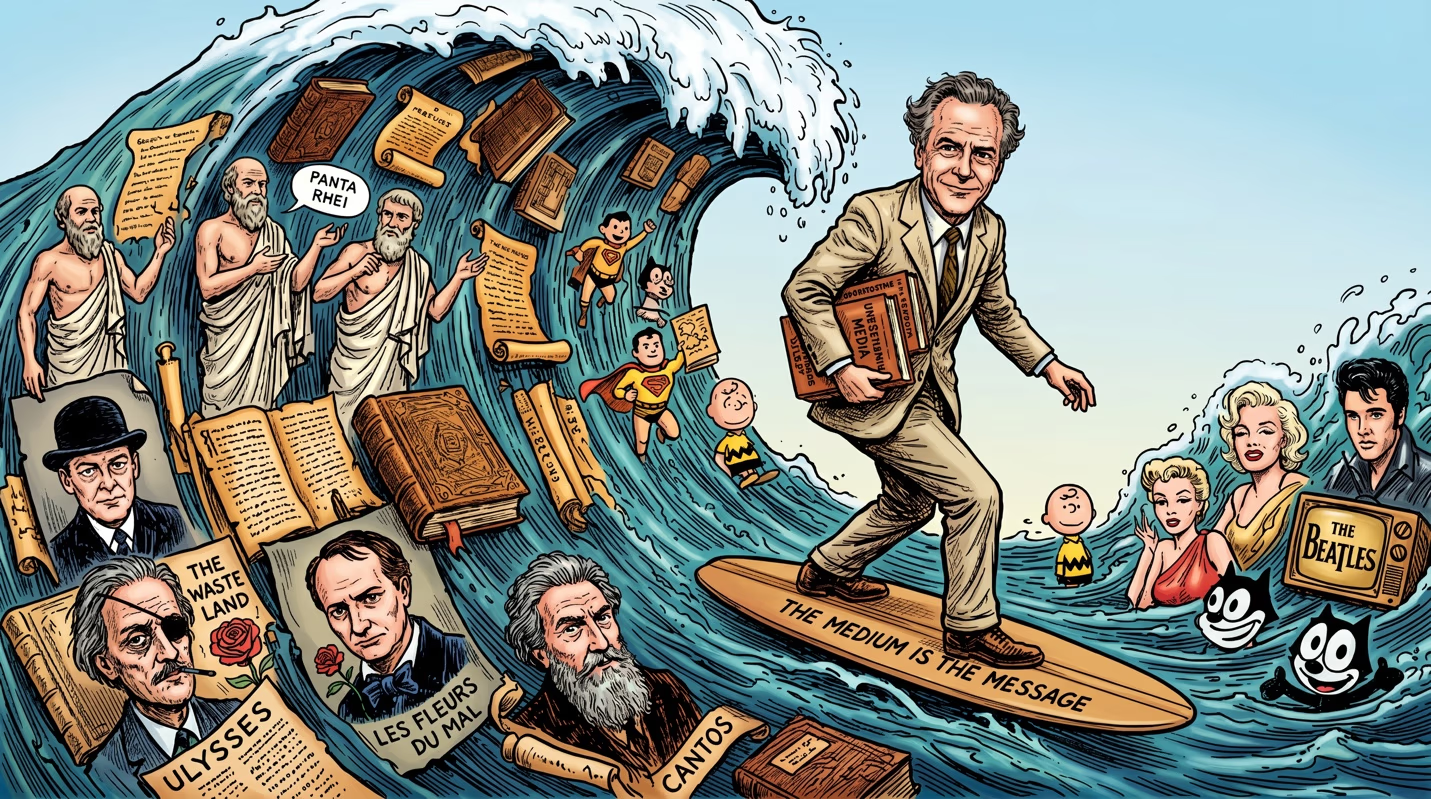
Heidegger surf-boards along on the electronic wave as triumphantly as Descartes rode the mechanical wave.
The Gutenberg Galaxy, 1962, p 280
Year: 1962
In the electric age, when our central nervous system is technologically extended to involve us in the whole of mankind and to incorporate the whole of mankind in us, we necessarily participate, in depth, in the consequences of our every action. It is no longer possible to adopt the aloof and dissociated role of the literate Westerner.
Understanding Media, 1964, MIT/Routledge edition, p 4
Year: 1964
The electric light is pure information. It is a medium without a message.
Understanding Media, 1964, MIT/Routledge edition, p 8
Year: 1964
Chapter:
McLuhanisms & Zingers
Electricity does not centralize, but decentralizes. It is like the difference between a railway system and an electric grid system: the one requires railheads and big urban centers. Electric power, equally available in the farmhouse and the Executive Suite, permits any place to be a center, and does not require large aggregations.
Understanding Media, 1964, MIT/Routledge edition, p 36
Year: 1964
The Concept of Dread, by Soren Kierkegaard, appeared in 1844, first year of the commercial telegraph...It mentions the telegraph as a reason for dread and nowness or existent.
Understanding Media, 1964, MIT/Routledge edition, p 99
Year: 1964
By electricity we have not been driven out of our senses so much as our senses have been driven out of us.
Understanding Media, 1964, MIT/Routledge edition, p 375
Year: 1964
We must first master and then teach these new languages in all their minute particularity and riches. In so doing we have available on an unprecedented scale the resources of comparison and contrast.
“Educational Effects of Mass Media of Communication”, 1956, p 403
Year: 1956
Chapters:
Media Study | Teaching
My main theme is the extension of the nervous system in the electric age, and thus, the complete break with 5000 years of mechanical technology. This I state over and over again. I do not say whether it is a good or bad thing. To do so would be meaningless and arrogant.
Letter to Robert Fulford, June 1st, 1964, in Letters of Marshall McLuhan (1987), p 300
Year: 1964
Chapter:
Values & Value Judgments
Education must shift from instruction, from imposing of stencils, to discovery – to probing and exploration and to the recognition of the language of forms… The teach-in represents an attempt to shift education from instruction to discovery, from brainwashing students to brainwashing instructors. It is a big, dramatic reversal.
“McLuhanisms on Education,” in “Where It’s At / Where It’s Going” Campus Call (Fordham University), Vol. X, No. 5, pp. 3-4, January 19,1970, p 4
Year: 1970
In education the conventional division of the curriculum into subjects is already as outdated as the medieval trivium and quadrivium after the Renaissance. Any subject taken in depth at once relates to other subjects. Arithmetic in grade three or nine, when taught in terms of number theory, symbolic logic, and cultural history, ceases to be mere practice in problems. Continued in their present patterns of fragmented interrelation, our school curricula will insure a citizenry unable to understand the cybernated world in which they live.
“McLuhanisms on Education,” in “Where It’s At / Where It’s Going” Campus Call (Fordham University), Vol. X, No. 5, pp. 3-4, January 19,1970, p 4
Year: 1970
Chapter:
Living Unity
Electric speeds tends to abolish time and space in human awareness. There is no delay in the effect of one event upon another. The electric extension of the nervous system creates the unified field of organically interrelated structures that we call the present Age of Information.
“The Role of the Media in Social Change” (1964), p 1
Year: 1964
Chapter:
Present [The]
ESP, horoscopy, and all the occult forms come with electric speeds. In fact, all forms of the electric service-environment are essentially occult because they’re invisible. The mere fact of electricity is invisible. At the speed of light all the physical factors disappear.
“Review of Books and Religion” (1974), p 2
Year: 1974
By electricity… we have not been driven out of our senses, so much that our senses have been driven out of us.
Understanding Media, 1964, MIT/Routledge edition, p 375
Year: 1964
…the Nazi death camps are as much a part of the new electric involvement as the Peace Corps and the Beatles.
“Art as Anti-Environment” (1965), p 3
Year: 1965
The psychic and social impact of new technologies and their resulting environment will reverse all the characteristic psychic and social consequences of the old technology and its environments.
War and Peace in the Global Village, 1968, p 82
Year: 1968
"In the electronic age, we're living by music."
Recounted from a 1979 seminar, by B.W. Powe
"In the electronic age, we're living by music."
Recounted from a 1979 seminar, by B.W. Powe
Chapters:
Music | Today’s Transition
The right hemisphere crowd are the only ones LEFT behind.
Recalled from personally heard in the mid-1970s by Thomas Cooper
Chapter:
McLuhanisms & Zingers
The stepping-up of speed from the mechanical to the instant electric form reverses explosion into implosion.
Understanding Media, 1964, MIT/Routledge edition, p 57
Year: 1964
Chapter:
Chiasmus, Flips, Reversals
Electricity is the charge of the light brigade.
Recalled by Tom Cooper from classes and conversations with McLuhan, 1976-1979
Chapter:
McLuhanisms & Zingers
“Electricity is the charge of the light brigade.”
Recalled by Tom Cooper from classes and conversations with McLuhan, 1976-1979
Year: 1976
Chapter:
McLuhanisms & Zingers