Viewing chapter Evolution (17 quotes)
We put on our technology as evolutionary clothing.
Quoted in W. Terrence Gordon, Marshall McLuhan Escape into Understanding, (1997), p 26
Year: 1997
Evolution [in the electric age] became not an involuntary response of organisms to new conditions but a part of the consensus of human consciousness.
Counterblast (1969), p 143
Year: 1969
Chapters:
Consciousness | Corporate Consciousness
This power to extend ourselves was used as a theme by Hans Hass in his book The Human Animal. In it he considers this human ability to create additional organs as “an enormity from the evolutionary standpoint - an advance laden with unfathomable consequences.”
Man and Media,” lecture delivered at York University, Toronto, (1979), in Understanding Me (2003), p 283
Year: 1979
The media extensions of man are the hominization of the planet; it is the second phase of the original creation.
The Global Village with Bruce Powers, 1988, p 93
Year: 1988
The man-made environment has a principle of evolutionary change.
Tom Cooper interview with MM,1976, transcript
Year: 1976
Chapters:
Environment | Extension Theory
The evolutionary process has shifted from biology to technology in an eminent degree since electricity.
Letter to Jacques Maritain, May 6, 1969 (LAC)
Year: 1969
The plane ends the relation of wheel and road.
Culture Is Our Business, (1970), p 22
Year: 1970
Chapter:
Living Unity
First, the hunter, then the miner of the soil; next the mechanical industrialist. And now the information engineer.
Culture Is Our Business, (1970), p 42
Year: 1970
Increasingly these forms [typewriters, cars, airplanes, highways, etc.] have evolved by their own logic toward organic life, as in forms begun as clumsy adaptations of primary experience in the handicrafts. The scientist propelled them abstractly toward the freedom of art and the inner coherence of organisms. Working from the opposite end, the artists of our time have moved from primary impressionism toward abstract art.
“Review of Paul Klee, by Carola Giedion-Welcker”, in Shenandoah, Vol. 4, No. 1, Spring, (1953), p 80
Year: 1953
Chapter:
Environment
[Electronic technologies] are a form of clothing that can be programmed at will to produce any effect desired. Quite naturally, they take over the evolutionary work that Darwin had seen in the spontaneities of biology.
War and Peace in the Global Village, 1968, p 37
Year: 1968
One major difference between the age of Copernicus and that of Einstein is the fact that there was nobody who could apply the ideas of Copernicus to anything but poetry and painting. Today the most abstruse theories go into action even before they have had their day in science fiction.
“The Humanities in the Electronic Age” (1961), in McLuhan Unbound (2017), p 18
Year: 1961
[My theme] is that all technologies are immediate extensions of our physical and sensory lives. In short, any new technology is an evolutionary and biological mutation opening new doors of perception and new spheres of action to mankind.
Letter to William French of The Globe and Mail, July 15, 1964 [confirm in LAC F.A.]
Essential 282
Essential 282
Year: 1964
Chapter:
Extension Theory
Letters had been codified as dots for the fingers long before the Morse Code was developed for telegraph use. And it is relevant to note how electric technology, in like manner, had converged on the world of speech and language, from the beginning of electricity. That which had been the first great extension of our central nervous system—the mass media of the spoken word—was soon wedded to the second great extension of the central nervous system—electric technology.
Understanding Media (1964), MIT/Routledge edition, p 269
Year: 1964
Chapters:
Media Reprocess Media | Telegraph
New media are to the world of man-made artifacts what new species are to biology, i.e. they are probes, thrusters into the unexplored dimensions of our world. When the man-made satellite environment was put around the earth, nature in the familiar sense ended. The earth became the content of an information environment and ceased to be the environment of social man. In evolutionary terms, technology has taken over from biology.
Dedication for Magnovia II, February, 1968
Year: 1968
Chapter:
Media
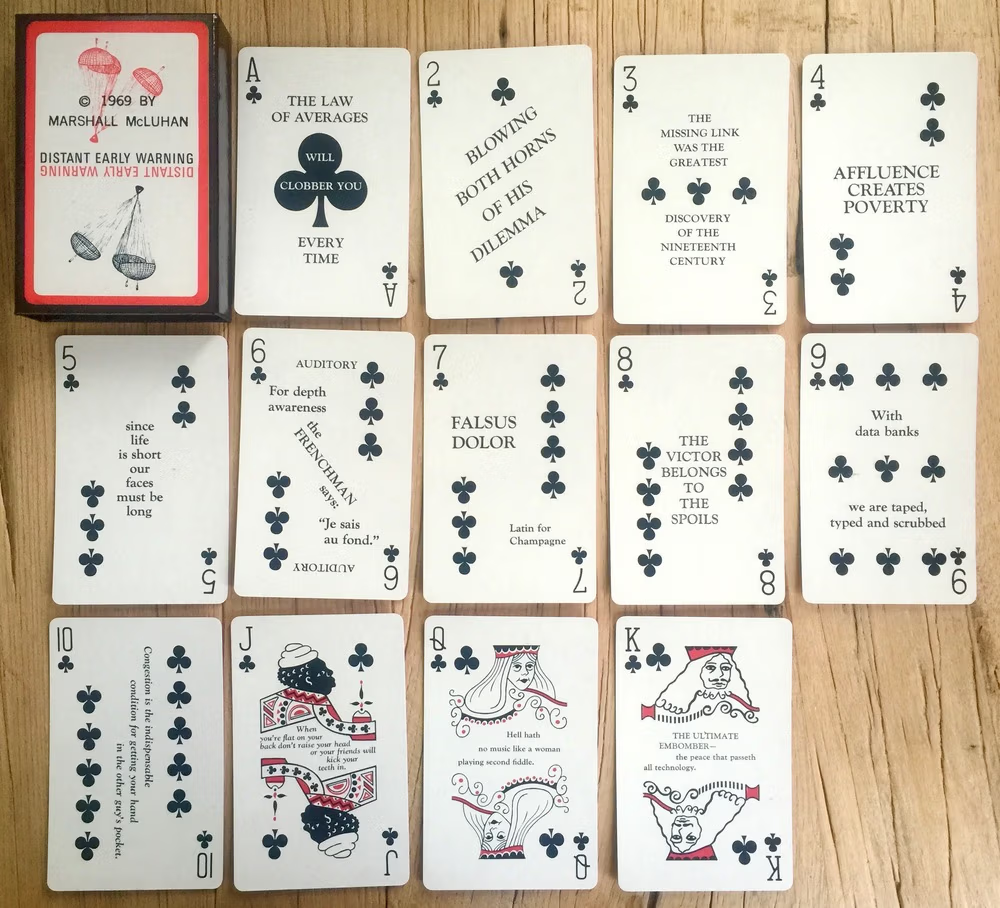
The “missing link” was the greatest discovery of the 19th century. But it was not missing at all; it was an interface; it was where the new evolution began.
“The Hardware-Software Mergers: How Successful Have They Been?” Speech at a conference, Reappraisal of the Educational Technology Industry, University of Chicago, November 16-18, 1969; Transcript, p 4
Year: 1969
Conceptual choices, like “natural selection,” can come only after the fact. The origins: of all species vanish in the rear-view perspectives, while the music goes round and round.
“Symposium” (1973), p 11
Year: 1973
The possibility of programming evolution by deliberate means is wide open in the age of the computer, but it also involves a much greater responsibility than any previous age dreamt of.
The Museum as Large-Room Pinball Machine, Marshall McLuhan, Harley Parker, and Museum Professionals, 1967, full transcript of a seminar at the City Museum of New York, October 9-10, 1967, edited by William Buxton, published by U. of Alberta Press, 2026, p 80
Year: 1967
Chapters:
Computer | Environment