Viewing chapter Eye vs Ear (14 quotes)
The interiorization of the technology of the phonetic [alphabet] translates man from the magical world of the ear to the neutral visual world [of the eye].
The Gutenberg Galaxy, 1962, p 21
Year: 1962
Chapter:
Present [The]
Civilizations gives the or tribal man an eye for an ear and is now at odds with the electronic world.
The Gutenberg Galaxy, 1962, p 26
Year: 1962
All language is layered with puns that the penman (eye) suppresses.
Culture Is Our Business (1970), p 146
Year: 1970
The ear is intolerant, closed, and exclusive, whereas the eye is open, neutral, and associative. Ideas of tolerance came to the West only after two or three centuries of literacy and visual Gutenberg culture. No such saturation with visual values had occurred in Germany by 1930. Russia is still far from any such involvement with visual order and values.
Understanding Media (1964), MIT/Routledge edition, pp 302-303
Year: 1964
Chapter:
Senses
The very word idea is indicative of the revolution in thinking that took place with literacy. This word, which is not to be found in Homeric Greek, derived from the word eidos, indicating “visual image.” The alphabet had the mysterious and unique power of separating the visual faculty from the other senses and giving dominant play to the visual.
“The Alphabet, Mother of Invention” with Robert K. Logan, in Et Cetera, 1977, p 377
Year: 1977
One of the big flips that’s taking place in our time is the changeover from the eye to the ear. Most of us, having grown up in the visual world, are now suddenly confronted with the problems of living in an acoustic world which is, in effect, a world of simultaneous information.
“Living in an Acoustic World,” Speech at the University of South Florida, 1970, in McLuhan Speaks, transcript
Year: 1970
Chapter:
Chiasmus, Flips, Reversals
But as I said, the Negro arouses hostility in whites precisely because they subliminally recognize that he is closest to that tribal depth involvement and simultaneity and harmony that is the richest and most highly developed expression of human consciousness.
“Playboy Interview: Marshall McLuhan: A Candid Conversation with the High Priest of Popcult and Metaphysician of Media”. By Eric Norden. Playboy Magazine, March (1969), p 68, reprinted in Essential McLuhan, (1995), pp 256-257
Year: 1969
Chapters:
America, North America | Consciousness





[W]hen FDR mastered the microphone, as a political instrument, he found it important, if not necessary, to pit his mike against the press, the oral against the written.
“Why the CBC Must Be Dull,”, in Saturday Night, February 16th, (1957), p 14
Year: 1957
Chapter:
Acoustic Space
…retribalization means going back into the world of all-at-onceness, of echoland, in which the auditory resonance is dominant…
“The Hardware-Software Mergers: How Successful Have They Been?” 1969, transcript of speech, p 5
Year: 1969
Chapter:
Retribalizing
Last night I was reading Finnegans Wake pages 492 to 505. I thought at once of writing to Giedion about it. In these pages Joyce runs through the letters of the alphabet from A to Z as a social cycle. When he gets to Z, the cycle begins again. He explicitly indicates the return to primal undiscriminated auditory space, then begins again the discovery of the vertical plane and enclosed space and numbers and measurement. Joyce is quite explicit that (page 501) as the alphabet ends its cycle we move out of visual space into discontinuous auditory space again. This he mentions as the return to "Lewd’s Carol", that is, through the looking glass into the world of non-Euclidean space once more, lewd, ignorant, tribal, involved totally as in group singing. In his "Beginnings of Architecture" Giedion cites the evidence several times that there is no architectural enclosing of space before script. Giedion does not know why this should be. Visual space alone of all the space discriminated by our various senses is continuous, uniform
and connected.
Letter to Jacqueline Tyrwhitt, May 11, 1964, Letters (1987), p 298
Year: 1964
Chapter:
Joyce, James
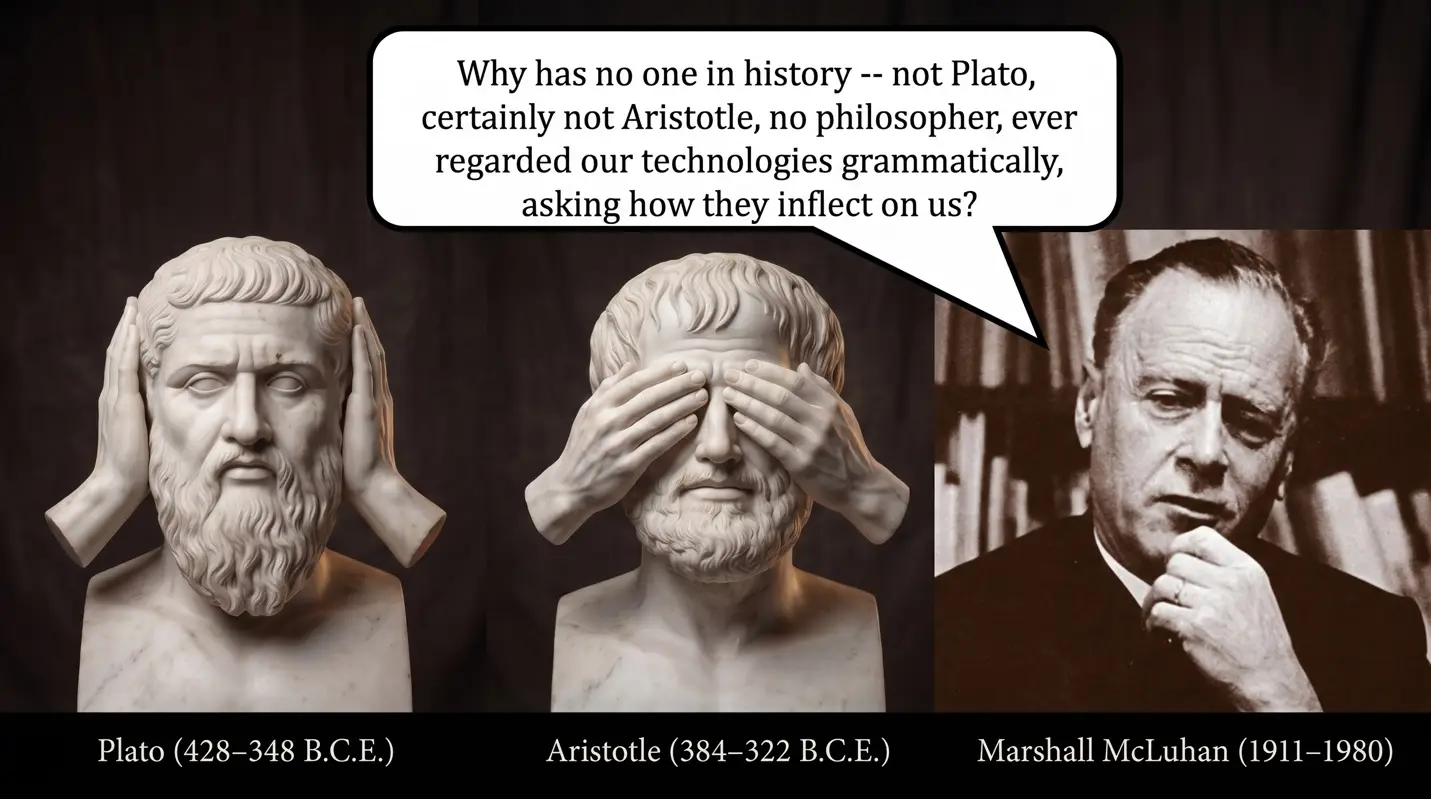
“[McLuhan] good-naturedly blamed Plato for writing down Socrates' dialogues and thus inaugurating ‘codified culture’…"
Anonymous New Yorker staffer, reporting on a speech McLuhan gave at Spencer Memorial Church in Brooklyn Heights, New York in early May 1965; this passage appeared in “Toast of the Town” in The New Yorker, May 15, 1965, p 44
Year: 1965
In terms of eye and ear, both are completely right, but when one begins making value judgments about the other — as Bergson did — the trouble begins. Bergson simply went over to the ear side of things and denounced the visual order as the enemy of all Being.
“Communication Media: Makers of the Modern World” (1959), in The Medium and the Light (1999), p 44
Year: 1959
Chapter:
Values & Value Judgments
Of all the great hybrid unions that breed furious release of energy and change, there is none to surpass the meeting of literate and oral cultures. The giving of man of an eye for an ear by phonetic literacy is, socially and politically, probably the most radical explosion that can occur in any social structure. This explosion of the eye, frequently repeated in “backward areas", we call Westernization. With literature now about to hybridize the cultures of the Chinese, the Indians, and the Africans, we are about to experience such a release of human power and aggressive violence as makes the previous history of phonetic alphabet technology seem quite tame.
Understanding Media (1964), MIT/Routledge edition, pp 49-50
Year: 1964
When Coleridge said that all men are born either Platonists or Aristotelians, he was saying that all men tend to be either acoustic or visual in their sensory bias.
Laws of Media: The New Science with Eric McLuhan, (1988), p 113
Year: 1988