Viewing chapter LOM 4 - Flip, or Reverse into the Opposite (27 quotes)
Film was, as a form, the final fulfillment of the great potential of typographic fragmentation. But the electric implosion has now reversed the entire process of expansion by fragmentation.
Understanding Media, (1964), MIT/Routledge edition, p 294
Year: 1964
In all fields, in all media, there is a development of a cluster of opposite characteristics if the form is pushed far enough the exact opposite tendency occurs. The consumer is left to do half the job.
“The Electronic Revolution in North America” (1959), p 8 International Literary Annual, No. 1. Ed. John Wain. London: John Calder. pp. 165-169.
Year: 1959
The reversal aspect of the tetrad is succinctly exemplified in a maxim from information theory: data overload equals pattern recognition. Any word of process or form, pushed to the limit of its potential, reverses its characteristics and becomes a complementary form, just as the airplane, pushed to the limit of its potential, reverses its controls when it passes the “sound barrier.” Money (hardware), when pushed to its limit, reverses into the lack of money, that is credit (software or information), and the credit card. At high speed or in great quantity, the motor car reverts to nautical form, and traffic (or a crowd) “flows.”
Laws of Media: The New Science with Eric McLuhan, (1988), pp 107-108
Year: 1988
The expressway becomes a parking lot, simply by putting a faster spin on the hardware of the motor car than it can accommodate. The satellite environment of the planet has put a new spin on the earth, transforming our vision of it. The satellites "scrapped" Nature, turning the planet into an art form as decisively as TV turned the movie into an art form.
Letter to C.A. Doxiades, Dec. 17, 1969, in Letters of Marshall McLuhan (1987), p 392
Year: 1969
In the age of electric information and programmed production, commodities themselves assume more and more the character of information, although this trend appears mainly in the advertising budget. In his A Study of History Arnold Toynbee notes a great many reversals of form and dynamic, as when, in the middle of the fourth century AD, the Germans in the Roman service began abruptly to be proud of their tribal names and to retain them.
Laws of Media: The New Science with Eric McLuhan, (1988), p 106
Year: 1988
The price exacted of the twentieth century [for reversing the trend of specialism) is a return to involvement in the most primitive modes of human consciousness.
Take Today with Barrington Nevitt (1972), p 204
Year: 1972
Chapters:
Involvement | Retribalizing
It is an old observation of Aristotle and others that any process pushed to its limit reverses its characteristics.
“Roles, Masks and Performances” (1971), p 527, reprinted in McLuhan Unbound #12 (2017), p 20
Year: 1971
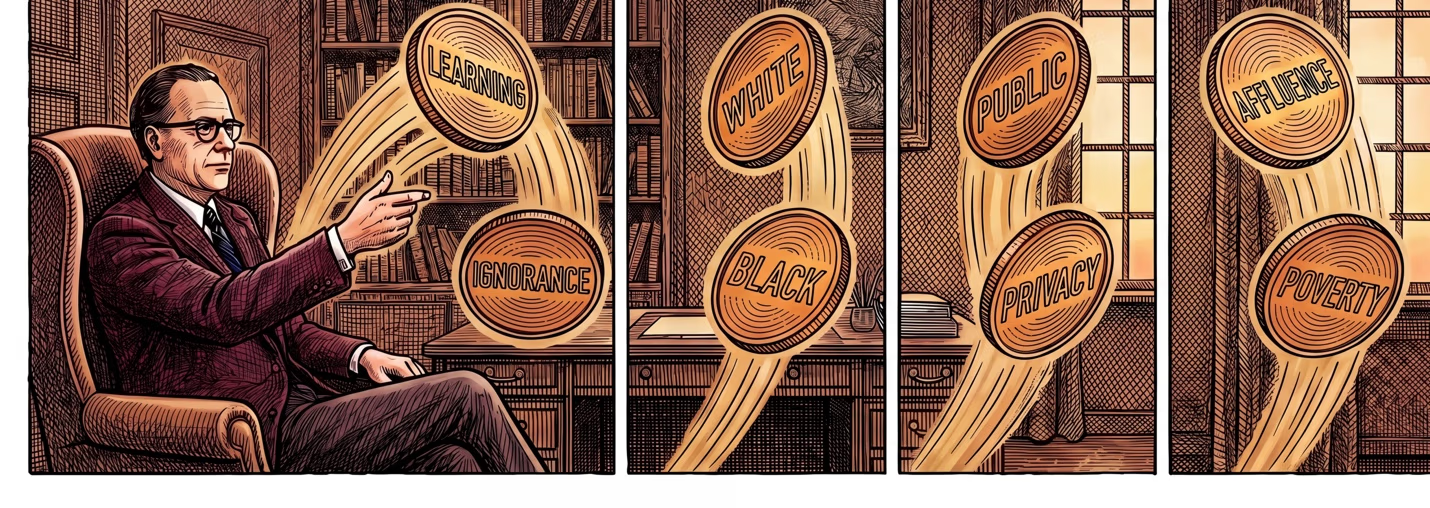

One sure way to perceive the structure of any situation easily is to reverse its figure/ground relationship.
City as Classroom, 1977, p 20
Year: 1977
When audience participation becomes too extensive, the villains on trial flip into public heroes because the audience quickly identifies with them, especially when they are men who are carrying out robotlike activities which necessarily resemble those of the average audience.
“The End of the Work Ethic”, 1972, in Understanding Me, 2003, p 193
Year: 1972
Chapter:
Chiasmus, Flips, Reversals
Perhaps trends cannot always be trusted. The trend toward increasing enlightenment by electric media has flipped us back into the world of the occult, that is, the world of horoscopes and hidden forces.
Letter to the Editor, the Toronto Star, July 24, 1974, in Letters of Marshall McLuhan, 1987, p 503
Year: 1974
Just how quickly the public participation flips from audience to actor has recently been noticed in Watergate, and earlier in the trial of Lieutenant Calley. When audience participation becomes too extensive, the villains on trial flip into public heroes because the audience quickly identifies with them, especially when they are men who are carrying out robot-like activities which necessarily resemble those of the average audience.
The End of the Work Ethic, 1972, in Media Research, 1997, p 99
Year: 1972
The genuine fake has become the real McCoy.
Take Today with Barrington Nevitt, 1972, p 79
Year: 1972
At electric speed, everything becomes X-ray. Watergate is a nice parable or example of how secrecy was flipped into show business.
Living at the Speed of Light (Speech, U of So Fla), 1974, in Understanding Me (2003) , p 237
Year: 1974
It was the electric spark that enabled the gasoline engine to take over from the steam engine. The crossing of electricity, the biological form, with the mechanical form was never to release a greater force.
Understanding Media, 1964, MIT/Routledge, p 220
Year: 1964
As technology advances, it reverse the characteristics of every situation again and again. The age of automation is going to be the age of "do it yourself.”
“Conspicuous Coexistence”, 1957, p 2
Year: 1957
Chapter:
Chiasmus, Flips, Reversals
A few years ago, the car was made to bring the farmer to town. As roads improved, the town went to the country. As cars and roads improved, the highway was no longer a link with the country but a substitute for the count ry. A spin in the country now means a spin on the highway.
“Conspicuous Co-existence”, 1957, p 2
Year: 1957
Chapter:
Car
A flip point from the mechanical to the acoustic -- the rounded tin foil cylinder. New symbol of the coming acoustic age.
“Angels to Robots: From Euclidean Space to Einsteinian Space”, in The Global Village with Bruce Powers 1989, p 139
Year: 1989
Things reverse form when pushed to the limit of their potential. The flip from visual to acoustic order, from rational connectedness to intuitive insight, came on the heels of the Gothic revival and seemed to prelude the advent of the electronic age of quantum mechanics and discontinuous matter and space.
Laws of Media: The New Science with Eric McLuhan, (1988), p 109
Year: 1988
Print over the centuries had stabilized a pattern of producer-consumer relations. But with the telegraph a century ago the reader of the press had to assume an editorial function unknown to the reader of the pre-telegraph press.
“What Fundamental Changes—", 1959, p 5
Year: 1959
Vannevar Bush devised the "microdot library" for the astronauts. Just when the paper deluge had reached the point of no return, Bush put an electric period to the process - a full stop or dot that was, in effect, a complete cultural cycle - a period in the old sense of a peri hodos, the road round.
“Innovation Is Obsolete”, in Evergreen Review, Vol. 15, No. 90, June (1971), p 49
Year: 1971
Any process, pushed to its limit, flips. The specialized acoustic image of the demagogue on radio, or talking movie, is suddenly shifted into iconic or "cartoon" form on TV.
“Technology and the Human Dimension” (Interview, Louis Forsdale), 1974, in Marshall McLuhan: The Man and His Message (1989) p 23
Year: 1974
Chapter:
Television
When first put on, the Stratton glasses turn the world upside down for the wearer. However, after a few hours the wearer finds that the world flips right-side up again. Then, when he removes the glasses, the world goes upside down again and remains so for a few hours.
“Reading and the Future of Private Identity”, 1973, pp 5-6
Year: 1973
On the other hand CB is a fascinating flip in which you use the condition of the car as an intercom system for socializing. The Citizen's Band. You get in your car and then you can talk to anybody socially on a party line... It's a complete flip using the car for social life instead of solitude.
Carl Scharfe Interview, A discontinuous chat with Marshall McLuhan, October 25, 1976, transcript p 3
Year: 1976
Chapter:
Chiasmus, Flips, Reversals
The movie, by sheer speeding up of the mechanical, carried us from the world of sequence and connections into the world of creative configuration and structure.
Understanding Media 1964, MIT/Routledge, p 12
Year: 1964
Note that the older symphony orchestra was, by comparison, a machine of separate instruments that gave the effect of organic unity. With the electronic instrument, one starts with organic unity as an immediate fact of perfect synchronization.
Understanding Media 1964, MIT/Routledge, p 357
Year: 1964
Perhaps the best way to illustrate the complete flip from hardware to software, from products to information, that takes place at electric speed, is to point to the shift from the labor market to the stock market.
“Media and the Inflation Crowd” (1973), in The Man and His Message (1989), p 62
Year: 1973
The mechanical age had pushed man into the machine mold. The man who had been subdued into a mechanism by time/motion studies in the early twentieth century now rebels and flips into his integral primitive state of space/time once more.
“Inside on the Outside, Or the Spaced-Out American” (1976), in MM: the Man and His Message (1989), p 146
Year: 1976