Viewing chapter Media Reprocess Media (58 quotes)
Is it natural that one medium should appropriate and exploit another?
Marshall McLuhan
McLuhan: Hot and Cool, edited by Gerald Emanuel Stearn, 1967, p. 156. This question also serves as the title of an MM essay in this book, beginning on p 151
Year: 1967
Chapters:
Dropout | Environment | Extension Theory | Living Unity | Media Effects | Media Reprocess Media | Questions He Asks
The stock market was created by the telegraph and the telephone, and its panics are engineered by carefully orchestrated stories in the press.
Culture Is Our Business, (1970), p 106
Year: 1970
Artists in various fields are always the first to discvover how to enable one medium to use or release the power of another. In a simpler form, it is the technique employed by Charles Boyer in his kind of French-English blend of urbane, throaty delirium.
Understanding Media (1964), MIT/Routledge edition, p 54
Year: 1964
Chapter:
Art, Artists
I think one of the things that happens when a new medium comes on the scene is you become aware of the basic characteristics of older media in a way that you were not when they were the only things around. I think we’re becoming more aware now of what print is than we were before. Radio seems to have acquired more sense of its own identity since television, and movies likewise.
“The Communications Revolution” (1960), in Understanding Me (2003), p 35
Year: 1960
Although the medium is the message, the controls go beyond programming. The restraints are always directed to the "content," which is always another medium. The content of the press is literary statement, as the content of the book is speech, and
the content of the movie is the novel. So the effects of radio are quite independent of its programming. To those who have never studied media, this fact is quite as baffling as literacy is to natives, who say, " Why do you write? Can't you remember?"
Understanding Media, 1964, MIT/Routledge edition, p 305
Year: 1964
Motion pictures are a blend of Euclidean and acoustic thinking, the mechanical and the electrical…”
“Conversation with Bruce Powers”, The Global Village with Bruce Powers, p 134
It is not only that a new medium creates a new environment, which acts upon the sensory life of its inhabitants. The same new environment acts upon the older literary and artistic forms as well.
“The Emperor's New Clothes”, (1968), reprinted in Essential McLuhan (1995), p 354
Year: 1968
It is the psychic mechanism of this sort [a new, invisible environment giving sharp relief to an older environment] that nearly all business enterprises are conducted in terms of yesterday’s breadwinners. The 10% of the events in the business that cause 90% of the events is the invisible environment area. Yet it is the 10% area that is the area of opportunity and new potential.
“The Future of Objectives, in Popular Culture Mosaic (1972), p 2
Year: 1972
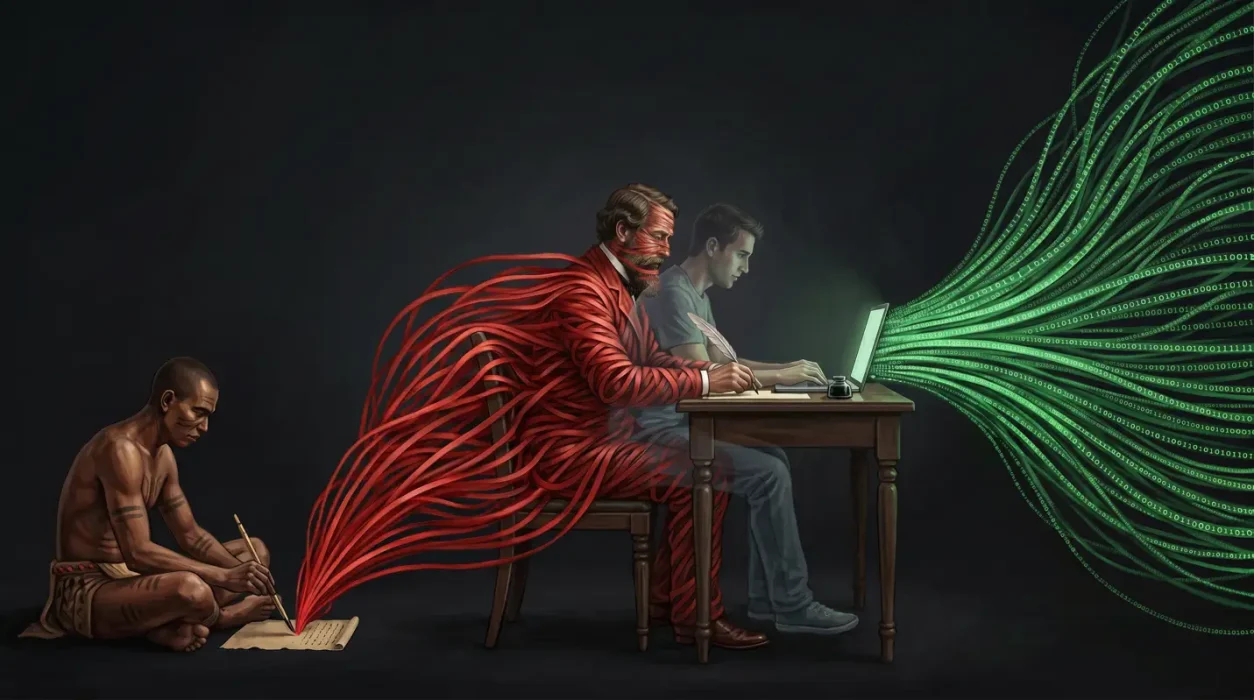
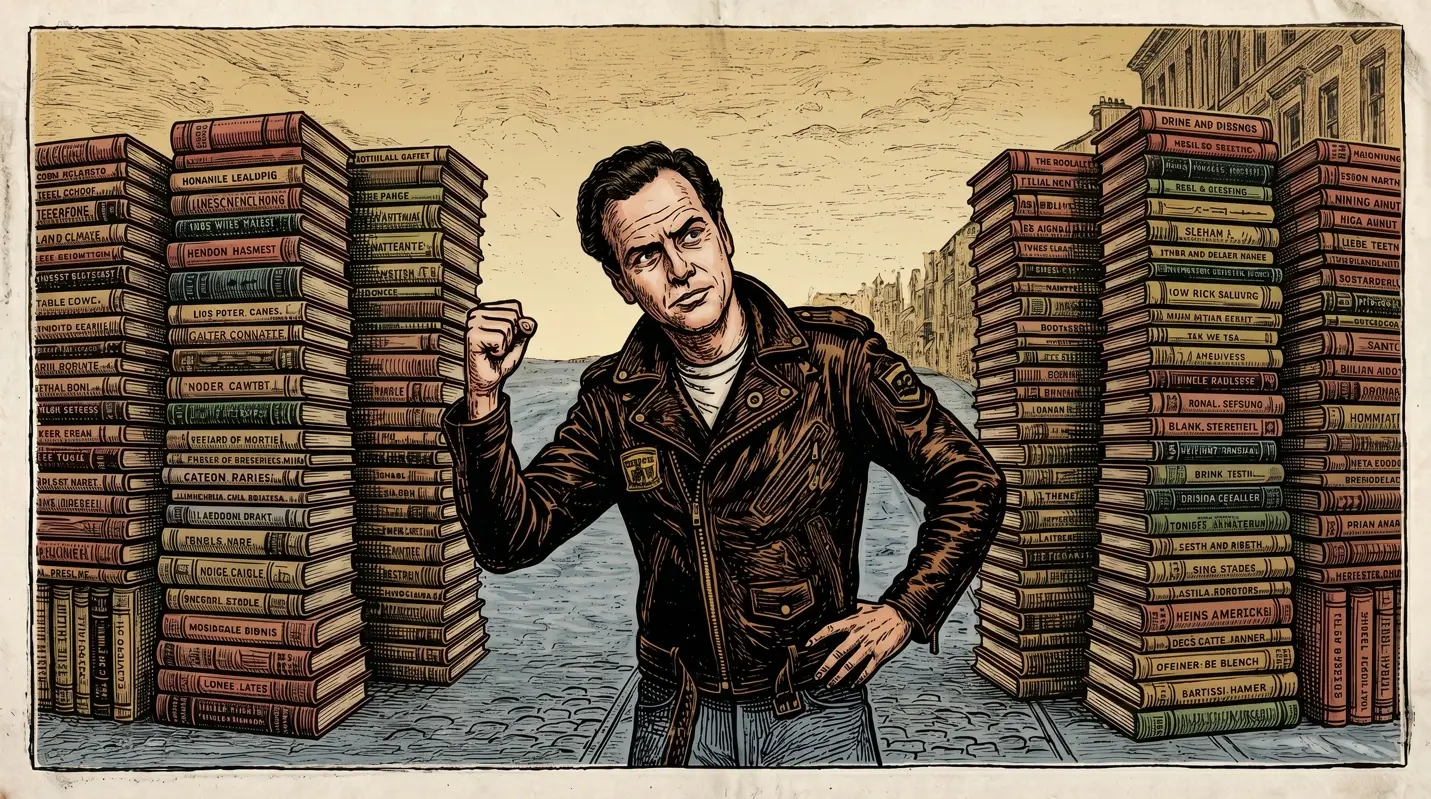
When the cinema and gramophone and radio and TV became new environmental services, the traditional book began to be read by a completely different kind of public. If Gutenberg created a new kind of human being with new perception and new outlook and new goals, the electric age of radio and video has perhaps restored a public with many of the oral habits of the pre-Gutenberg time.
“The Future of the Book” (1972), in Understanding Me, p 180
Year: 1972
A major aspect of media effects and development appears in the case of the road as a means of transportation. Like writing or radio the "content" of the read is always another medium or other media, whether pedestrians, equestrians, wagons or cars.
“General introductions to chart”, in Report on understanding new media, p 15
The principle of new technologies as an archetypal environment that moulds new art forms out of the antecedent technologies is a principle that applies to all the arts and sciences, to architecture, as much as to music, or mathematics.
“The New Media and the Arts” (1964), p 242
Year: 1964
… it would seem natural that older forms [media or technologies] are put to new uses and discover new roles. The book, for example, in our time has discovered many new functions that it never had fifty or a hundred years ago. It has become very powerfully directed toward teaching people how to learn other things besides books [e.g. how-to books], how to learn arts of many kinds. The book has taken on a vast new function as a means of informing people, directing people’s skills in many, many areas.
“The Communications Revolution” (1960), in Understanding Me (2003), p 35
Year: 1960
The content of film is a collection of media within media. The ‘message’ is all of them at once.
Counterblast, 1969, p 23
Year: 1969
Except for light, all other media come in pairs, with one acting as the "content" of the other, obscuring the operation of both.
Understanding Media (1964), MIT/Routledge edition, p 52
Year: 1964
Gramophone and movies were merely the mechanization of speech and gesture. But the radio and TV were not just the electronification of speech and gesture but the electronification of the entire range of human personal expressiveness. With electronification the flow is taken out of the wire and into the vacuum tube circuit, which confers freedom and flexibility such as are in metaphor and in words themselves.
“A Historical Approach to the Media” (1955), reprinted in reprinted from Teachers College Record, Vol 57, No. 2, November 1955, p 109-110
Year: 1955
Chapter:
Electric, Electronic
The content of writing is speech, just as the written word is the content of print, and print is the content of the telegraph.
Understanding Media (1964), MIT/Routledge edition, p 8
Year: 1964
What has happened to the movie since television is better known than what happened to the book after the newspaper, to the book after movies, radio or TV… and if studied not as a change in our view of the movies but as a change in the uses and forms of the movie, much can be learned about the movie, and about television and movie at the same time….
The Medium Is the Message (1960), p 22
Year: 1960
Chapter:
Media Literacy
But in the case of environments that are created by new technologies, while they are quite invisible in themselves, they do tend to make visible the old environments. We can always see the Emperor's old clothes, but not his new ones.
The Medium Is the Message, (1960), p 163
Year: 1960
Chapter:
Environment
“The medium is the message” is a phrase that came to me during a conference of radio broadcasters in Vancouver in 1959. TV was threatening the radio world at that time and I wished merely to draw attention to the fact that each medium created its own public and set up a unique equilibrium in its users. The idea that there could be an equilibrium or “homeostasis” among the components of any living system, individual or corporate, stems from the work of Claude Bernard in the middle of the nineteenth century. Taken in a psychological or social context, any new component distorts the balance of the entire system by requiring some kind of partial compensation for the new factor. Gestalt or figure-ground considerations are natural accompaniments of any equilibrium theory, and in the phrase “the medium is the message” there is an interplay of figure and ground in that the “medium” can be figure and the “message” can be ground, or vice versa. To illustrate, the motor car is ground for the figure of the driver, but the same car is figure against the ground of the highway and the basic services of industry and fuel which sustain the car as a social fact.
Untitled one-page typescript on the origin of the phrase, “The medium is the message,” 1973
Year: 1973
Like the typewriter, the telephone fuses functions, enabling the call-girl, for example, to be her own procurer and madam. The call-girl dispenses with the procurer and the madam.
Understanding Media (1964), MIT/Routledge edition, p 263
Year: 1964
An army needs more typewriters than medium and light artillery pieces, even in the field, suggesting that the typewriter now fuses the functions of the pen and sword.
Understanding Media (1964), MIT/Routledge edition, p 260
Year: 1964
Chapter:
Typewriter
The typewriter fuses composition and publication, causing an entirely new attitude to the written and printed word. Composing on the typewriter has altered the forms of the language and literature.
“A Discussion About Typewriters” (1974), pp 45-6
Year: 1974
Chapter:
Typewriter
The very nature of the telephone, as all electric media, is to compress and unify that which had previously been divided and specialized.
Understanding Media, 1964, MIT/Routledge, p 225
Year: 1964
[F.D.R.] was at great pains to use an unfavorable press to enhance his radio image. The art of politics today requires an orchestral use of the varied instruments of public communication. These instruments do not exist or function in isolation from one another any more than do our senses function in isolation.
Public and Private Sectors in the Elec. Age, (1964), p 5
Year: 1964
…the art of politics today requires an orchestral use of the varied instruments of public communication.
“Public and Private Sectors in the Electronic Age” (1964), p 5
Year: 1964
The Negro created a music based on language (" jaser" -- New Orleans for "to yatter") that was totally involving of all the senses. We still talk ineptly about "Negro integration,'' ignoring the fact that the Negro integrated all the countries of the world in the l920's. That integration still holds.
“Pound, Playboy of...” (1967), p 6
Year: 1967
But whereas the age of photo, radio and movie was the period of fission in media and marketing, with TV we now move into the age of fusion The message of TV is of interfusion, implosion, and integral effort.
Amer Marketing Assoc. speech, 1961, p 6
Year: 1961
Let us now note a few of the effects of media hybrids, or of the interpenetration of one medium by another.
Understanding Media (1964), MIT/Routledge edition, p 51
Year: 1964
The hybrid or the meeting of two media is a moment of truth and revelation from which new form is born.
Understanding Media (1964), MIT/Routledge edition, p 55
Year: 1964
Letters had been codified as dots for the fingers long before the Morse Code was developed for telegraph use. And it is relevant to note how electric technology, in like manner, had converged on the world of speech and language, from the beginning of electricity. That which had been the first great extension of our central nervous system—the mass media of the spoken word—was soon wedded to the second great extension of the central nervous system—electric technology.
Understanding Media (1964), MIT/Routledge edition, p 269
Year: 1964
This hybridizing, this crossing of one technology with another, goes on all the time. The internal combustion engine was a wedding of the old machine and the electric circuit. Perhaps the most startling and most upsetting electric innovation is coming in the matter of xerox and xerograph.
“The Invisible Environment: The Future of an Erosion”, Perspecta, Vol.11, (1967), p 166, reprinted in On the Nature of Media, (2016), p 118
Year: 1967
One of the most common causes of breaks in any system is the cross-fertilization with another system, such as happened to print with the steam press, or with radio and movies (that yielded the talkies).
Understanding Media (1964), MIT/Routledge edition, p 39
Year: 1964
The telegraph is an electric form that, when crossed with print and rotary presses, yields the modern newspaper.
Understanding Media (1964), MIT/Routledge edition, p 194
Year: 1964
Since all media are fragments of ourselves extended into the public domain, the action upon us of any one medium tends to bring the other senses into play in a new relation.
Understanding Media (1964), MIT/Routledge edition, pp 266-267
Year: 1964
And the photograph is not a machine, but a chemical and light process that, crossed with the machine, yields the movie.
Understanding Media (1964), MIT/Routledge edition, p 194
Year: 1964
With the telegraph and after we enter the world of interdependence and inter-action, in which no medium has its meaning alone and no product or advertisement has its meaning or use by itself
American Marketing Association speech, 1961, published transcript, p 7
Year: 1961
Chapter:
Telephone
Motion pictures are a blend of Euclidean and acoustic thinking, the mechanical and the electrical…”
“Conversation with Bruce Powers”, The Global Village with Bruce Powers, p 134
Dickens, by using the newspaper as the content of the older novel form, created a new hybrid of great power. As usual, when the new medium swallowed an older one, conventional taste protested that vulgarization had occurred.
“The New Media and the Arts” (1964), p 241
Year: 1964
In much the same way, the Braille system of dots-for-letters had begun as a means of reading military messages in darkness, then was transferred to music, and finally to reading for the blind.
Understanding Media (1964), MIT/Routledge edition, p 269
Year: 1964
The crossings or hybridization of the media release great new force and energy as by fission or fusion…
Understanding Media (1964), MIT/Routledge edition, p 48
Year: 1964
Of all the great hybrid unions that breed furious release of energy and change, there is none to surpass the meeting of literate and oral cultures. The giving of man of an eye for an ear by phonetic literacy is, socially and politically, probably the most radical explosion that can occur in any social structure. This explosion of the eye, frequently repeated in “backward areas", we call Westernization. With literature now about to hybridize the cultures of the Chinese, the Indians, and the Africans, we are about to experience such a release of human power and aggressive violence as makes the previous history of phonetic alphabet technology seem quite tame.
Understanding Media (1964), MIT/Routledge edition, pp 49-50
Year: 1964
However, the credit card can be hybridized with other technologies like that of the computer, which, in turn, gives to credit fantastic dimensions such as the change of form and function with the coming of telegraph services and the “wired planet.”
“Predicting 1983 and the Fourth World,” in Man and the Future of Organizations, Franklin Foundation Lecture Series, Volume 5, 1975, p 19
Year: 1983
The electric typewriter is a contradiction in terms. It is a hybrid of the fragmentary and the integral. Our world is filled with such hybrids. The internal combustion engine is such a hybrid.
Letter to Ursula Cliff of Dot Matrix, 20 April 1964 [LAC]
Year: 1964
The detective story in which the characters do not have cartoon-like bounding lines, but are given the realistic treatment of a conventional novel, is a very strange hybrid.
From Cliché to Archetype, with Wilfred Watson 1970, p 89
Year: 1970
When media act together they can so change our consciousness as to create whole new universes of psychic meaning.
The Global Village, with Bruce Powers, 1989, p 87
Year: 1989
Today, with the cinema and the electric speed-up of information movement, the formal structure of the printed word, as of mechanism in general, stands forth like a branch washed up on the beach. A new medium is never an addition to an old one, nor does it leave the old one in peace. It never ceases to oppress the older media until it finds new shapes and positions for them.
Understanding Media (1964), MIT/Routledge edition, p 174
Year: 1964
It can be enunciated as a principle that all new media or technologies, whatever, create new environments, psychic and social, that assume as their natural content the earlier technologies. Moreover, the content of these new environments undergoes a progressive reshaping so that what had appeared earlier as dishevelled and degraded becomes conventionalized into an artistic genre. TV, as the latest archetypal environment or technology, is very much in this dishevelled phase.
“The New Media and the Arts” (1964), p 242
Year: 1964
One of the many effects of television on radio has been to shift radio from an entertainment medium into a kind of nervous information system. News bulletins, time signals, traffic data, and, above all, weather reports now serve to enhance the native power of radio to involve people in one another
Understanding Media, 1964, MIT/Routledge, p 298
Year: 1964
And we have seen how the news reporter linking the printed page to the telephone and the telegraph created a unified corporate image out of the fragmented government departments.
Understanding Media, 1964, MIT/Routledge, p 271
Year: 1964
A major aspect of media effects and development appears in the case of the road as a means of transportation. Like writing or radio the "content" of the read is always another medium or other media, whether pedestrians, equestrians, wagens or cars.
“General introductions to chart”, in Report on understanding new media, p 15
Except for light, all other media come in pairs, with one acting as the "content" of the other, obscuring the operation of both.
Understanding Media (1964), MIT/Routledge edition, p 52
Year: 1964
The content of writing is speech, just as the written word is the content of print, and print is the content of the telegraph.
Understanding Media (1964), MIT/Routledge edition, p 8
Year: 1964
Disneyland is itself a wondrous media mix. His cartoons drove the photo back to myth and dream screen. E.S. Carpenter, in his review of The Disney Version (Richard Schickel, Simon and Schuster), points to another media mix in Disney's life: "The only splash of color in Disney's private life was a model train that circled his home....Much of his social life consisted of donning an engineer's cap....He enjoyed planning wrecks....'Boy, we're sure going to have some wrecks now!"
Culture Is Our Business (1970), p 206
Year: 1970
The pains that F.D.R. spent on adjusting his image for a radio audience were not misspent. He understood that the radio medium put ht President in an entirely new relation to the governed – a relation quite different from that created by the press. Indeed, he was at great paints to use an unfavourable press to enhance his radio image.
‘”Public and Private Sectors in the Electronic Age,” 1964, p 5
Year: 1964
Chapters:
Politics and Government | Radio
With the telegraph and after we enter the world of interdependence and inter-action, in which no medium has its meaning alone and no product or advertisement has its meaning or use by itself.
American Marketing Association speech, 1961, typescript p 7
Year: 1961
Chapter:
Telephone
If you wanted to study radio as a medium in its impact on society, you would do well to look at what happens to radio in a movie. What use is there made of radio in the movie, because the form is then translated into another medium and some of its characteristics are high-lighted. What happens to a telephone in a Broadway play? What use is there made of telephone in drama which tells you a lot about the telephone?
“The Electronic Revolution in North America”, 1959, p 10
Year: 1959
Chapters:
Questions He Asks | Radio
Radio, when it uses telephone as I understand it does a great deal locally, is reverting to a primitive form of radio… To use telephone or wire, and feed it through the radio channel is to create an impurity – a very effective one – let’s say a hybrid, and a very powerful hybrid I think it is.
“The Electronic Revolution in North America,” 1959, p 10
Year: 1959
Dickens, by using the newspaper as the content of the older novel form, created a new hybrid of great power. As usual, when the new medium swallowed an older one, conventional taste protested that vulgarization had occurred. Paradoxically, Dickens, by pushing the camera eye to a point of high fidelity, broke out of the domain of perspective and moved back into the highly tactual and iconic world of surrealism and modern art.
“The New Media and the Arts”, 1964, p 241
Year: 1964
A new medium is never an addition to an old one, nor does it leave the old one in peace. It never ceases to oppress the older media until it finds new shapes and positions for them.
Understanding Media, 1964, MIT/Routledge edition, p 174
Year: 1964
Chapter:
Media Study