Viewing chapter Media Study (72 quotes)
What happened to the book after the newspaper? To the book after the movie? To the book after radio and television? Nobody seems to know.
The Medium Is the Message, (1960), in McLuhan Unbound #17, (2017), p 14
Year: 1960
Chapter:
Questions He Asks
It is wise to withhold all value judgments when studying these media matters, since their effects are not capable of being isolated.
Understanding Media (1964), MIT/ROUTLEDGE edition, p 315
Year: 1964
Chapters:
Advice | Values & Value Judgments
In fact, Finnegans Wake is the greatest guide to media ever devised on this planet, and is a tremendous study of the action of all media upon the human psyche and sensorium. It’s difficult to read but it’s worth it.
“Open Mind Surgery,” Lecture at Fordham University (1967), in Understanding Me (2003), p 132
Year: 1967
All of my recommendations, therefore, can be reduced to this one: study the modes of the media, in order to hoick all assumptions out of the subliminal, non-verbal realm for scrutiny and for prediction and control of human purposes. Such a program can most readily be instituted today at the level of secondary education.
Recommendations, in NAEB Report on Understanding New Media, June (1960) p 3
Year: 1960
It's misleading to assume there is any basic difference between education and entertainment. This distinction merely relieves people of the responsibility of looking into the matter.
��Classroom without walls”, in Explorations in communication. An anthology with Edmund Carpenter (1960), p 3
Year: 1960
Chapters:
Education | McLuhanisms & Zingers
The “content” approach to media and to the testing of media efficacy in teaching and in public relations and politics is, I am reasonably satisfied, derivative from the habit of literacy itself. We would not talk about the “content” of a tune or a melody. But as soon as man learned how to encode the audible in visible terns (writing) he easily began to make divisions between ”form” and “content,” and between thought and feeling, individual and state, and so on. Insofar as these separations correspond to real modes of being we should try to retain them. Insofar as they are fictions and illusions fostered by the subliminal action of media, they need to be considered and criticised with a view to their permanent value. Perhaps we shall learn to cherish some of the fruits of literacy as we might do with precious artifacts of vanished societies. Whether it be possible to retain the fruits of literacy without the soil and tree of literacy would appear to be the test we are now undergoing in the Western world. Certainly we shall learn many new aspects of literacy as we study its intact on the ancient cultures of India and China. For literacy in the West did not slice into ancient civilizations, but struck into tribal societies which wilted under its impact.
Speech to the NAEB, Sept. 23, 1959, reprinted in Cameron McEwen’s blog, McLuhan’s New Sciences.
Year: 1959
This raises a major issue for us all to study: Namely, when does a mechanical code of transmission of information itself become a language? Under what conditions does a language revert to a code of transmission? With our new coding devices today such as movies and TV, tapes, discs, radio, teletype and so on, we are setting about to establish whether these means of transmission have themselves so deeply altered human sensibilities and re-shaped human institutions and attitudes as to have acquired the status of new languages.
Speech to the NAEB, Sept. 23, 1959, reprinted in Cameron McEwen’s blog, McLuhan’s New Sciences.
Year: 1959
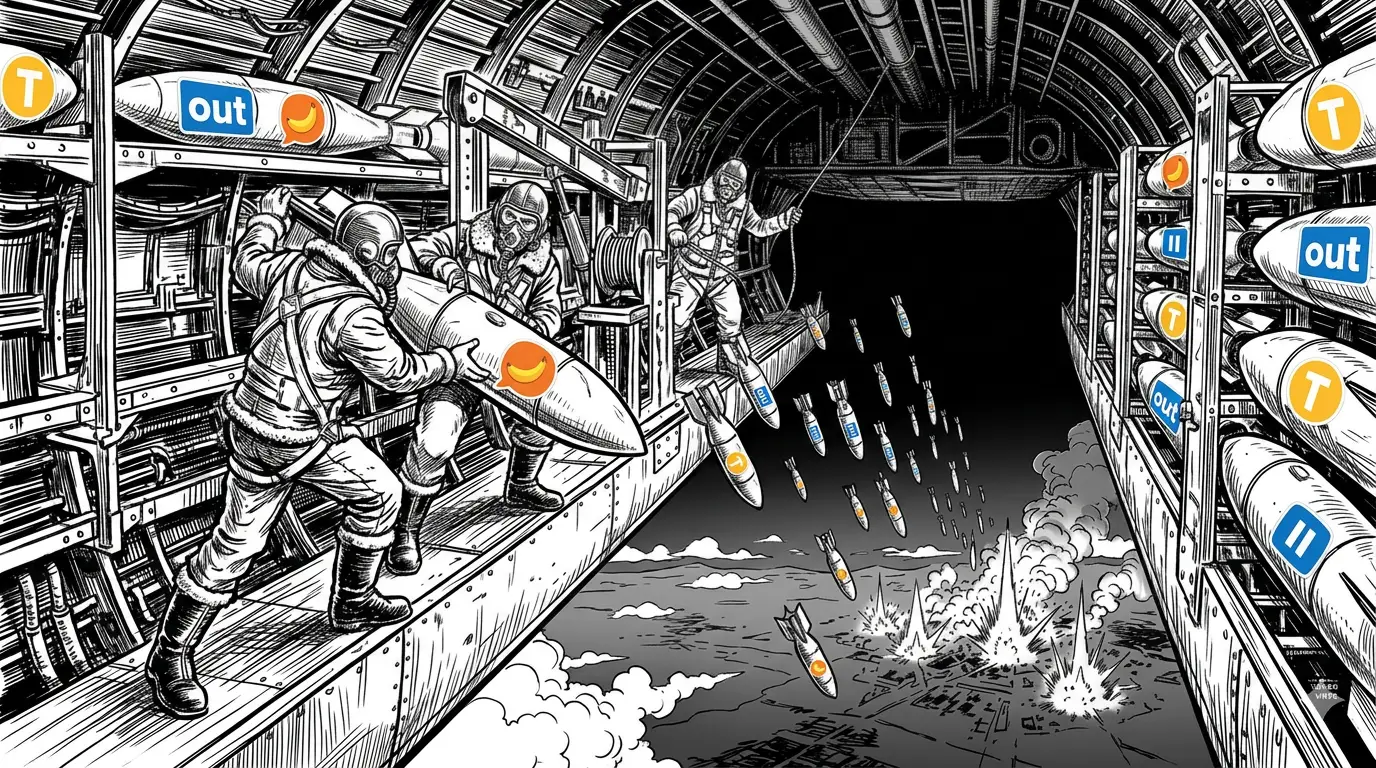
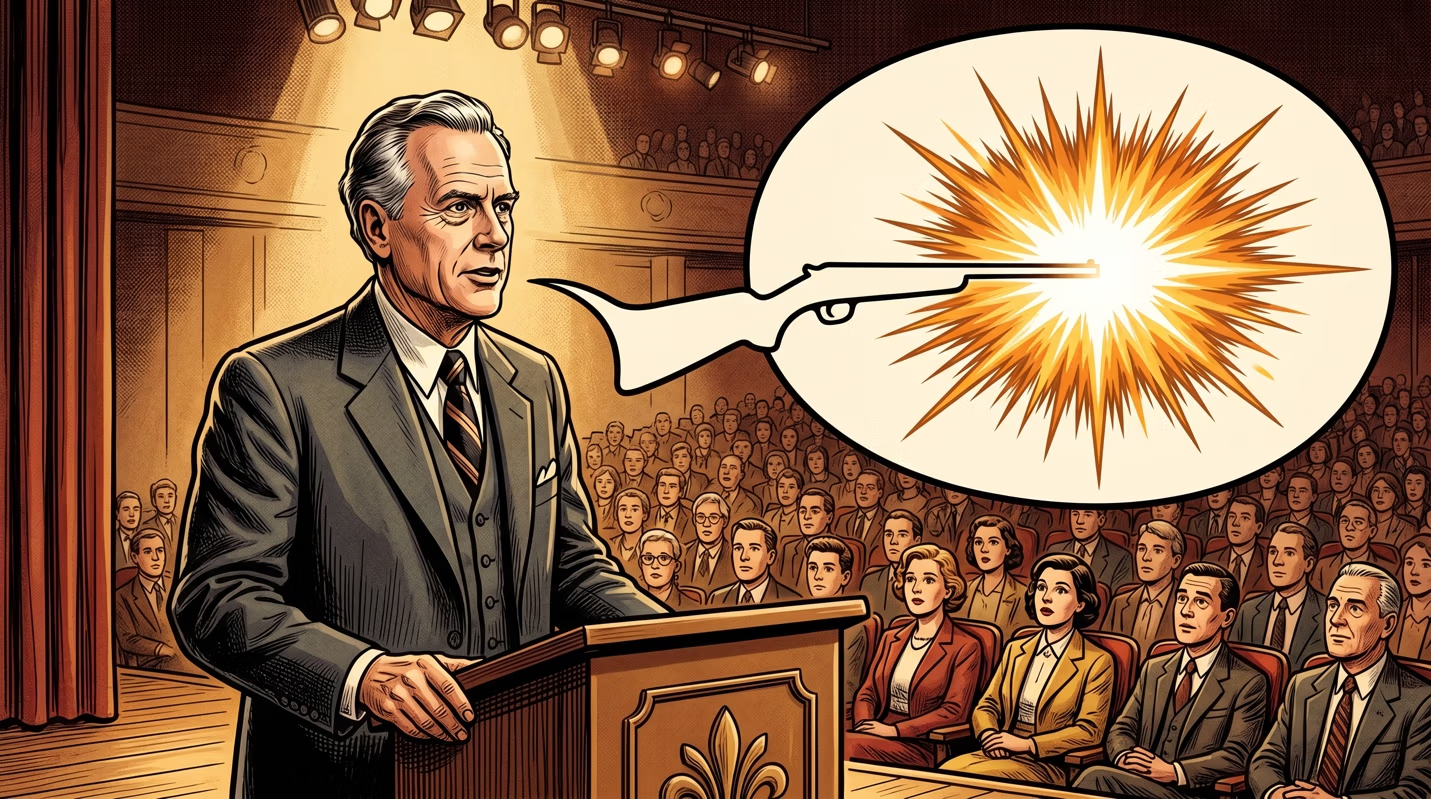
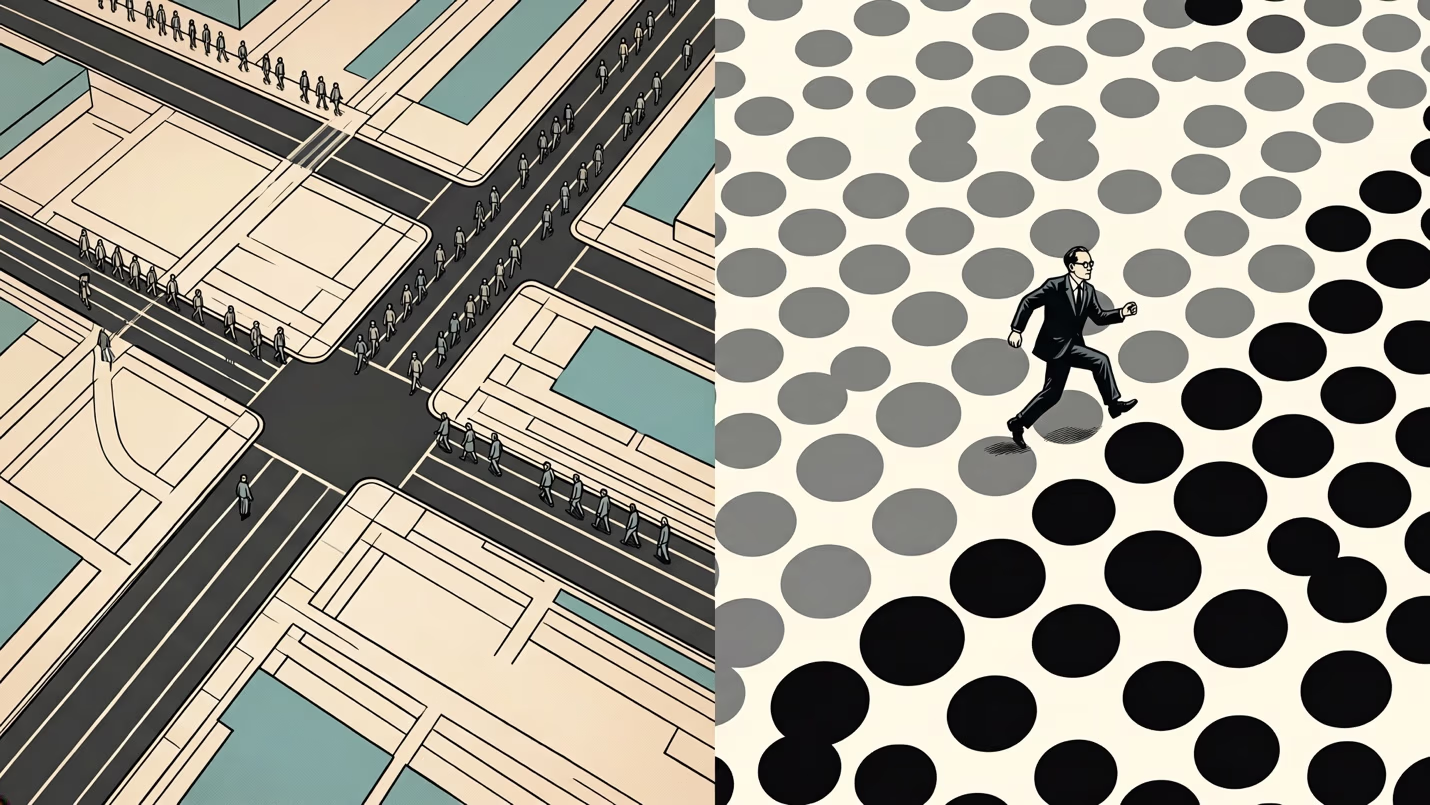
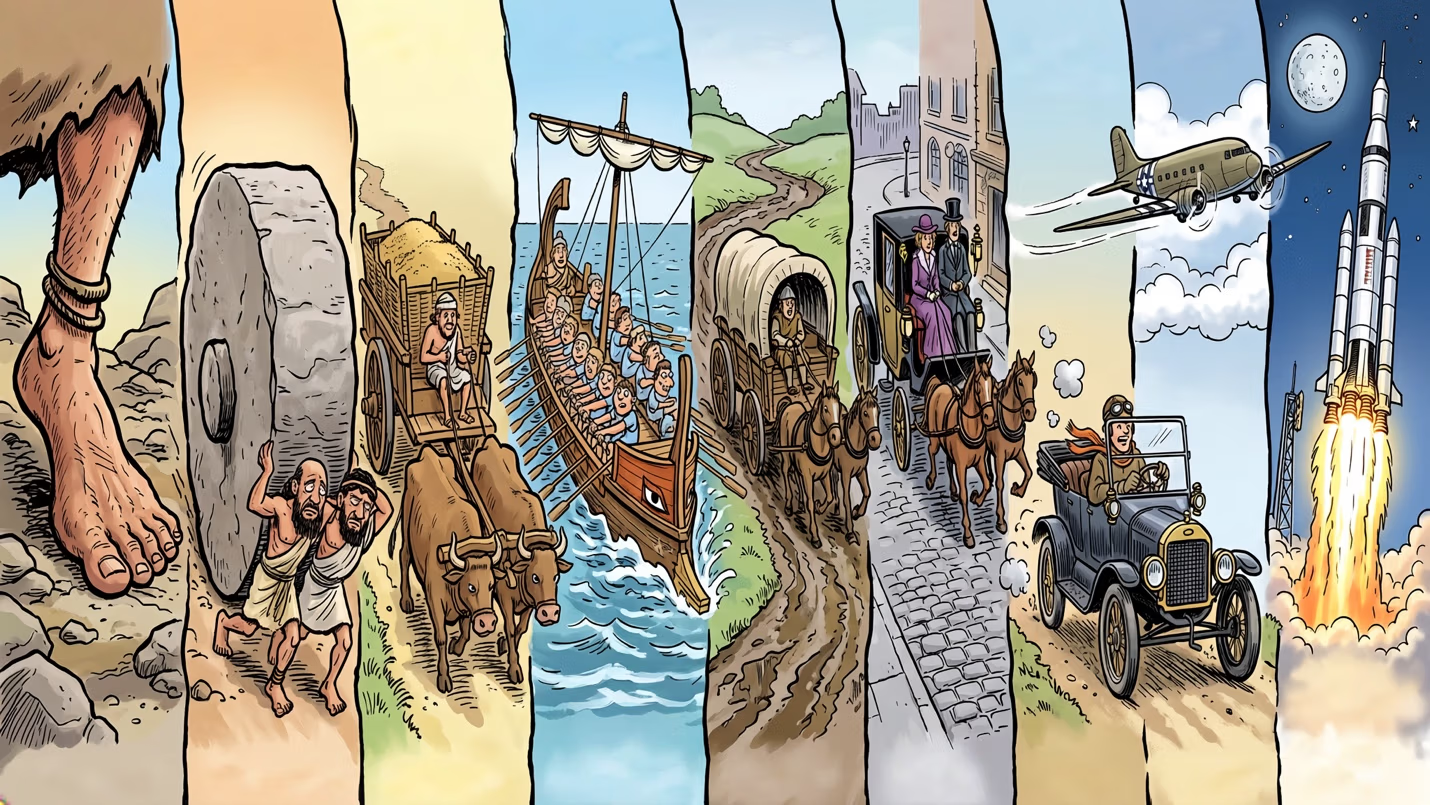
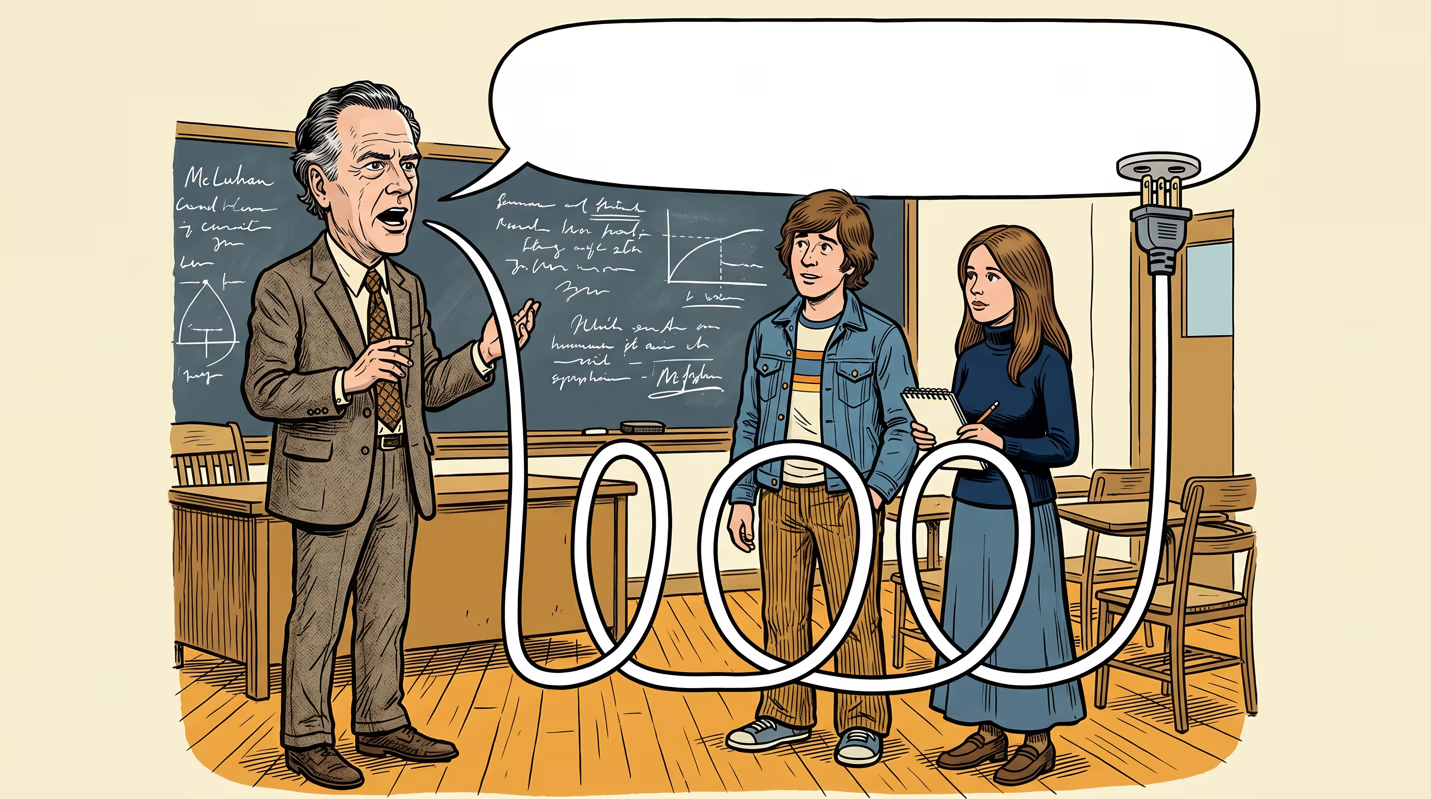

Radio and TV aren’t audio-visual aids to enhance or to popularize previous forms of experience. They are new languages. We must first master and then teach these new languages in all their minute particularity and riches. In so doing we have available on an unprecedented scale the resources of comparison and contrst. We can compare the same play or novel or poem or news story as it’s changed artistically in passing onto the movie form, the stage, the radio and TV. We can note the precise qualities of each medium, as we would compare the the various degrees of effectiveness of a thought in Greek or French or English. This is what the young are doing sloppily and helplessly outside the classroom every day. This holds their attention automatically as the classroom does not.
“The Post-Literate Man”, 1973, Cycle 7: Essays, Short Stories, Poems for Freshman English, ed. by James Burl Hogins and Robert Earl Yaber, p 231
Year: 1973
Chapter:
Education
A primary method for studying the effects of anything is simply to imagine ourselves as suddenly deprived of them. If students were to interview physically deprived people about the effects of living in a world which has no place for a paraplegic, or a blind man, they would quickly apprehend the menace of our man-made service environment. They would soon discover that it is we ourselves who serve these environments.
“English Literature as Control Tower” (1974), p 6
Year: 1974
Chapters:
Services, Disservices | Tools We Shape, Reshape Us
But our schools have not accepted the challenge of teaching the new media as new languages, and so we do not speak these new languages, even though we can discern some of their meaning.
“What the Mass Media Mean for Teachers of English,” Address to the 45th Convention of the National Council of Teachers of English, 24, November. 7, 1955, p 7
Year: 1955
Chapter:
Teaching
We must first master and then teach these new languages in all their minute particularity and riches. In so doing we have available on an unprecedented scale the resources of comparison and contrast.
“Educational Effects of Mass Media of Communication” (1956), p 403
Year: 1956
Chapters:
Electric, Electronic | Teaching
We must maximize rather than minimize the various features of our new media. It’s easy now to see that they are not mere vehicles for already achieved experience and insight. We have move far beyond mechanization. Let us not lose ourselves by supposing that we have merely to contend with new forms of mechanization. Ratio and TV aren’t new ways of handling manuscript and book culture. The motor-car wasn’t a substitute for hte horse. It did what the horse could never do. Radio and TV aren’t audio-visual aids to enhance or to popularize previous forms of experience. They are new languages. We must first master and then teach these new languages in all their minute particularity and riches.
“The Post-Literate Man”, 1973, Cycles 7, p 231
Year: 1973
Would it not seem natural and necessary that the young be provided with at least as much training of perception in this graphic and photographic world as they get in the typographic? In fact, they need more training in graphics, because the art of casting and arranging actors in ads is both complex and forcefully insidious.
Understanding Media, 1964, MIT/Routledge edition, p 230
Year: 1964
If thirty years ago Mr. T. S. Eliot could modestly suggest that the internal combustion engine had modified the general ear for speech and rhythm, it is now obvious that the entire learning process has been changed by allied development.
“The Later Innis" Queen's Quarterly, Vol. 60, No 3, Autumn (1953), p 388, reprinted in On the Nature of Media (2016), p 42
Year: 1953
There does exist, then, a two-way bridge between the traditional and technological worlds which are at war in Western culture. But it has been officially ignored or condemned. To travel this bridge requires of the traveler an acquaintance with the language and techniques of poetry on the one hand, and of the language and techniques of painting, architecture, and the visual world on the other. Few are prepared to acquire both languages and so the war between these worlds continues, waged witlessly in classroom.
“Space, Time and Poetry”, in Explorations 4, (1955), p 60, (2016) reprint, p 55, reprinted as McLuhan Unbound #13, (2017), p 11
Year: 1955
[Of his book The Mechanical Bride] Where visual symbols [in ads] have been employed in an effort to paralyze the mind, they are here used as a method of energizing it.
The Mecahnical Bride, 1951, p v
Year: 1951
Media study has lagged behind all other fields in this century, even behind economics.
Purpose of Project 69, in NAEB Report on Understanding New Media, June (1960), p 4
Year: 1960
Such new environments, that all of us react to with the precision of marionettes, turn whole populations into servo-mechanisms. Much as the canoe paddler adopts a necessary posture and relation to his vehicle or physical extension, so does the manager of Macy's or the technician of a warning system.
“Art as Anti-Environment” (1965), pp 2-3
Year: 1965
Chapters:
Extension Theory | Tools We Shape, Reshape Us
I think that if we are to have a constitutional order and balance among these new oligarchs [new media], we shall have to study their configurations, their psychodynamics, and their long-term messages. To treat them as humble servants (audiovisual aids) of our established conventions would be as fatal as to use an X-ray unit as a space heater.
“Electronic Revolution: Revolutionary Effects of New Media”, (1959), speech reprinted in Understanding Me: Lectures and Interviews, (2003), p 4
Year: 1959
Chapter:
Balance
By contrast, does a form of writing that favors attention to one-thing-at-a-time foster instability and change?
Projects and Questions, Writing, in NAEB Report on Understanding New Media, June (1960), p 40
Year: 1960
Chapter:
Questions He Asks
The basic mode of research in physics is to bombard nuclei of unknown structure by nuclei of known structure. How does this parallel the study of languages and media by translation?
Phonograph (Chart), in NAEB Report on Understanding New Media, June (1960), p 111
Year: 1960
Radio created Hitler as a delinquent Peter Pan, charged with cosmic emanation. Would not a high degree of awareness of these media effects (e.g. radio in Nigeria or in any tribal territory) enable us to set up social therapies and immunizing programs exactly comparable to medical action in the face of an endemic disease?
“To Pierre Elliott Trudeau (1968)”, in Letters of McLuhan, p 353
Year: 1968
[We must] develop an awareness about print and the newest technologies of communication so that we can orchestrate them, minimize their mutual frustrations, and get the best out of each in the educational process.
“Alone in the Global Village,” Peterborough Examiner, March 22, 1967
Year: 1967
Chapters:
Advice | Mastering Technology
Up until now, media studies have been concerned with programming and content, rather than with the effects of the media themselves on the social and psychic make-up of their users. The recent awareness of the twin hemispheres of man’s brain has also drawn attention to the fact that the dominance of one or the other of these hemispheres depends upon the man-made environments to which they respond. Julian Jaynes attributes the rise of private consciousness and human individuality to the coming of the literate environment which broke down the tribal or bicameral unity of the two hemispheres of the brain. Today the split between the hemispheres is being mended by the new simultaneous environment of electric information. Nuclear man may be on the verge of abandoning his civilized institutions and their function in providing guidelines, goals and objectives. Now is the time to examine sociologically the peculiar and unique impact of the numerous extensions of our own bodies and nervous system.
The sociological approach to the human environment began with Sputnik in 1957. So far, society has meant hardware, and supplies, and quanitification of things and people. Now the time is ripe to scan the software environment, the planetary surround of electric information and its effects on the diverse populations of the globe.
“When the West Goes East and the East Goes West,” unpublished one page typescript dated January 6, 1977.
Year: 1977
You cannot tell what it [any innovation and the environment it creates] is until you have seen it do things to the old one.
“The Invisible Environment: The Future of an Erosion”, Perspecta, Vol.11, (1967), p 166, reprinted in On the Nature of Media, (2016), p 119
Year: 1967
There is nothing new or strange in a parochial preference for those pseudo-events that happened to enter into the composition of society just before the electric revolution of this century. The student of media soon comes to expect the new media of any period whatever to be classed as pseudo by those who have acquired the patterns of earlier media, whatever they may happen to be.
Understanding Media, 1964, MIT/Routledge, p 199
Year: 1964
Understanding several media simultaneously is the best way of approaching any one of them.
Letter to Bruce Mickleburgh, editor, Monday Morning, March 2, 1970
Year: 1970
The “content” approach to the media has real meaning for the newspaper as a medium. Its relevance outside the newspaper, for radio or movie or TV, is very small.
“Media Log II,” p 4 , (1959), located among correspondence with the National Association of Broadcasters on the topic of Project in Understanding New Media) Jan-June ,(1959), p 224 quoted in a footnote in The Letters of Marshall McLuhan (1987), p 267
Year: 1959
Nothing has its meaning alone. Every figure must have its ground or environment. A single word, divorced from its linguistic ground, would be useless. A note in isolation is not music. Consciousness is corporate action involving all the senses (Latin sensus communis or "common sense" is the translation of all the senses into each other). The "meaning of meaning" is relationship. When young activists harp on "relevance," they are asking for interface or the abrasion of dialogue; they are ECO-sounding to discover where it's at.
Take Today with Barrington Nevitt (1972), p 3
Year: 1972
MCMANUS: What now briefly is this thing called media ecology?
MCLUHAN: It means arranging various media to help each other so they won’t cancel each other out, to buttress one medium with another. You might say, for example, that radio is a bigger help to literacy than television, but television might be a very wonderful aid to teaching languages. So, you can do some things on some media that you cannot do on others. Therefore, if you watch the whole field, you can prevent this waste that comes by one cancelling out the other.
MCMANUS: But do you think that perhaps at the end of your studies of media ecology, you're going to advise a cut-down on watching television? $500 for anyone who will give it up for a day?
MCLUHAN: Europeans have cut back on that almost down to nothing long ago because they realized that it threatened literate values very much. An hour a week is about what the French child gets for television.
Mike McManus TVO interview, 1977, transcript 17:57. Also in Understanding Me (2003), p 275
Year: 1977
Chapter:
Ecology
Media are always and necessarily corporate or group activities, whether they are the mother tongues or the father images of big corporations. With the proliferation of multi-media in our time, there is a new consensus that some manner of media ecology , a control be put into action; but against proposal there is a negative and factor in the Western world.
“The Violence of the Media”, 1976, Canadian Forum, p 9; reprinted in MM: The Man and His Message (1989), p ??
Year: 1976
Chapter:
Ecology
With the proliferation of multimedia in our time, there is a new consensus that some manner of media ecology and control be put into action; but against this proposal there is a negative and hidden factor in the Western world. Edward Hall, the anthropologist, has drawn attention to this negative attitude in the Western world in a recent study, The Fourth Dimension in Architecture: The Impact of Building on Man s Behavior.
“Violence in the Media” (1976),”, 1976, Canadian Forum, p 9; reprinted in MM: The Man and His Message (1989), p 92
Year: 1976
Chapter:
Ecology
We now have to confront the need for an ecology of media themselves. It’s not just raw materials but the manmade materials too that now have to be harmonized and resolved in their interaction. Tony Schwartz, in his book “The Responsive Chord”, explains this very tricky problem about television as a new environmental medium, by saying that the TV image uses the eye as an ear”
LIVING IN AN ACOUSTIC WORLD, SPEECH AT UNIVERSITY OF SOUTH FLORIDA. 1974, transcript, 50.01 and forward
Year: 1974
Is it not strange that rationalism hasn’t been applied to commonplaces of daily life?
His pitch, in the late 1940s, to publishers to sell the manuscript that became The Mechanical Bride, quoted in Gordon, MM: Escape into Understanding, 1997, p 139
Year: 1940
You can never perceive the impact of any new technology directly, but it can be done in the manner of Perseus looking in the mirror at Medusa. It has to be done indirectly.
Address at Vision '65, The American Scholar, Spring, 1966, p 202
Year: 1966
Chapters:
Environment | Rear View Mirror
In the same way, if you wanted to check the effects of automation, you do an inventory of all the types of changes -- not what automation is being set to do. You would never find out anything about automation by looking at what it has been asked to do, card catalogues and such, always the old job, never the new job. You would find out what automation was by checking the effects of automation on the outlook of people, on their relation to work organization and decision making, because in effect automation is an acceleration, a speedup of information processes, and speedup completely alters pattern recognition, completely alters the ways in which we cope with their own lives.
Interview by Eric F. Goldman for "The Open Mind," WNBC Television, March 1966 , p 10 of transcript
Year: 1966
Chapters:
Innovation | Pattern Recognition
The message is the effect of interplay between the user and whatever extension of himself is in play. Clothing is obvious as a ground for these figures. Monarchy or a movie star is less obvious as a service environment. A reading public as a service environment created by a writer or an entertainer is even less obvious as message.
IF figure and ground relationship are carefully heeded, no confusion need arise.
“Bull’s Eye, Cow’s Eye”, 1971 broadsheet, typescript
“Bull’s Eye, Cow’s Eye”, 1971 broadsheet, typescript
Year: 1971
Chapter:
User as Content
Usually, 'media study' (and equally, promotion) covers only the first two aspects, enhancement and obsolescence, and these lightly.
Laws of Media, with Eric McLuhan, 1988, p 99
Year: 1988
“The illusion" of content likewise siphons off all attention from the forms and effects of the media
NAEB Report on Understanding New Media, 1960, p 14
Year: 1960
As mechanical media have popularized and enforced the presence of the arts on all people it becomes more and more necessary to make studies of the function and effect of communication on society.
Letter to Harold Adams lnnis, March 14, 1951, in Letters of Marshall McLuhan, 1987, p 222
Year: 1951
Studying the future helps us toward understanding of the present.
The future of education: The class of 1989. Marshall McLuhan and George Leonard, Look magazine, February 21, 1967.
Year: 1989
Chapters:
Future | McLuhanisms & Zingers
Since all media are extensions of ourselves, or translations of some part of us into various materials, any study of one medium helps us to understand all others. Money is no exception.
Understanding Media (1964), MIT/Routledge edition, p 139
Year: 1964
Chapter:
Money
But the concentric with its endless intersection of planes is necessary for insight. In fact, it is the technique of insight, and as such is necessary for media study, since no medium has its meaning or existence alone, but only in constant interplay with other media.
Understanding Media (1964), MIT/Routledge edition, p 26
Year: 1964
For some years now I have been concerned with the Gutenberg era as a period in which the vitality of new forms spread into all phases of life and consciousness.
“Printing and Social Change”, 1959, p 5
Year: 1959
Nobody can see how new technologies metamorphose earlier ones into art forms. There is certainly no connection between these events. If there were any connection there could be no change. The action is where the gap is. It has always been thus. Change requires the resonant and abrasive interval, whether in the tragic flaw of character in the tragic hero of Aristotle, or in the chemical bond of Linus Pauling. The gap created by the complementary forms of white and colored, of affluence and poverty, of war and peace, of ignorance and knowledge, all engender the processes of change.
Letter to Editor of New Society, March 10, 1970
Year: 1970
The best way to study the nature of any medium is to study its effects on other media because you can see them spelled out there. So when you study the effect of TV on sports, then you begin to understand the nature of TV. And when you see its effects on politics, in advertising and in movies, then you begin to understand it.
Conversation with MM, 1977, p 62
Year: 1977
Chapter:
Effect
[How to study media: first step:] Make an inventory of the effects of the new thing as it encounters all the older forms of the society.
“The Future of Morality”, in The New Morality: Continuity and Discontinuity, ed. William Dunphy (New York: Herder and Herder, 1967).
Year: 1967
The history of the arts and sciences could be written in terms of the continuing process by which new technologies create new environments for old technologies.
“New Media and the Arts” (1964), p 239
Year: 1964
It is quite impossible to know the effect of writing and printing in the Western world which developed these forms. In their very growth they assume a cloak of invisibility, just as television is doing right now.
The Care And Feeding Of Communication Innovation, Conference on 8mm Sound Film and Education Dinner Speech, Teachers College Columbia University , November 8, 1961, p 2
Year: 1961
Chapter:
Environment
Any study of one medium helps us to understand all others.
Understanding Media (1964), MIT/Routledge edition, p 139
Year: 1964
You must be literate in umpteen media to be really “literate” nowadays.
Quoted in Richard Kostalonetz, “Understanding McLuhan” (In Part), 1966, typescript, p 5
Year: 1966
Chapter:
Media Education
A new medium is never an addition to an old one, nor does it leave the old one in peace. It never ceases to oppress the older media until it finds new shapes and positions for them.
Understanding Media (1964), MIT/Routledge edition, p 174
Year: 1964
Chapter:
Media Reprocess Media
And as technology increasingly undertakes to submi the entire planet as well as the contents of consciousness to the purposes of man's active intelligence it behooves us to consider the whole process of magical transformation involved in the media acutely and extensively.
“Sight, Sound and the Fury”, Commonweal, April 9, 1954, Vol. 60, No. 1, p 10. Later reprinted in Mass Culture: The Popular Arts in America,1964, pp. 489-495.
Year: 1954
You have to perceive the consequences of the new environment on the old environment before you know what the new environment is.
“The Invisible Environment: The Future of an Erosion”, Perspecta, Vol.11, (1967), p 166, reprinted in On the Nature of Media, (2016), p 119
Year: 1967
You would never find out anything about automation by looking at what it has been asked to do, card catalogues and such, always the old job, never the new job. You would find out what automation was by checking the effects of automation on the outlook of people, on their relation to work organization and decision making, because in effect [it] is acceleration.
Interview by Eric F. Goldman for "The Open Mind," WNBC Television, Harch 1966 , p 10 of transcript
Year: 1966
Chapters:
Innovation | Pattern Recognition
The hypertrophy of written messages, which has been dubbed "Parkinson's Law" by its author, would appear to be caused not by paper-shuffling and the typewriter, but by the effort of the typewriter to keep pace with the acceleration of information movement created by the telephone and electronic media.
“Effects of the Improvements of��” (1960), p 567
Year: 1960
Chapters:
Typewriter | Writing
Yet does General Motors, for example, know, or even suspect, anything about the effect of the TV image on the users of motorcars?
Understanding Media (1964), MIT/Routledge edition, p 195
Year: 1964
[The consequence of Xerox being used to make private materials public] …is that the confidential briefing is now beginning to take an oral rather than a written form. It seems useful to consider the impact of Xerox if only because it illustrates how profoundly one technology can alter traditional patterns of relation between writing and speaking.
“Do Books Matter?” (1973), p 36
Year: 1973
[As a result of TV] The hard focus photograph was changed to low definition or soft focus, and along with the change went the shift from picture story to mosaic image building. TV forced this change on Life magazine, just as it has rendered the old hot style of Time magazine obsolete.
“The Care and Feeding Of Communication Innovation”, Conference on 8mm Sound Film and Education Dinner Speech, Teachers College Columbia University, November 8, 1961, p 6
Year: 1961
At the typewriter, the poet commands the resources of the printing press. The machine is like a public-address system immediately at hand.
Understanding Media (1964), MIT/Routledge edition, p 260
Year: 1964
Chapter:
Typewriter
The alphabet was one thing when applied to clay or stone, and quite another when set down on light papyrus.
Understanding Media (1964), MIT/Routledge edition, p 143
Year: 1964
Today the decentralizing of such institutions [as department stores] into a multiplicity of small shops in shopping plazas is partly the creation of the car, partly the result of TV.
Understanding Media (1964), MIT/Routledge edition, p 200
Year: 1964
Chapter:
Centralized / Decentralized
One of the many effects of television on radio has been to shift radio from an entertainment medium into a kind of nervous information system. News vulletins, time signals, traffic data, above all weather reports, now serve to enhance the native power of radio to involve people in one another.
Understanding Media (1964), MIT/Routledge edition, p 298
Year: 1964
The effect of TV, as the most recent and spectacular electric extension of our central nervous system, is hard to grasp for various reasons. Since it has affected the totality of our lives, personal and social and political, it would be quite unrealistic to attempt a “systematic” or visual presentation of such influence. Instead, it is more feasible to “present” TV as a complex gestalt of data gathered almost at random.
Understanding Media (1964), MIT/Routledge edition, p 317
Year: 1964
Today we can test the contrast between radio and TV in a variety of ways. We have only to imagine what might be the effects of video-phone on telephone to perceive the utter diversity of these media.
“Innovation Is Obsolete”, 1971, p 49
Year: 1971
A primary method for studying the effects of anything is simply to imagine ourselves as suddenly deprived of them.
“English Literature as Control Tower”, 1974, p 6
Year: 1974
It was James Joyce in Finnegans Wake who demonstrated that the way to overcome the fear of the present is to make an inventory of all the effects of the new thing as it encounters all the older forms of the society.
“The New Morality”, 1967, p 176
Year: 1967
If you want to understand the nature of TV, you make a complete inventory of all the things that have changed in the past 12 years, in dress, in social behavior, in program tastes.
Eric Goldman TV interview, 1966
Year: 1966
Technology cannot bring in the century of the common man. It can merely reduce man to his lowest common denominator as a consuming animal. If technology is to minister to free men, men must struggle to acquire the practical disciplines related to speech as they have never struggled before. For in acquiring excellent speech men acquire the heritage of our entire civilization.
“Education of Free Men: The Liberal Arts” (1943), p 49
Year: 1943
“With the proliferation of multimedia in our time, there is a new consensus that some manner of media ecology and control be put into action; but against this proposal there is a negative and hidden factor in the stem world. Edward Hall, the anthropologist, has drawn attention to this negative attitude in the Western world in a recent study, The Fourth Dimension in Architecture: The Impact of Building on Man´s Behavior.
“Violence of the Media” (1976), in The Man and His Message (1989), p 92
Year: 1976
Chapter:
Ecology
As for restricting the use of TV. it surely should be part of a media ecology program. If people became aware that TV watching diseased the young, physically, and independently of programming, there would be no problem about restricting its use. TV is as radioactive as radium.
Letter to Clare Boothe Luce, August 29, 1977, in Letters of Marshall McLuhan (1987) p 534
Year: 1977
We now have to confront the need for an ecology of media themselves. It’s not just raw materials but the manmade materials too that now have to be harmonized and resolved in their interaction. Tony Schwartz, in his book “The Responsive Chord”, explains this very tricky problem about television as a new environmental medium, by saying that the TV image uses the eye as an ear.
“Living in an Acoustic World,” Speech at the University of South Florida, 1974, “McLuhan Speaks” transcript: 50.01 and forward
Year: 1974