Viewing chapter Media as Form (26 quotes)
Ads, comics, and movies are not codes in North America but basic languages. That we have not yet begun to teach their grammars is as natural as it is for pre-;literate man to ignore the written or visual mode of his language. Grammar comes from the Greek “written.” And education would seem to involve the translation of experience into a new mode.
“The Medium Is the Message”, (1960), p 24
Year: 1960
Chapters:
Language | Media Literacy
This raises a major issue for us all to study: Namely, when does a mechanical code of transmission of information itself become a language? Under what conditions does a language revert to a code of transmission? With our new coding devices today such as movies and TV, tapes, discs, radio, teletype and so on, we are setting about to establish whether these means of transmission have themselves so deeply altered human sensibilities and re-shaped human institutions and attitudes as to have acquired the status of new languages.
Speech to the NAEB, Sept. 23, 1959, reprinted in Cameron McEwen’s blog, McLuhan’s New Sciences.
Year: 1959
The “content” approach to media and to the testing of media efficacy in teaching and in public relations and politics is, I am reasonably satisfied, derivative from the habit of literacy itself. We would not talk about the “content” of a tune or a melody. But as soon as man learned how to encode the audible in visible terns (writing) he easily began to make divisions between ”form” and “content,” and between thought and feeling, individual and state, and so on. Insofar as these separations correspond to real modes of being we should try to retain them. Insofar as they are fictions and illusions fostered by the subliminal action of media, they need to be considered and criticised with a view to their permanent value. Perhaps we shall learn to cherish some of the fruits of literacy as we might do with precious artifacts of vanished societies. Whether it be possible to retain the fruits of literacy without the soil and tree of literacy would appear to be the test we are now undergoing in the Western world. Certainly we shall learn many new aspects of literacy as we study its intact on the ancient cultures of India and China. For literacy in the West did not slice into ancient civilizations, but struck into tribal societies which wilted under its impact.
Speech to the NAEB, Sept. 23, 1959, reprinted in Cameron McEwen’s blog, McLuhan’s New Sciences.
Year: 1959
Motion pictures are a blend of Euclidean and acoustic thinking, the mechanical and the electrical…”
“Conversation with Bruce Powers”, The Global Village with Bruce Powers, p 134
The study of media constituents and content can never reveal the dynamics of media effects.
Purpose of Project 69, in NAEB Report on Understanding New Media, June (1960), p 3
Year: 1960
May not it be our job in the new electronic age to study the action of the new vortex on the body of the older cultures?
The Gutenberg Galaxy : The Making of Typographic Man , (1962), p 77
Year: 1962
The new TV environment is an electric circuit that takes as its content the earlier environment, the photograph and the movie in particular. It is in the interplay between the old and the new environments that there is generated an innumerable series of problems and confusions. They extend all the way from how to allocate the time of children and adults to the problem of pay-TV and TV in the classroom. The new medium of TV as an environment creates new occupations. As an environment, it is imperceptible except in terms of its content.
“The Relation of Environment to Anti-Environment,” The University of Windsor Review, Vol. 11, No. 1, (1966), p 1-2; reprinted in Through the Vanishing Point with Harley Parker (1968),p 241 and McLuhan Unbound #4, (2017), p 6
Year: 1966
Chapter:
Television
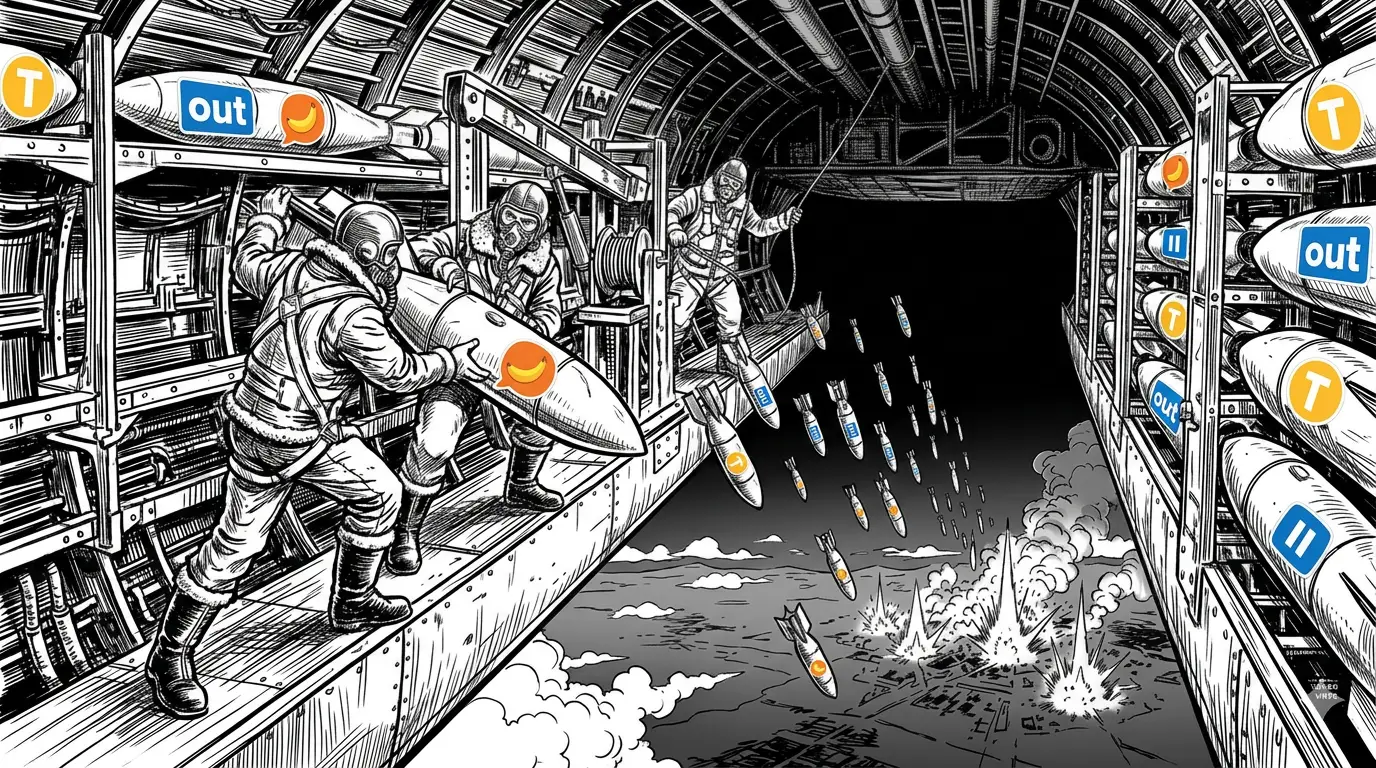
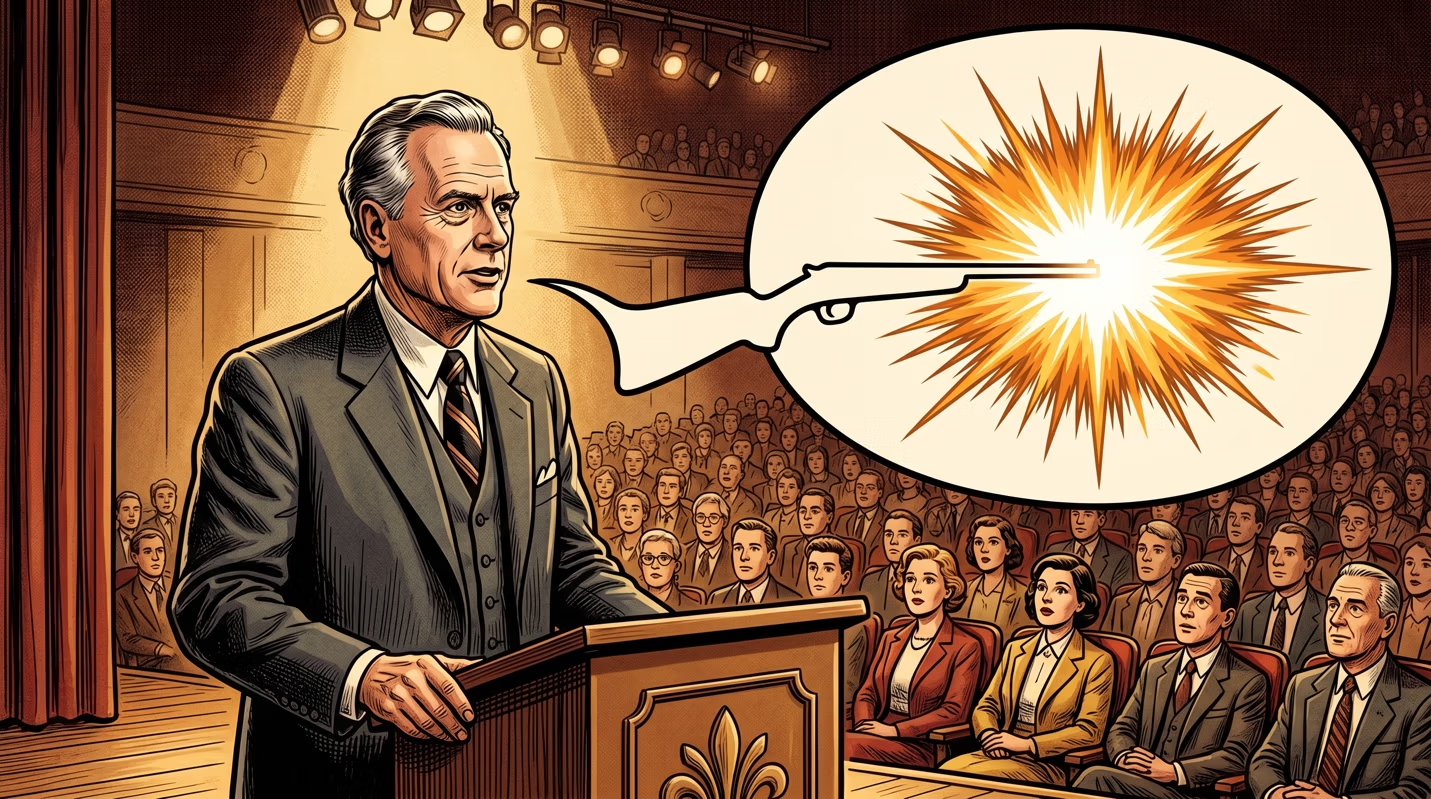
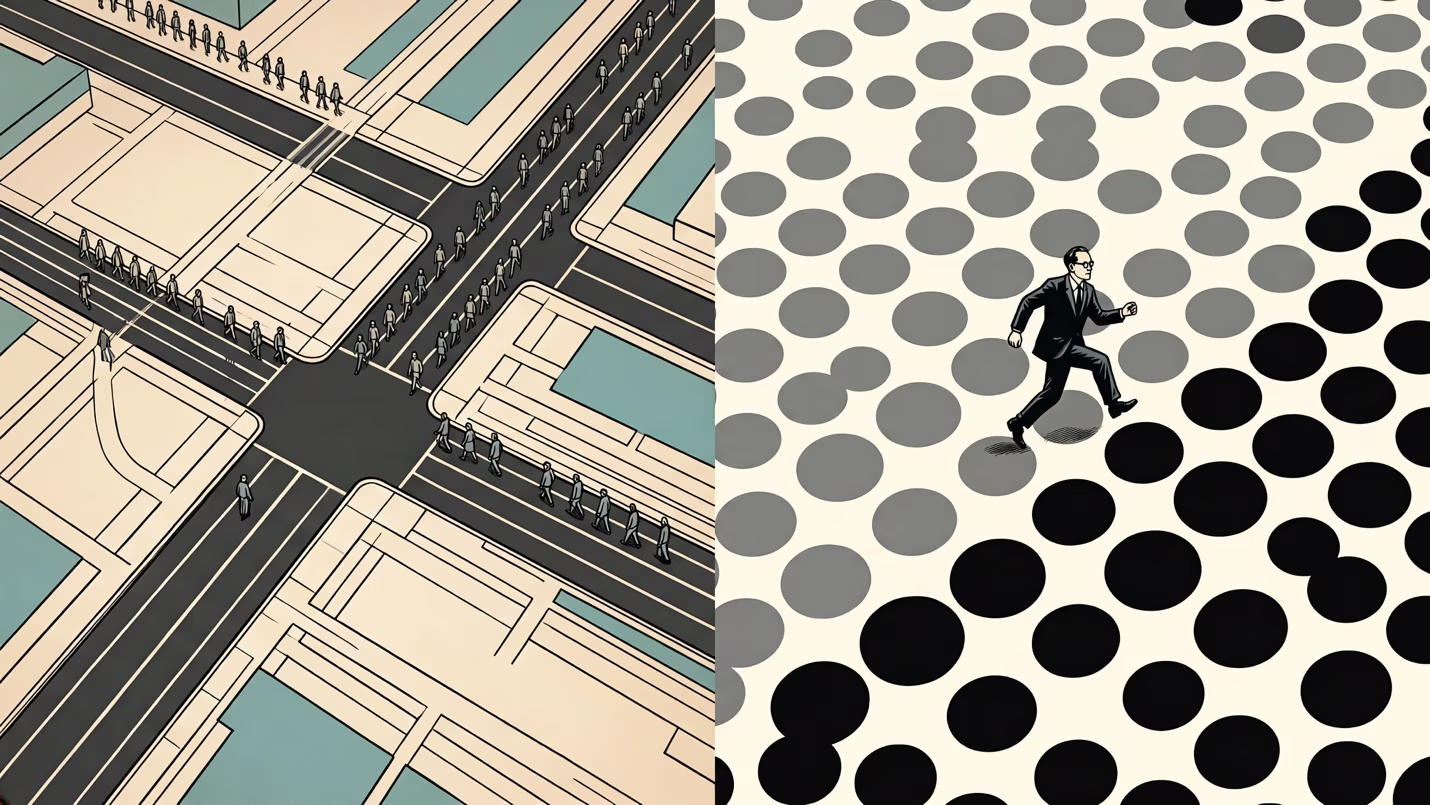
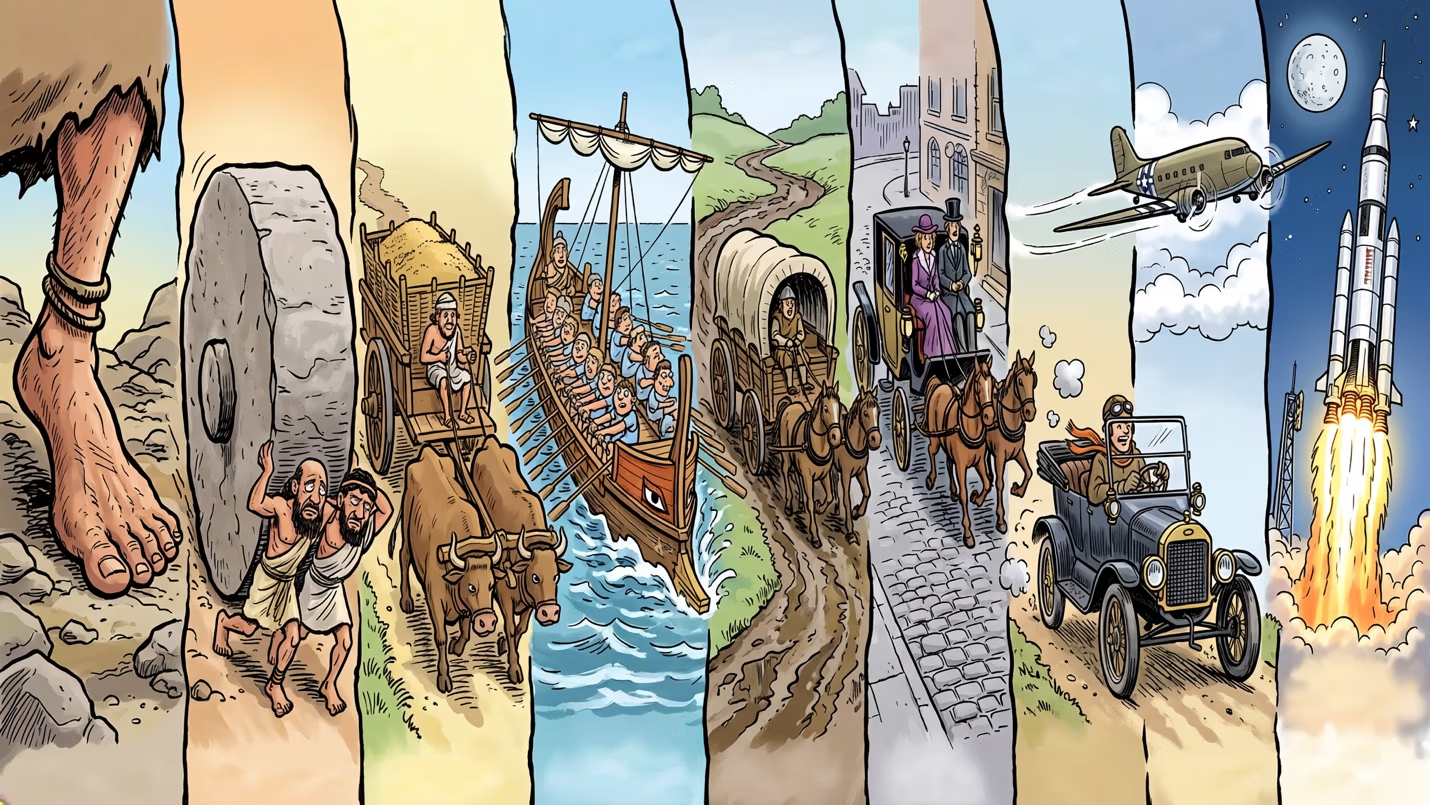
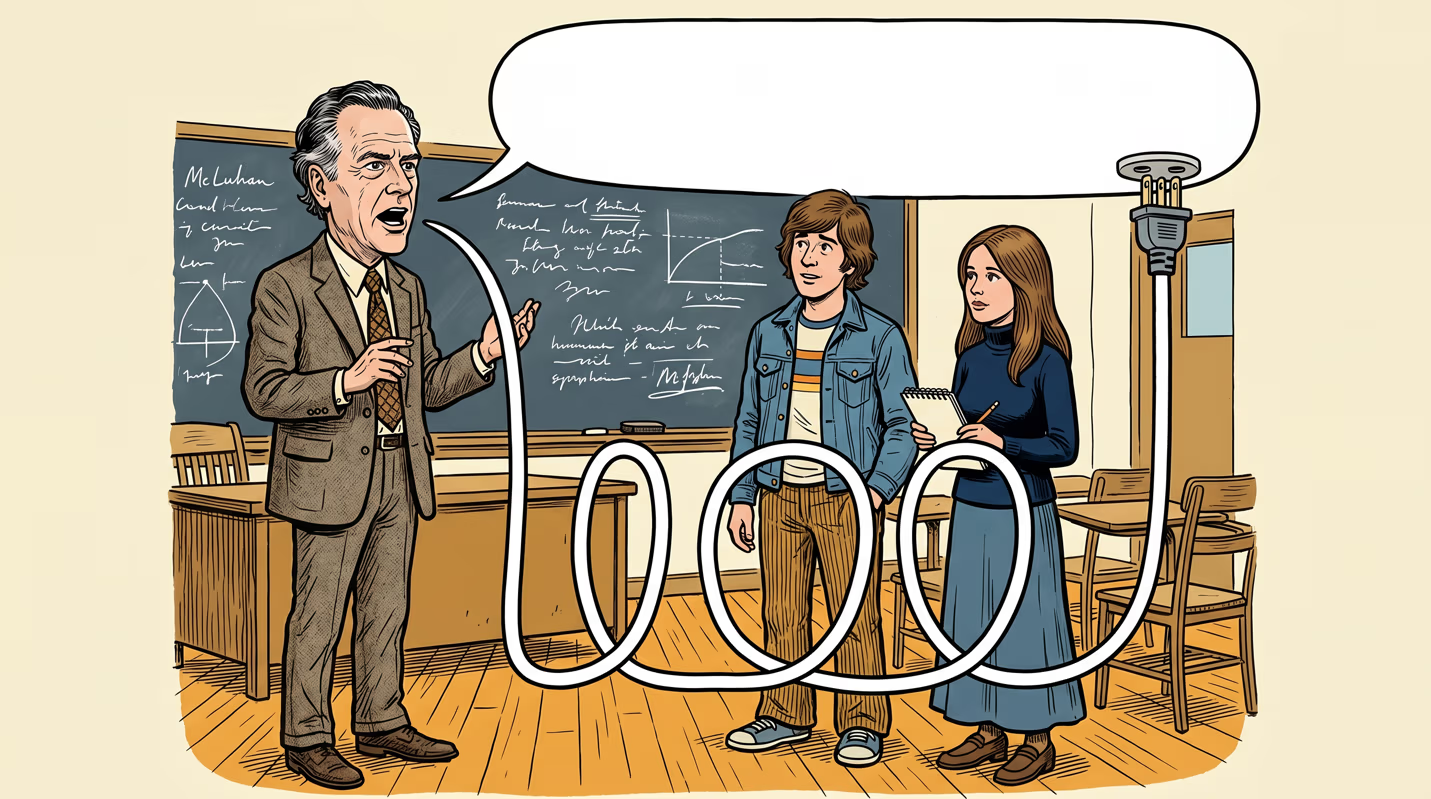

How are we to bypass, or offset, the merely physical response to new technology and new environments created by new technologies? This problem has not been raised by anybody, except that we have to live with it every day.
Lecture, “Men and Media,” at York University, 1975, transcript, p 1,
Year: 1975
Something overlooked by Hans Hass [in The Human Animal] is the absence of biological or psychological means of coping with the effects of our own technical ingenuity in creating new organs. The problem is clearly indicated by Albert Simeons in Man’s Presumptuous Brain, in which he says that ”when about a half million years ago, when man began slowly to embark upon the road to cultural advance, an entirely new situation arose. The use of instruments and the control of fire introduced artifacts in which the cortex could avail itself for purposes of living. These artifacts had no relationship whatever to the organization of the body and could, therefore, not be integrated into the functioning of the brain-stem.”
….. What Simeons is saying is that our natural responses to media and to technology are irrelevant, that we cannot trust our instincts or our natural physical responses to new things. They will destroy us. How are we to bypass or offset merely physical response to new technology and new environments created by new technologies?
Man and Media,” lecture delivered at York University, Toronto, (1979), in Understanding Me, (2003), p 284
Year: 1979
The bias of each medium of communication is far more distorting than the deliberate lie.
“A Historical Approach to the Media”, in Teachers College Record, Vol.57, Issue 2, Nov (1955) ,p 110. Reprinted in Counterblast,(1970), p 119
Year: 1955
Chapters:
Misinformed by Media | News
All of the existing media studies have omitted to examine the impact of media forms, as such. If Gutenberg made everybody a reader, Xerox makes everybody a publisher, and the consequences in both cases are immense and revolutionary, regardless of what is printed or copied.
“When the West Goes East and the East Goes West,” unpublished one page typescript dated January 6, 1977
Year: 1977
…when a medium becomes a means of depth experience the old categories of “Classical” and “popular” or of “highbrow” and “lowbrow” no longer obtain. Watching blue-baby heart operation on TV is an experience that will fit none of the categories.
Understanding Media (1964), MIT/Routledge edition, p 282
Year: 1964
Any artist in any field whatever knows that “form” and “content” are a bogus pair. But when such a notion is all we have with which to cope with modern entertainment (and education) we are helpless. When we hear that “the medium is the message in the long run”, we think it is jabberwocky or Finneganese. And so it is. That is, such a formula speaks not of one plane of fact at a time, but is multi-leveled.
“Around the World, Around the Clock (review of The Image Industries by William Lynch, S.J.-ed.)”, in Renascence Magazine, volume 12, No.4, Summer, 1960, p 205
Year: 1960
It is the medium that shapes and controls the scale and form of human associations and action.
Understanding Media (1964), MIT/Routledge edition, p 9
Year: 1964
If you use a pencil, you'll write one thing. If you use a pen or typewriter, you'll write something completely unlike it.
Recollected by William Kuhns from a conversation on his first meeting with McLuhan at Fordham, February, 1968; McLuhan had been writing, his pencil snapped, upon the offer of a pen by Kuhns, McLuhan refused, giving this as his reason.
Year: 1968
[to Mike Wallace] If l tum off this mike my relationship to you is changed instantly.
Diebold Conversation, 1966, p 15
Year: 1966
Chapter:
Media
Every new technology creates an environment that is itself regarded as corrupt and degrading. Yet the new one turns its predecessor into an art form.
“Introduction to the Second Edition”, in Understanding Media Second Edition (1966), p ix
Year: 1966
Chapter:
Environment
Media are means of extending and enlarging our organic sense lives into our environment.
The Care and Feeding of Communication Innovation: Dinner Address to Conference on 8 mm Sound Film and Education, Teachers College, Columbia University, 8 November 1961
Year: 1961
The discovery that languages are not channels like the telegraph for little messages but basically forms of perception and association by perception has been a tremendous revolution in literature.
“The Meaning of TV to Children”, 1965, p 2
Year: 1965
What I am saying is that media as extensions of our senses institute new ratios, not only among our private senses, but among themselves, when they interact among themselves.
Understanding Media (1964), MIT/Routledge edition, p 53
Year: 1964
All media work us over completely. They are so pervasive in their personal, political, economic, aesthetic, psychological, moral, ethical, and social consequences that they leave no part of us untouched, unaffected, unaltered. The medium is the massage. Any understanding of social and cultural change is impossible without a knowledge of the way media work as environments.
The Medium Is the Massage, 1967, p 26
Year: 1967
Chapter:
Media
The unspoken and even subliminal assumptions in any pattern of human association are dictated by the available means of codifying experience and of moving information. General awareness of this quite drastic fact seems to have departed from literate communities soon after the advent of the phonetic alphabet.
Popular/Mass Culture, Speech, 1960, in Understanding Me (2003), p 17
Year: 1960
[To Mike Wallace] If I turn off this mike my relationship to you is changed instantly.
(Diebold discussion, 1966, p 15)
Year: 1966
Chapter:
Media
Clothing has long been used as weaponry. Hippies, in rejecting literate fashion, reject the consumer world and the demands it imposes on them. For centuries the power structure kept the middle class impotent by forcing them to exhaust their limited resources buying a succession of new clothes. Today the Lenin cap is popular in England. Youths mockingly wear Guardsmen uniforms. One miniskirt is called Hello, officer!" The Nehru coat and cap were originally prison garb; serving time in a British prison was once a pre-requisite for election to public office in India. Manufacturers supply such weapons because kids now have money and "customer" is a difficult status in our society to degrade. In the last stages of the Roman Empire, youths dressed and groomed themselves in the style of the barbarians.
“McLuhan Looks at Fashion” (1968), in On the Nature of Media (2016), pp 152-153
Year: 1968
The new media of communication are forms – not simple ones, but complex forms. But they are forms. And their effect upon us is that of forms, not of ideas or of concepts. The editorials in a newspaper have nothing to do with the effect of the newspaper on you. Whether it is Pravda, the New York Times, or the Toronto Daily Star makes no difference as far as the formal, causal pressure of that newspaper on those concerned. Just why people should be so obsessed by what they suppose to be the content of those forms, and so completely unaware of the formal structure and the formal causes of such forms, I do not understand.
“Communication Media: Makers of the Modern World” (1959), reprinted in The Medium and the Light (1999), p 38
Year: 1959
“The meaning of a work of art, as the artists of past centuries can tell us, has nothing to do with what you think about it. It has to do with its actions upon you. It is a form: it acts upon you. It invades your senses. It restructures your outlook. It completely changes your attitudes, your wavelengths. So our attitudes, our sensibilities are completely altered by new forms, regardless of what we think about them.
“Communication Media: Makers of the Modern World” (1959), reprinted in The Medium and the Light (1999), p 38
Year: 1959