Viewing chapter Narcissus, Denial of Media Effects (36 quotes)
Every technology contrived and outered by man has the power to numb human awareness during the period of its first interiorization.
The Gutenberg Galaxy: The Making of Typographic Man, (1962), p 153
Year: 1962
Imagine people in 1910 being baffled by visual cubism, when they wallowed in it in their newspapers every day! The difficulty is not to explain cubism but to account for the mental process of those who found it obscure.
“Electronics as E.S.P.” in Explorations 8, 1957, reprinted as Verbi-Voco-Visual in 1967, both unpaginated
Year: 1957
Chapter:
Cubism
I have discovered over the years that the effects of innovation are always subliminal, and because people resent having this pointed out, feeling that you are invading their privacy by so doing.
Letter to Pierre Elliott Trudeau, March 26, 1974, in Letters of Marshall McLuhan (1987), p 494
Year: 1974
Is it not obvious that there are always enough moral problems without also taking a moral stand on technological grounds?
The Gutenberg Galaxy: The Making of Typographic Man, (1962), p 157
Year: 1962
…we still cannot free ourselves of he delusion that it is how a medium is used that counts, rather than what it does to us and with us. This is the zombie stance of the technological idiot.
Playboy Interview, (1969), in Essential McLuhan (UK edition, 1997), p 228
Year: 1969
Chapter:
Sleepwalkers
There may be some hitherto unsuspected and wise motive for mental sleep and self-hypnosis in man which the confrontation of the effects of media technology would reveal. However this may be, it is plain that the pseudo-dichotomies and visual quantities imposed on our psychology by print began in the seventeenth century to assume the character of consumer packages or “systems” of philosophy. They are the kind that can be described and presented in a few minutes, but, thanks to the mesmerizing of print, were to occupy the attention of generations.
The Gutenberg Galaxy: The Making of Typographic Man, (1962), p 246
Year: 1962
It may even be that the loss of power to recognize new patterns of power in the environment is in direct ratio to the impact of such new powers. We are most nearly numb where impact is most severe… A.J. Toynbee has shown few if any instances of societies meeting the challenge of major change successfully.
“The Nerves of Government” (1964), p 4
Year: 1964


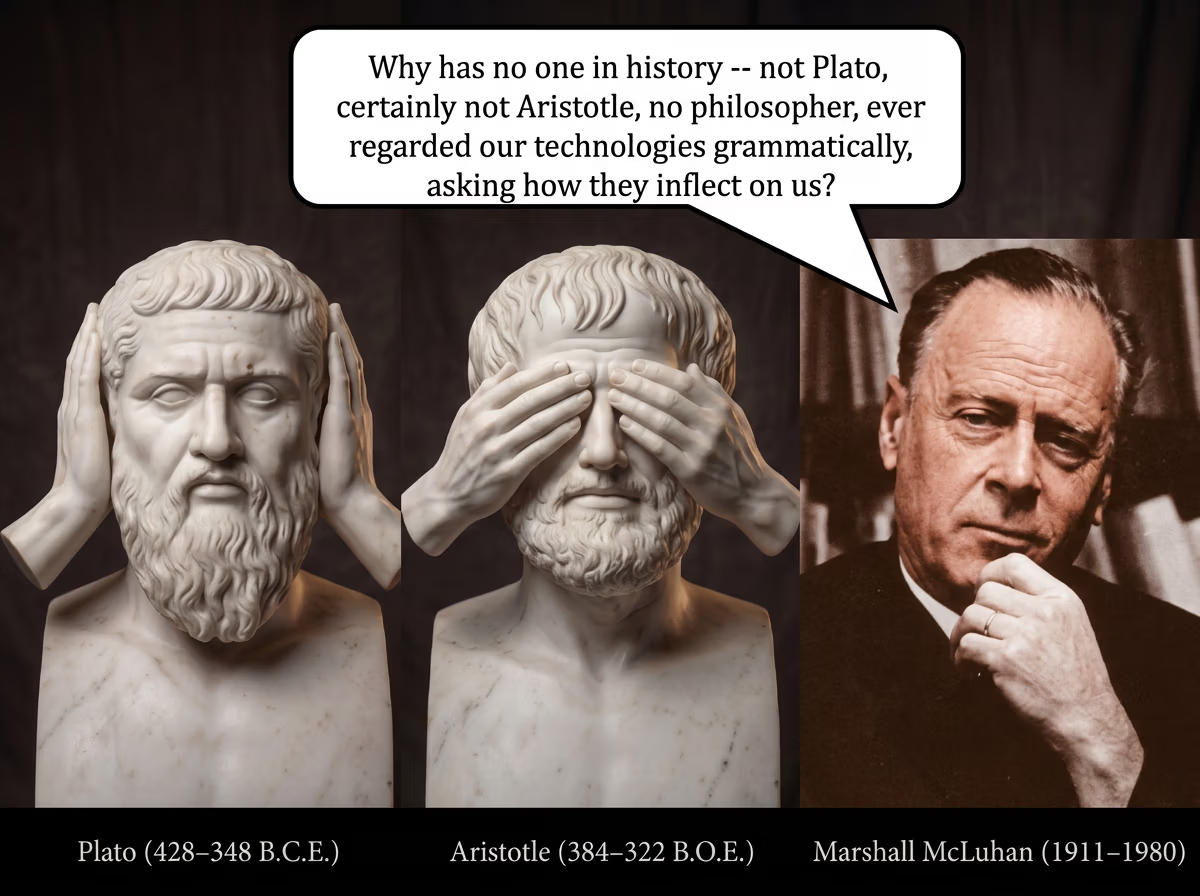
During the process of digestion of the old environment, man finds it expedient to anesthetize himself as much as possible. He pays as little attention to the action of the environment as the patient heeds the surgeon's scalpel.
“Notes on Burroughs” (1963), in Media Research (1997), p 87
Year: 1963
Chapter:
Attention
The student of media soon comes to expect the new media of any period whatever to be classed as pseudo by those who have acquired the patterns of earlier media, whatever they may happen to be. This would seem to be a normal, and even amiable, trait ensuring a maximal degree of social continuity and permanence amidst change and innovation. But all the conservatism in the world does not afford even a token resistance to the ecological sweep of the new electric media.
Understanding Media, 1964, MIT/Routledge edition, p 199
Year: 1964
Philosophy was as naive as science in its unconscious acceptance of the assumptions or dynamic of typography.
The Gutenberg Galaxy: The Making of Typographic Man, (1962), p 278
Year: 1962
Failure to understand this [the mechanization of psyche and culture] arises from various overriding assumptions about the universal benefits of print.
"Joyce, Mallarmé and the Press", in The Sewanee Review, Vol.62, No.1, Jan-March (1954), p 38 reprinted in The Interior Landscape The Literary Criticism of Marshall McLuhan, (1969), p 6.
Year: 1954
All our technologies in the Western world are built on the assumption that they have complete immunity from inspection.
Hot and Cool Interview (1967) in Media Research (1997), p 76
Year: 1967
Since there are no visual or quantifiable connections between radio and TV and their effects, Western man humbly and dumbly submits to their magic.
“Violence of the Media” in MM the Man and his Message (1989), p 94
Year: 1989
Chapter:
McLuhanisms & Zingers
This is the sense of the Narcissus myth. The young man's image is a self-amputation or extension induced by irritating pressures.
Understanding Media (1964), MIT/Routledge edition, p 43
Year: 1964
The antithetic electric power of instant information that reverses social explosion into implosion, private enterprise into organization man, and expanding empires into common markets, has obtained as little recognition as the written word. The power of radio to retribalize mankind, its almost instant reversal of individualism into collectivism, Fascist or Marxist, has gone unnoticed. So extraordinary is this unawareness that it is what needs to be explained. The transforming power of media is easy to explain, but the ignoring of this power is not at all easy to explain. It goes without saying that the universal ignoring of the psychic action of technology bespeaks some inherent function, some essential numbing of consciousness such as occurs under stress and shock conditions.
Understanding Media, 1964, MIT/Routledge edition, p 304
Year: 1964
Chapters:
Advice | Between Two Ages | Electric, Electronic | From Tribal to Literate | Marx, Karl | Media Effects | Radio | Sleepwalkers | Today’s Transition
Plato and Aristotle were quite unaware of the ways in which the phonetic alphabet had created a new primacy of visual or Euclidean space. They imagined that their sudden preference for connectedness of analytic reasoning and clarification had arisen from their own conceptual activities merely. Eric Havelock's Preface to Plato records the sudden revulsion against the bardic modes of education with the coming of phonetic literacy. Today we have returned to the bardic tradition through the universal use of the sum word both in ads and entertainment. In fact, the poets had fervently moved in this direction from Blake, Words-worth, and Coleridge, forward. The poets merely preferred the bardic to the more ludicrous extremes of mechanism that had been perceived by Swift and Pope. The Dunciad is a dismissal of the crushing impact of an excess of printed matter on the human intellect.
Letter to Robert J. Leuver, C.M.F., July 30, 1969, in Letters of Marshall McLuhan (1987) p 385; also “A Peculiar War to Fight": Letter to Robert J. Leuver, in The Medium and the Light (1997), p 90
Year: 1969
There is a deep-seated repugnance in the human breast against understanding the processes in which we are involved. Such understanding implies far too much responsibility for our actions.
Letter to Jacques Maritain, May 6, 1969, in Letters of Marshall McLuhan, p 370
Year: 1969
Chapters:
Media Effects | Warnings
In five centuries explicit comment and awareness of the effects of print on human sensibility are very scarce.
Understanding Media (1964), MIT/Routledge edition, p 172
Year: 1964
The Greek myth of Narcissus is directly concerned with a fact of human experience, as the word Narcissus indicates. It is from the Greek word narcosis or numbness. The youth Narcissus mistook his own reflection in the water for another person. This extension of himself by mirror numbed his perceptions until he became the servomechanism of his own extended or repeated image. The nymph Echo tried to win his love with fragments of his own speech, but in vain. He was numb. He had adapted to his extension of himself and had become a closed system. Now the point of this myth is the fact that men at once become fascinated by any extension of themselves in any material other than themselves.
Understanding Media (1964), MIT/Routledge edition, p 41
Year: 1964
What remains to be recognized is that a very able person may often choose to freeze or anesthetize large areas of his mind and experience for the sake of social and practical success or the pleasures of group solidarity.
The Mechanical Bride (1951), p 10
Year: 1951
There is a deep-seated repugnance in the human breast against understanding the processes in which we are involved. Such understanding involves far too much responsibility for our actions.
Letter to Jacques Maritain, May 6, 1969, in Letters of Marshall McLuhan, p 370
Year: 1969
Chapters:
Media Effects | Warnings
…the wisdom of the Narcissus myth does not convey any idea that Narcissus fell in love with anything he regarded as himself. Obviously he would have had very different feelings about the image had he known it was an extension or repetition of himself.
Understanding Media (1964), MIT/Routledge edition, pp 42-43
Year: 1964
An extension appears to be an amplification of an organ, a sense or a function, that inspires the central nervous system to a self-protective gesture of numbing of the extended area, at least so far as direct inspection and awareness are concerned.
Understanding Media (1964), p 172
Year: 1964
From the time of the telegraph onward, however, Western man began to live an implosion. He began suddenly with Nietzschean insouciance to play the movie of his 2,500-year explosion backward. But he still enjoys the results of the extreme fragmentation of the original components of his tribal life. It is this fragmentation that enables him to ignore cause-and-effect in all interplay of technology and culture.
Understanding Media, MIT/Routledge edition, (1964), p 270
Year: 1964
Typographic man can express but is helpless to read the configurations of print technology.
The Gutenberg Galaxy: The Making of Typographic Man, (1962), p 216
Year: 1962
The transforming power of media is easy to explain, but the ignoring of this power is not at all easy to explain.
Understanding Media, MIT/Routledge edition, (1964), p 304
Year: 1964
The transforming power of media is easy to explain, but the ignoring of this power is not at all easy to explain. It goes without saying that the universal ignoring of the psychic action of technology bespeaks some inherent function, some essential numbing of consciousness such as occurs under stress and shock condition
Understanding Media (1962), MIT/ROUTLEDGE, p 304
Year: 1962
Chapters:
Advice | Between Two Ages | Electric, Electronic | From Tribal to Literate | Marx, Karl | Media Effects | Radio | Sleepwalkers | Today’s Transition
People in new environments always produce the new perceptual modality without any difficulty or awareness of change. It is later that the psychic and social realignments baffle societies.
“Art as Anti-Environment”, Art News Annual, Vol 31, Art Foundation, 1966. P 56
Year: 1966
Chapter:
Change
Narcissus fell in love with an “outering” (projection, extension) of himself. And people always fall in love with the latest gimmick or gadget that is merely an extension of their own bodies. But Narcissus means “numb”, dead, narcosis. He was completely unaware that it was himself that he’d fallen in love with. And when reading or when in the motor car or watching TV or listening to the radio we are pretty unaware that we’re merely obsessed, fascinated with a little bit of ourselves, stuck out there, in another material. I think it is very important to know that it is a bit of yourself out there because otherwise you are never going to get off the hook.
“Prospect”, Arts Canada, 1962, p 1
Year: 1962
The fact that the psychic and social consequences of the various extensions of man are just as complex as the dynamic interplay of our own nervous systems seems to appal many people.
Letter to Bascom St John, July 10, 1964, in Letters of Marshall McLuhan (1987), p 306
Year: 1964
Leasing our eyes and ears and nerves to commercial interests is like handing over the common speech to a private corporation, or like giving the earth's atmosphere to a company as a monopoly. Something like this has already happened with outer space, for the same reasons that we have leased our central nervous systems to various corporations. As long as we adopt the attitude of regarding the extensions of our own bodies as really out there and really independent of us, we will meet all technological challenges with the same sort of banana-skin pirouette and collapse.
Understanding Media (1964), MIT/Routledge edition, p 648
Year: 1964
Nobody has ever questioned my evidence for these extensions as creating new service/disservice environments which alter modes of private and corporate perception.
Letter to the Editor, New Society, March 10, 1970, in Letters of Marshall McLuhan (1987), p 402
Year: 1970
It goes without saying that the universal ignoring of the psychic action of technology bespeaks some inherent function, some essential numbing of consciousness such as occurs under stress and shock conditions.
Understanding Media (1964), MIT/Routledge edition, p 304
Year: 1964
Chapters:
Advice | Between Two Ages | Dropout | Electric, Electronic | From Tribal to Literate | Living Unity | Marx, Karl | Media Effects | Radio | Sleepwalkers | Today’s Transition
At no period of human culture have men understood the psychic mechanism involved in invention and technology.
Understanding Media (1964), MIT/Routledge edition, p 352
Year: 1964
To argue whether there is any quantitative proof of this, is part of the panic. Nobody wants any proof. Most people desperately don't want it.
Letter to Frank Kermode, March 4,1971, in Letters of Marshall McLuhan (1987) p 426
Year: 1971
Just how it has been possible for those who regard Joyce and Eliot with respect to exempt themselves from a rigorous evaluation of every phase of commercial culture is perhaps only to be explained by the obsession with mechanistic abstraction which an industrial society imposes.
“Inside Blake and Hollywood”, in Sewanee Review, Vol.55, No.4, October, (1947), p 713
Year: 1947