Viewing chapter News (125 quotes)
Aesthetically the newspaper creates an impact of immediacy and of super-realism. Metaphysically its mode is existential. Its impact is that of the very process of actualization. The entire world becomes, in this way, a laboratory in which everybody can watch the stages of an experiment, and the reader is given a do-it-yourself kit. This telegraph pattern was soon transferred to poetry, painting , and music…
“Technology and Political Change,” in International Journal, Vol 7, No. 3, Summer, (1952), p 191
Year: 1952
Everybody becomes a spectator of the biggest show on earth -- namely the entire human family in its most gossipy intimacy.
“Technology and Political Change,” in International Journal, Vol 7, No. 3, Summer, (1952), p 191
Year: 1952
News is an artifact where media are concerned. Any kind of good or bad news can be turned on or off at will for varying periods.
Culture Is Our Business ,(1970), p 268
Year: 1970
News is now making, not matching. The news of the sponsor is, at least, as central to decision-making as the news of the press. Another gap has closed.
Culture Is Our Business, (1970), p 272
Year: 1970
By the time of the power press in the early 19th century, the newspapers were rapidly changing the character of politics by creating public opinion. In a new country like America the new medium of the press created the first instance of a state founded on public opinion. English political forms, predating the press, still depend much less on public opinion, as do those of Canada.
Counterblast, (1969), 125
Year: 1969
A new style [of news story] appears, one of immersion, of human interest: prose that does your feeling for you.
Telegraph Press Tetrad, Laws of the Media with Eric McLuhan, the widely circulated first draft of 1975, p 274
Year: 1975
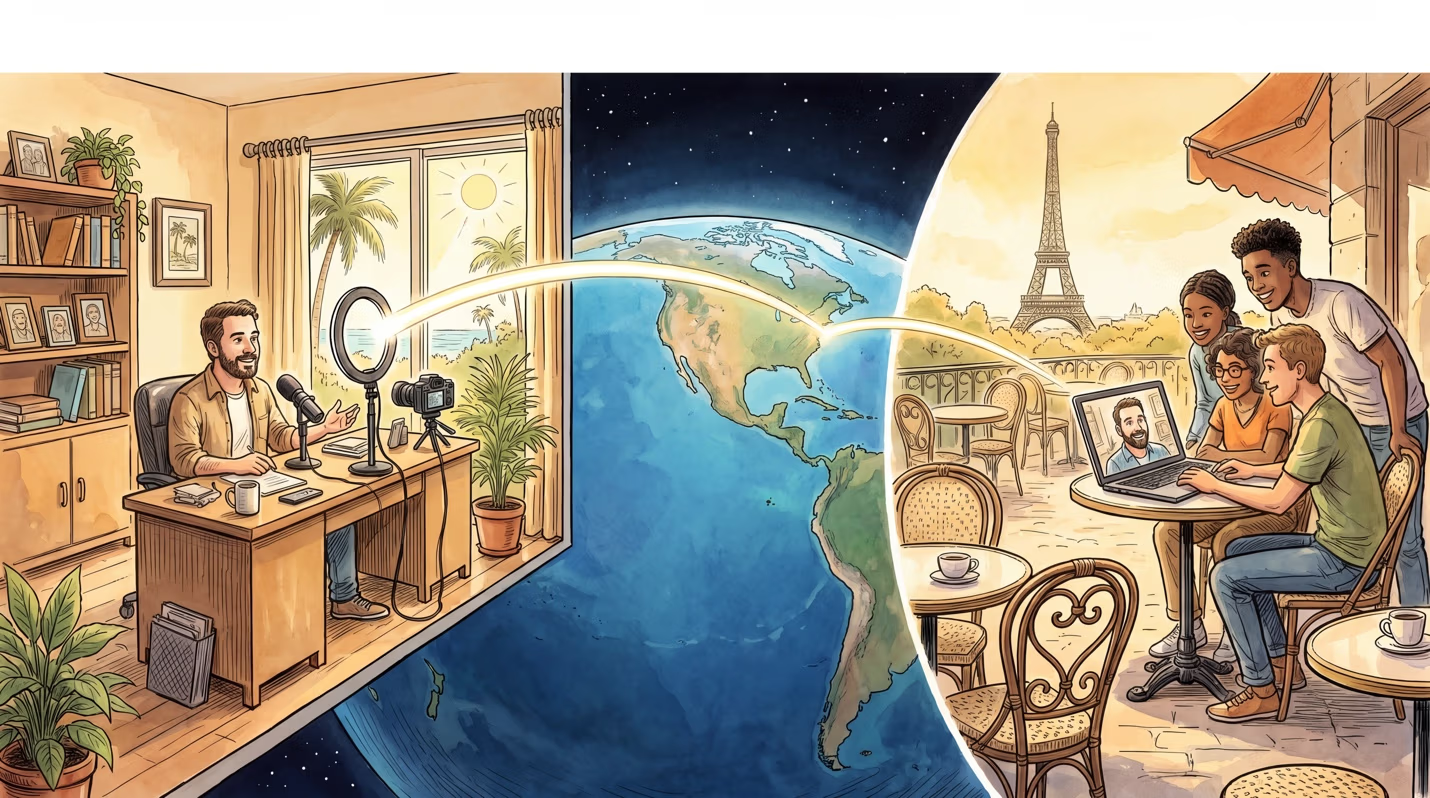
The satellite means, among other things, the end oif “news.” It can zero in on any part of the globe at any time and give you direct participation in whatever you want to see going on. No more news reports: they’re just a momentary, passing thing of the recent decade. With the satellite, news becomes so total, so complete that reports are meaningless. The electronic age is organic, total.
“Like Yoga, Not Like the Movies,” Forbes, March 15, 1967, p 40
Year: 1967

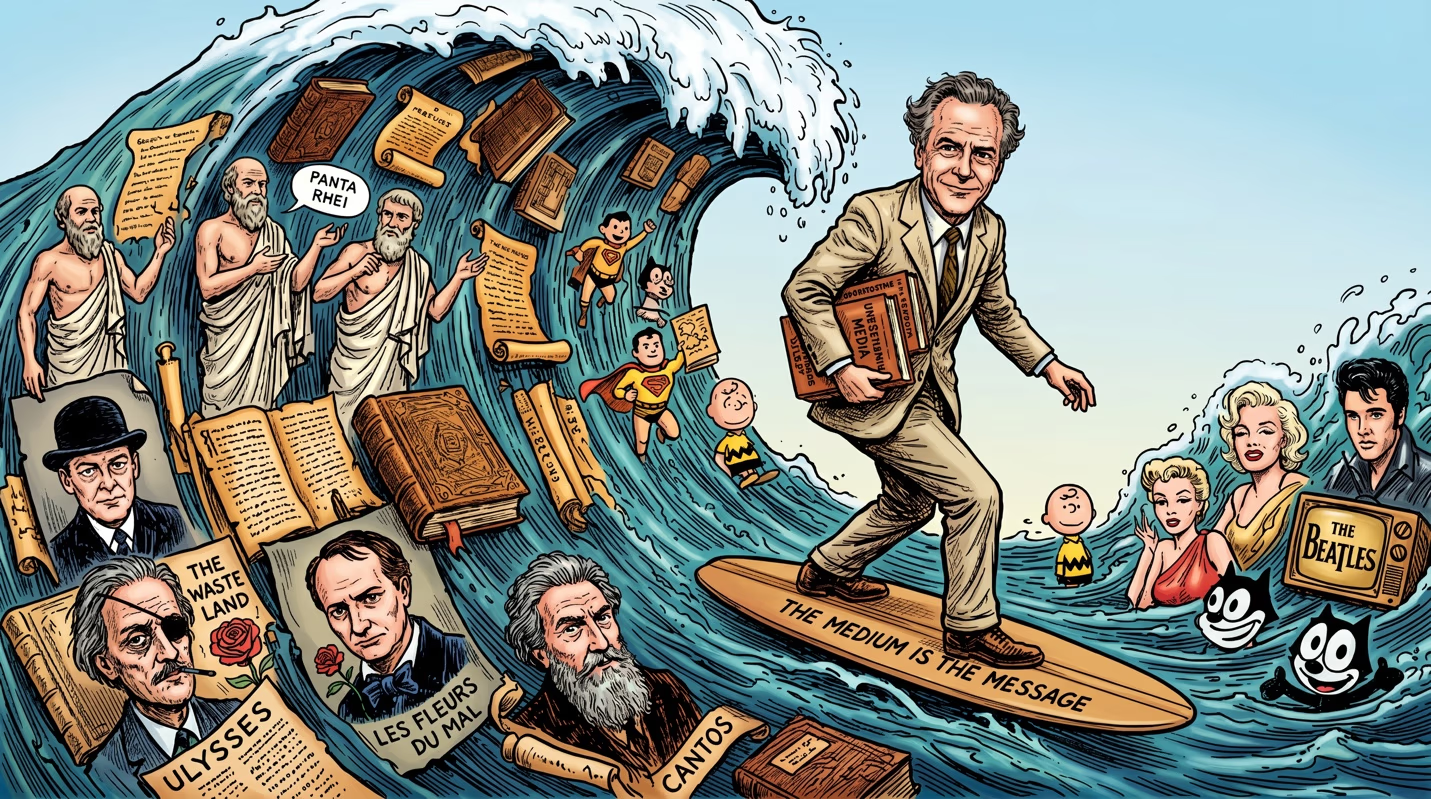
The Waste Land is a newspaper epyllion, or little epic, using newspaper discontinuity and mosaic to include East and West, past and present in a single moment.
Culture Is Our Business, (1970), p 270
Year: 1970
One curious aspect of the press is its willingness to be as surrealist as possible in its handling of geography and space, while sticking rigidly to the convention of a date-line. As soon as the same treatment is accorded time as space, we are in the world of Ulysses, where it is 800 B.C. and 11904 A.D. at the same time.
“Technology and Political Change,” in International Journal, Vol 7, No. 3, Summer, (1952), p 191
Year: 1952
The book is a private confessional form that provides a " point of view." The press is a group confessional form that provides communal participation. It can " color" events by using them or by not using them at all. But it is the daily communal exposure of multiple items in juxtaposition that gives the press its complex dimension of human interest.
Understanding Media, 1964, MIT/Routledge edition, p 201
Year: 1964
Chapter:
Book
Even before the telegraph speed-up, the newspaper of the nineteenth century had moved a long way toward a mosaic form. Rotary steam presses came into use decades before electricity, but typesetting by hand remained more satisfactory than any mechanical means until the development of linotype about 1890. W i t h linotype, the press could adjust its form more fully to the news-gathering of the telegraph and the news-printing of the rotary presses. I t is typical and significant that the linotype answer to the long-standing slowness of typesetting did not come from those directly engaged w i t h the problem. Fortunes had been vainly spent on typesetting machines before James Clephane, seeking a fast way of writing out and duplicating shorthand notes, found a way to combine the typewriter and the typesetter. I t was the typewriter that solved the utterly different typesetting problem. Today the publishing of book and newspaper both depends on the typewriter.
Understanding Media, 1964, MIT/Routledge edition, p 205
Year: 1964
Slow down typesetting and news-gathering, and there occurs a change, not only in the physical appearance of the press, but also in the prose style of those writing for it. The first great change in style came early in the eighteenth century, when the famous Toiler and Spectator of Addison and Steele discovered a new prose technique to match the form of the printed word. It was the technique of equitone. It consisted in maintaining a single level of tone and attitude to the reader throughout the entire composition.
Understanding Media, 1964, MIT/Routledge edition, pp 205-206
Year: 1964
The format of the press—that is, its structural characteristics —were quite naturally taken over b y the poets after Baudelaire in order to evoke an inclusive awareness. Our ordinary newspaper page today is not only symbolist and surrealist in an avant-garde way, but it was the earlier inspiration of symbolism and surrealism in art and poetry, as anybody can discover by reading Flaubert or Rimbaud. Approached as newspaper form, any part of Joyce's Ulysses or any poem of T . S. Eliot's before the Quartets is more readily enjoyed.
Understanding Media, 1964, MIT/Routledge edition, pp 216
Year: 1964
Both book and newspaper are confessional in character, creating the effect of inside story by their mere form, regardless of content. As the book page yields the inside story of the author's mental adventures, so the press page yields the inside story of the community in action and interaction. I t is for this reason that the press seems to be performing its function most when revealing the seamy side.
Understanding Media, 1964, MIT/Routledge edition, p 205
Year: 1964
In the press an Eskimo item will repose beside a Parisian event, the neolithic and the atomic man meet in the same flat paper landscape of the press.
“James Joyce: Trivial and Quadrivial” Thought: Fordham University Quarterly, Vol. 28, No 1, (1953), reprinted in The Interior Landscape (1969), pp 44-45
Year: 1953
The mere format of the page of newsprint was more revolutionary in its intellectual and emotional consequences than anything that could be said about any part of the globe.
“Culture without Literacy”, in Explorations #1, December (1953), p 118 reprinted in Essential McLuhan, (1995), p 304, additional reprint in Media Research Technology, Art and Communication (1997), p 127, and McLuhan Unbound #6, (2017)
Year: 1953
Reading the history of the newspaper retrospectively we can see that it was not a mere extension of the art form of the book page. As used by Rimbaud, Mallarmé and Joyce the newspaper page is a revolution in itself, juxtaposing many book pages on a single sheet. And the news page was, moreover, more nearly a mass medium not only in reaching more people than the book, but in being more instantaneous in its coverage and communication. Once linked to the telegraph, the press achieved the speed of light, as radio and TV have done since then. Total global coverage in space, instantaneity in time. Those are the two basic characters that I can detect in a mechanical mass medium. There are other characteristics derivative from these, namely anonymity of those originating the messages or forms, and anonymity in the recipients. But in respect of this anonymity it is necessary to regard not only words and metaphors as mass media but buildings and cities as well.
“Culture without Literacy”, in Explorations #1, December (1953), p 125 reprinted in Essential McLuhan, (1995), p 310, additional reprint in Media Research Technology, Art and Communication (1997), p 135. and McLuhan Unbound #6, (2017)
Year: 1953
So that, if the book page could imitate visual perspective as in Renaissance painting, setting facts and concepts in proportions that reproduced the optical image of the three-dimensional object-world, the uninhibited world of the press and modern advertising abandoned such realistic proprieties in favor of weighting news and commercial objects by every dynamic and structural device of size and colour bringing words and pictures back into a plastic and meaningful connection.
“Culture without Literacy”, in Explorations #1, December (1953), p 125 reprinted in Essential McLuhan, (1995), p 310, additional reprint in Media Research Technology, Art and Communication (1997), p 135. and McLuhan Unbound #6, (2017)
Year: 1953
the moment you put a person on trial today, the public feels that it is being accused: what did we do to make this man do these things? The minute you put a convict in the public eye, he is a hero. The coverage is bigger than the event.
“Jean Pare interview”, in Forces magazine a Hydro Quebec publication, No.22, (1973), p 11
Year: 1973
How would a large population know how to feel about a large number of ever-changing matters without a daily press?
Projects and Questions -Press, In NAEB Report on Understanding New Media, June (1960), p 73
Year: 1960
Chapter:
Questions He Asks
Do headlines act as mandates much as dress models in shop windows? …
Projects and Questions -Press, In NAEB Report on Understanding New Media, June (1960), p 73
Year: 1960
But this mosaic form [of contemporary media, exemplified in the newspaper] is precisely the model of the new global dialogue (or multitudinous interface of unconnected events) that releases energy by interplay. (It is the “play” in the wheel that makes its movement possible; it is the play or discontinuity in events that makes discovery and development possible.)
“McLuhan Futuregram #1: Culture Is Our Big / New / Hot Business,” Dew-Line Newsletter, Vol 1 No. 4, October, 1968, p 6
Year: 1968
Chapter:
Interval
So-called objective news is that kind which is strongly dependent on the eye. The eye alone of all our senses fosters detachment. Touch and smell and hearing do not claim objectivity. The horse that’s known by touch along is lal horse but not visibly recognizable. The horse drawn by a blind man would be a blotty gestalt.
“Sharing the News” (1971), p 9
Year: 1971
Chapter:
Visual Space
Today the process of reporting and distributing news has become greater than the events that are reported.
“The Hardware-Software Mergers: How Successful Have They Been?” Speech at the conference, Reappraisal of the Educational Technology Industry,” University of Chicago, November 16-18, 1969. Transcript, p 10
Year: 1969
The physical landscape of the earth was changed very quickly by the landscapes of the newspaper, even though the political scene has not yet caught up. The networks of news, trade and transport were one.
"Joyce, Mallarmé and the Press", in The Sewanee Review, Vol.62, No.1, Jan-March (1954), p 43-44, reprinted in The Interior Landscape The Literary Criticism of Marshall McLuhan, (1969), p 10
Year: 1954
Chapters:
Discontinuity | Information
David Riesman, after much investigation into why people read newspapers, was utterly baggled. So far as interview samplings could determine, their main function seemed to be to provide a hedge to hide behind on bus and streetcar. They were part of a commputer’s shock equipment. On the other hand, in the past century or so, the press has revolutionized transportation. The race to get and distribute news finally put an electric girdle round the earth. Shakespeare’s fancy about Puck putting a girdle round the earth in forty minutes was surpassed by telegraph and cable. Space was annihilated. And the village gossip became a world gossip. In 1844 the telegraph was greeted as “the first definite pulsation of the real nervous system of the world.”
“The Newspaper,” undated, unpublished typescript, p 1
Chapter:
Electric, Electronic
Now if you are going to sell all good news, you have to have an awful lot of bad news to make it go over. Hence, newspapers.
“What TV Is Doing To Us – And Why,” Washington Post, 1977, p H5 [add date]
Year: 1977
An amplifying system hitched to one’s own heartbeat can, the Russians have found, break down the strongest morale. And the press used as a means of thrill and excitement produces a general emotional situation which leads to a crescendo and crescendo calls for a catharsis – a blood-bath. The actual outbreak of the Second World War was a relief to many after the years of tense waiting.
The Mechanical Bride (1951), p 7
Year: 1951
…what is printed as news has nothing to do with what is reported in any other medium as news.
“The Hardware-Software Mergers: How Successful Have They Been?” Speech at the conference, Reappraisal of the Educational Technology Industry, University of Chicago, November 16-18, 1969. Transcript, p 10
Year: 1969
Chapter:
McLuhanisms & Zingers
On every page of the newspaper, in the discontinuous mosaic of unrelated human items, there is a resonance that speaks universality even in triviality. Robert Louis Stevenson said, “I could make an epic from a newspaper if I knew what to leave out.”
“At the Moment of Sputnik—” (1974), typescript, p 4
Year: 1974
Chapter:
Living Unity
[News events today serve as a] literal realization of the physics formula that a particle moved at the speed of light acquires infinite mass. Today the most trivial facts can envelop and involve the whole world.
“The Hardware-Software Mergers: How Successful Have They Been?” Speech at the conference, Reappraisal of the Educational Technology Industry, University of Chicago, November 16-18, 1969. Transcript, p 10
Year: 1969
Chapters:
Living Unity | McLuhanisms & Zingers
Headlines means street sales. It takes emotion to move merchandise. And wars and rumors of wars are the merchandise and also the motion of the popular press.
The Mechanical Bride (1951), p 7
Year: 1951
Chapter:
War
If telegraph shortened the sentence, radio shortened the news story, and TV injected the interrogative mood into journalism. In fact, the press is now not only a telephoto mosaic of the human community hour by hour, but its technology is also a mosaic of all the technologies of the community.
Understanding Media (1964), MIT/Routledge edition, p 215
Year: 1964
Chapter:
Media Effects
Bad news, paradoxically, is very encouraging stuff to read and advertising is very discouraging. So, in order to have lots of ads, they have to have tremendous quantities of bad news to offset the threatening effect of advertising.
Foyle interview (1972), transcript, p 13
Year: 1972
The old journalism used to try to give an objective picture of a situation by giving the pro and the con. Objective journalism meant giving both sides at once. Strangely, everyone assumed there were two sides to every case. It never occurred to anyone that there might be forty sides or a thousand sides. No, just two sides, pro and con. Suddenly this form of journalism disappeared, and the new journalism arrived represented by Truman Capote, Norman Mailer, Tom Wolfe and many others. The new journalism doesn’t give us any side: It just immerses us in the feeling of the whole situation. It plunges us into the feeling of being at the convention or being at the fire, being somewhere, and it began with that famous phrase, “Something funny happened on the way to the forum.”
“Living in an Acoustic World,” public lecture to U of South Florida, in “Marshall McLuhan Speaks” transcript p 8
The news automatically becomes the real world for the TV user and is not a substitute for reality, but is itself an immediate reality. Death on TV is a form of fantasy.
“A Last Look at the Tube” (1978), typescript, p 3
Year: 1978
Chapter:
Media
People don't actually read newspapers. They step into them every morning like a hot bath.
Quoted in “Understanding McLuhan (In Part)” by Richard Kostalonetz, in the New York Times Magazine, January 29, 1967, p 37 Reported by Corinne McLuhan, what MM said on leaving a Kubrick-arranged screening of 2001: A Space Odyssey, early in 1968
Year: 1967
Chapters:
McLuhanisms & Zingers | Media
It takes emotion to move merchandise. And wars and rumors of wars are the merchandise and also the motion of the popular press.
The Mechanical Bride (1951), p 7
Year: 1951
Chapter:
War
The contents of newspapers, their messages and information, have steadily promoted nationalism. But the form of the newspaper page is powerfully intercultural and international. The unformulated message of an assembly of news items from every quarter of the globe is that the world today is one city. All war is civil war. All suffering is our own.
“Sight, Sound and the Fury” (1954), p 492
Year: 1954
It is not surprising that these new forms [telegraph, telephone, etc.] have beaten the book into the pulps, just as the book destroyed the manuscript and the great culture linked to it. In 1931 the poet Lamartine foresaw that the newspaper was the book and the poetry of the future.
“The Newspaper,” an undated, unpublished manuscript from the early 1970s; typescript, p 6
Year: 1970
In the nineteenth century, the newspapers, especially after the telegraph, paid for new roads and faster transport by land and sea. The press altered the forms of government, and the telegraph brought secret diplomacy to an end.
“Sight, Sound and the Fury” (1954), p 491
Year: 1954
This situation can be stated simply: the actual gathering and distribution of news has now become a much larger operation than anything the is “in the news.”
Letter to Mrs. Jamie Shalleck, Editor of AND/OR Press, February 27, 1970, p 2
Year: 1970
The Vietnam war is as very small operation compared to the personnel and technologies involved in reporting it and experiencing it. At that point news takes on a totally fictive character.
Letter to Mrs. Jamie Shalleck, Editor of AND/OR Press, February 27, 1970, p 2
Year: 1970
It takes a lot of people to make news, one person can’t make news it takes a lot of artists, lots and lots of machinery, a lot of bureaucrats, a lot of farrago, fire-working, little typesetters and so on, masses of people to make news.
Undated Monday Night Seminar, 1969-1972, found on Youtube, labeled “Marshall McLuhan 19691972, Full Recording of a Monday Night Seminar, Toronto University,” transcript, p 16 (22:56)
Year: 1969
There is no connection between the items otherwise than the dateline. And if you take away the dateline from any newspaper whatever, you have a quite handsome surrealist poem. It becomes much more enjoyable if you pull the dateline off.
“The medium is the massage” (1966), in Understanding Me (2003), p 82
Year: 1966
The newspaper is a profoundly important form of expression, but it's not self-expression. Take the date line off a newspaper and it becomes an exotic and fascinating surrealist poem.
“Television In a New Light” in The Meaning of Commercial Television (1966), p 97
Year: 1966
When news moves slowly the newspaper has time to provide perspectives, background, and interpretations for the news and the reader is given a consumer package. When the news comes at high speed there is no possibility of such arbitrary processing
“What Fundamental Changes Are Foreshadowed in the Prevailing Patterns of Educational Organization and Methods of Instruction by the Revolution in Electronics?” ‘Paper presented to Discussion Group 16 at the Fourteenth National Conference on Higher Education, Chicago, March 3, 1959. Transcript, p 5
Year: 1959
The headline is a primitive shout of rage, triumph, fear, or warning, and newspapers have thrived on wars ever since.
The Mechanical Bride (1951), p 7
Year: 1951
The newspaper is a highly specialized and collective art-form brought into existence by instantaneous telegraphic and radio abridgement of space. Nobody has yet written the story of how far telegraph and radio may have been fostered by the format and public of the newspapers.
“The Comics and Culture” (1952), in On the Nature of Media, 2016, p 29
Year: 1952
It is strange that the popular press as an art form has often attracted the enthusiastic attention of poets and aesthetes while rousing the gloomiest apprehensions in the academic mind.
McLuhan Hot and Cool (1967), p 128
Year: 1967
…the news has to be a put-on. It has to put on a public, and so the last comic twist in the news would be a way of dismissing the public and saying "so long." You know how in Laugh-In they do it that way. They have a rapid roundup, at the last as a dismissal, of wildly improbable comic turns… I think there are a whole lot of wonderful topics we've managed to broach at least, but it would take a long time to get into them”
“TV News as a New Mythic Form “(Interview with Tom Wolfe), 1970, in Understanding Me (2003), p 171
Year: 1970
[A] page of a newspaper is a melting pot of cultures that in scope and intensity far exceeds the American melting pot.
The Newspaper, n.d., unpublished typescript, 6
Mosaic news neither narrative, nor point of view, nor explanation, nor comment. It is a corporate image in depth of the community in action and invites maximal participation in the social process.
Understanding Media, 1964, MIT/ROUTLEDGE, p 227
Year: 1964
These news magazines are preeminently mosaic in form, offering not windows on the world like the old picture magazines, but presenting corporate images of society in action. Whereas the spectator of a picture magazine is passive, the reader of a news magazine becomes much involved in the making of meanings for the corporate image.
Understanding Media, 1964, MIT/ROUTLEDGE, p 204
Year: 1964
Quite independently of good or bad editorial policies, the ordinary man is now accustomed to human interest stories from every part of the globe... [T]he total effect [is] to enforce a deep sense of human solidarity.
The Mechanical Bride, 1951, pp 3-4
Year: 1951
[The newspaper] is a mosaic form with corporate authorship and an existence subsidized by ads which have pushed the cost of the newspaper down to the point where it would actually be cheaper to give it away than to sell it.
“Libraries, Past, Present, Future” (1970), p 16
Year: 1970
When the news team explains, “We’ve always tried to be ourselves,” they are quite naturally expressing their response to people and events. They seek to release the forms and meaning from people and things and to present the news “they way they feel about it.” By contrast, the press type of stories are detached ways of saying, “And that’s the way it is.”
“Display Ad 37 -- No Title” (Display_Ad_37), in New York Times, Aug 24, 1971, p 38
Year: 1971
Nobody can doubt that the entire range of modern applied science contributes to the very format of a newspaper. But the headline is a feature which began with the Napoleonic Wars.
“TV News,” Ad for ABC News, 1971, p 7
Year: 1971
The bias of each medium of communication is far more distorting than the deliberate lie.
A Historical Approach to the Media, in Teachers College Record, Vol.57, Issue.2, Nov (1955), p 110. Reprinted in Counterblast, (1969), p 119
Year: 1955
Chapters:
Media as Form | Misinformed by Media
“Making the news” was the phrase by which we recognize that all “news” is basically fictional making rather than matching.
Letter to Mrs. Jamie Shalleck, Editor of AND/OR Press, February 27, 1970, p 2
Year: 1970
The familiar idea of “making the news” now yields to making the world itself. For the best part of a century, we have been programming human consciousness with retrievals and replays of the tribal unconscious. The complementary of this process would seem to be the “natural” program for the period ahead: programming the unconscious with the recently achieved forms of consciousness.
Take Today with Barrington Nevitt (1972), p 297
Year: 1972
For the popular press offers no single vision, no point of view, but a mosaic of the postures of the collective consciousness, as Mallarmé proclaimed. Yet these modes of collective or tribal consciousness proliferating in the telegraphic (simultaneous) press, remain uncongenial and opaque to the bookmen locked in "single vision and Newton's sleep.”
The Gutenberg Galaxy: The Making of Typographic Man, (1962), p 268
Year: 1962
“He made the news” is a strangely ambiguous phrase, since to be in the newspaper is both to be news and to make news. Thus “making the news,” like “making good” implies a world of actions and fictions alike.
Understanding Media (1964), MIT/Routledge edition, p 212
Year: 1964
The reader of the newspaper accepts the newspaper not so much as a highly artificial image having some correspondence to reality as he tends to accept it as reality itself.
Counterblast (1969), p 125
Year: 1969
[In a newspaper] most trivial matters are given considerable additional intensity by being translated into prose at all. That is why no account of anything can be "truthful" in a newspaper.
From Cliché to Archetype with Wilfred Watson (1970), p 198
Year: 1970
Chapter:
Truth
The format and tone of some press styles may make the very concept of truth irrelevant.
Counterblast (1969), p 12
Year: 1969
The most urgent and reliable facts presented in this way [laid out on a newspaper page] are a travesty of any reality.
Counterblast (1969), p 122
Year: 1969
There is no connection between the items otherwise than the dateline. And if you take away the dateline from any newspaper whatever, you have a quite handsome surrealist poem. It becomes much more enjoyable if you pull the dateline off. The dateline presents a plausible pretext of rationality, meaning, connection, which is not really very deeply related to the newspaper.
“The Medium is the Massage” (1966) in Understanding Me (2003), p 82
Year: 1966
Here is a major instance of how a by-product of industrial imagination, a genuine agency of contemporary folklore, led to radical artistic developments. To the alerted eye, the front page of a newspaper is a superficial chaos which can lead the mind to attend to cosmic harmonies of a very high order. Yet when these harmonies are more sharply stylized by a Picasso or a Joyce, they seem to give offense to the very people who should appreciate them most.
The Mechanical Bride (1951), p 4
Year: 1951
Chapters:
Harmony | Living Unity
And nobody will find either human dimensions, human -order, or human complexity in Time, Life, or Fortune. These magazines are heavily farced mechanistic fantasies of a megalomaniac kind.
The Psychopathology of “Life” & “Time”, in Neurotica 5, 1948, p 148
Year: 1948
Let nobody dare to be as virile as the monkey-glandular backmen of Time or he will soon have his manly parts thrown in his face as a reminder of his undemocratic stature.
The Psychopathology of “Life” & “Time”, Neurotica 5, 1948, p 151
Year: 1948
The press is concerned with “What has happened.” TV news is closer to what is happening – i.e., a sort of instant replay of your own life, with resulting stress not on package but on process. TV news is an ongoing process. Thus weather has become a major news form since TV. Weather has no final edition. It is also an ongoing process like a talk show. Weather is always top news because it is an environment that includes everybody. On the other hand, printed news is very exclusive. What “happened” is press. What’s “happening,” where it’s at, is TV.
“TV News,” Ad for ABC News, 1973, p 2 [Confirm date]
Year: 1973
Like a symbolist poem, the ordinary newspaper page is an assembly of unconnected items in abstract mosaic form. Looked at in this way, it is plain that the newspaper had been a corporate poem for many years.
“At the Moment of Sputnik” 1974, in The Man and His Message, 1989, p 72
Year: 1974
Minus the story line of the connected narrative, the newspaper has long had an oral and corporate quality which relates it to many of the traditional art forms of mankind.
“At the Moment of Sputnik” 1974, in The Man and His Message, 1989, p 73
Year: 1974
Industrial man is not unlike the turtle that is quite blind to the beauty of the shell which it has grown on its back. In the same way, the modern newspaper isn't seen by the reporter except from the point of view of its mushy sensual content, its pulsating, romantic glamour. The reporter doesn't even know there's a beautiful shell above him. He grows the shell, unwittingly, subhumanly, biologically. This is not even the voice, but only the feel, of the turtle.
The Mechanical Bride (1951), p 4
Year: 1951
Chapter:
Tools We Shape, Reshape Us
Just as the book was losing its power to create high culture in the individual reader, the press seemed to spur the strivings to recover the human corporate, tribal past.
From Cliché to Archetype, 1970, p 38
Year: 1970
[After the telegraph, effects of the newspaper on literature] The speed with which the printed word now related public and the author turned the author into a corporate one, and this distressed people like John Stuart Mill, Carlyle, and Matthew Arnold, who saw the new situation as tragic.
From Cliché to Archetype, 1970, p 38
Year: 1970
It is noteworthy that the popular press as an art form has often attracted the enthusiastic attention of poets and aesthetes while rousing the gloomiest apprehensions in the academic mind.
“At the Moment of Sputnik”, 1974, reprinted in McLuhan: Man and His Message, 1989, p 75
Year: 1974
So-called “objective” news is that kind which is strongly dependent on the eye. The eye alone of our senses favors detachment. Touch and smell and hearing do not claim objectivity.
“TV News,” Ad for ABC News (1971), p 2
Year: 1971
Chapter:
Visual Space
Man uses the press for privacy in public conveyances.
“Marshall McLuhan at the Bottom of the Sea” by Harry Boyle, Toronto Star Weekend Magazine, March 18, 1967, p 4
Year: 1967
Because for rational beings to see or recognize their experience in a new material form is an unbought grace of life. Experience translated into a new medium literally bestows a delightful playback of earlier awareness. The press repeats the excitement we have in using our wits, and by using our wit s we can translate the outer world into the fabric of our own beings. This excitement of translation explains why people quite naturally wish to use their senses al l the time. Those external extensions of sense and faculty that we call media we use as constantly as we do our eyes and ears, and from the same motives.
Understanding Media, (1964), MIT/ROUTLEDGE, p 211
Year: 1964
Chapter:
Replay
It has often mystified readers of the press that real news is bad news. Good news is simply not news. The ads are full of good news. Good news is a repeat of the old environment, while bad news is a probe into the new environment. Bad news reveals the lines of force in an environment ...
“The Emperor's Old Clothes”, reprinted in Marshall McLuhan Unbound (2017), p 122
Year: 2017
MCLUHAN: I think that is one of the functions of news, to blow up a storm so big that you can dissipate it by coverage. It's a way of getting rid of the pressure by coverage, that you can actually dissipate a situation by giving it maximal coverage. It’s very disappointing from one angle, but it's survival from another.
SNYDER: Now don't you get into alarming people?
MCLUHAN: That's done by, not by coverage, hints, suggestions. But the big coverage merely enables people to get together and enjoy a sort of a group emotion. It's like being at a ball game, a big group emotion. But I d o think that that taught me that one of the mysteries of coverage is that it's a way of releasing tension and pressure, and that storm was doomed as soon as it got all that coverage.
“What TV Does Best”, TV interview with Tom Snyder, transcript in Understanding Me, p 252
Chapter:
Gossip and Rumors
…take the date-line off a newspaper, and then look at it. You’ll see it’s a surrealist poem. So long as there’s a date-line on , that’s environmental and hides the form.
Q&A with MM in Take One, 1966, p 10
Year: 1966
Chapters:
Environment | Extension Theory
It is the [hidden] environment that changes people, not the technology.
“Living at the speed of light” (1974), reprinted in Understanding Me, p 242
Year: 1974
It is a paradoxical situation, but the press in literature America has an intensely oral character, while in oral Russia and Europe the press has a strongly literary character and function.
Understanding Media (1964), MIT/Routledge edition, p 214
Year: 1964
It has often mystified readers of the press that real news is bad news. Good news is simply not news. The ads are full of good news. Good news is a repeat of the old environment, while bad news is a probe into the new environment. Bad news reveals the lines of force in an environment.
“The Emperor's Old Clothes.” in G. Kepes (Ed.), The Man-Made Object (1966), Reprinted in Marshall McLuhan Unbound (2017), p 5
Year: 1966
The fake coverage is bigger than the real. Howard Hughes is nothing, but the fake Clifford Irving is big.
“Jean Pare interview”, in Forces magazine a Hydro Quebec publication, No.22, (1973), p 23
Year: 1973
Mosaic news is neither narrative, nor point of view, nor explanation, nor comment. It is a corporate image in depth of the community in action and invites maximal participation in the social process.
Understanding Media (1964), MIT/Routledge edition, p 227
Year: 1964
[T]he mosaic of the press manages to effect a complex many-leveled function of group awareness and participation such as the book has never been able to perform.
Understanding Media (1964), MIT/Routledge edition, p 216
Year: 1964
Chapter:
Corporate
[T]he real tendency of disconnected news items assembled from all over the world, and placed side by side, was to evoke the image of a world society.
The Mechanical Bride, p 5
Electric *circuits scrap wheels and industrial hardware but retrieve the occult. Instant information translates whole populations into discarnate intelligences, transporting people everywhere in the world in an instant. The wheel centralized populations and the circuit broadcast them in all directions at once. Print and literacy gave the individual a keen sense of private identity which TV dulls and scrubs and soaks.
Letter to David Standish, Associate Editor, Playboy, July 7, 1971commenting on “The New Salvationists” by James Kavanaugh (LAC)
Year: 1971
Chapter:
Electric, Electronic
The unformulated message of an assembly of news items from every quarter of the globe is that the world today is one city. All war is civil war.
Sight, Sound and Fury, 1954, p 492
Year: 1954
The first blow against nationalism is struck by the photograph, because it ignores all
boundaries... What you see are people. What you read about is Egyptians, Koreans, and soon.
“Electronic Revolution in North America” (1959), p 11
Year: 1959
It was the fact that [the British] got daily reports of events [in the Crimean war] as they were happening that created the tremendous participation of the public in these events.
Prospect, 1962, p 363
Year: 1962
Chapter:
Participation
But it is the daily communal exposure of multiple items in juxtaposition that gives the press its complex dimension of human interest.
Understanding Media (1964), MIT/Routledge edition, p 204
Year: 1964
[T]he satellite... can zero in on any part of the globe at any time and give you direct participation in whatever you want to see going on news becomes so total, so complete that reports are meaningless. The electronic age is organic, total.
"Like Yoga," Forbes, 1967 p 40
Year: 1967
[W]e expect the press to "bug" the world and to challenge and penetrate all privacy and identity, whether private or corporate.
“At the Moment of Sputnik...” (1974), typescript, p 6
Year: 1974
The contents of newspapers, their messages and information, have steadily promoted nationalism. But the form of the newspaper page is powerfully intercultural and international.
“Sight, Sound and the Fury” (1954), p 492
Year: 1954
[The newspaper's] mosaic form means not a detached "point of view," but participation in process. For that reason, the press is inseparable from the democratic process, but quite expendable from a literary or book point of view.
Understanding Media (1964), MIT/Routledge edition, p 210
Year: 1964
The only thing common to all the cultures that are massed in any corner of a paper is the technology which enables you to read about them in a single space under a single date line.
The Newspaper, n.d., unpublished typescript, p 6
Liturgy on television affords every opportunity for full participation. It is possible to join one's intention to participate in the fullest extent, just as fully as in any church... Electric man has no ego and depends totally on close involvement with others. Similarly, electric liturgy would have no ego but a collective personality instead... The trouble with Christianity is that it has never had a theory of communication and a confrontation is fast developing between... the mystical body of the church and the electric environment.
"RC Church Should Accept Televised Liturgy As Valid Fulfilment of Sunday Mass: McLuhan," in the St. Catherine's Standard, Saturday, June 2, 1973
Year: 1973
Under the kind of news coverage we have, everybody ... expects to be transformed into show biz.
What TV Is Doing To Us, 1977, p H5
Year: 1977
The phrase "making money" came in at the beginning of the twentieth century along with "making news." Both are aspects of the same information process.
“The Inflation Crowd” (1973), typescript, p 9
Year: 1973
The satellite means, among other things, the end of “news.” It can zero in on any part of the globe at any time and give you direct participation in whatever you want to see going on. No more news reports… With the satellite, news becomes so total, so complete that reports are meaningless.
“Like Yoga But Not Like the Movies,” in Forbes Magazine, No. 99, March 15, 1967, p 40
Year: 1967
Didn't anybody ever mention to Kavanaugh that new environmental services scrap old services and retrieve even older ones? Electric circuits scrap wheels and industrial hardware but retrieve the occult. Instant information translates whole populations into discarnate intelligences, transporting people everywhere in the world in an instant. The wheel centralized populations and the circuit broadcast them in all directions at once. Print and literacy gave the individual a keen sense of private identity which TV dulls and scrubs and soaks.
Letter to David Standish, Associate Editor, Playboy, July 7, 1971commenting on “The New Salvationists” by James Kavanaugh (LAC)
Year: 1971
The proud motto: "All the news that's fit to print" advertises the fact that news is actually fiction... [that] there is a large factor of choice in looking at the world itself as something to fit print.
“Sharing the News” (1971), p 4
Year: 1971
The reader of the newspaper accepts the newspaper not so much as a highly artificial image having some correspondence to reality as he tends to accept it as reality itself.
Educational Effects of-- 1956 p 401
Year: 1956
When a visitor stepped into an antique store, he asked: “What’s new?” His jocular query draws attention to the fact that we live in the age of the fake antique, which is itself a form of the replay. Is not “news” itself a replay of he newspaper medium of events that have occurred in some other medium, and does not this replay quality in reporting urge us to narrow the margin between the event and the replay? Does this not make us define news as “the latest”?
“At the Moment of Sputnik—” (1974) Typescript, p 10
Year: 1974
I think that is one of the functions of news. To blow up a storm so big that you can dissipate it by coverage. It's a way of getting rid of the pressure, by coverage... You can actually dissipate a situation by giving it a maximal coverage...
[Asked about alarming people] Uh, that's done by rumors, not by coverage.
“What TV Does Best” (1976), in Understanding Me (2003), p 244
Year: 1976
[Agnew] at least drew attention to the reversal by which the process of gathering and distributing "news" became much greater than any of the news events reported. Thus the Viet Name War is a small operation compared to the numbers covering and participating in it by observation in their own homes.
Letter to The Globe and Mail, March 12, 1970, p 2
Year: 1970
If news came in so fast that no single editorial eye could process the entire contents of the paper, then it was necessary to package the news in a style that made the reader the editor.
“Media Alchemy,” 1958, p 65
Year: 1958
s, paradoxically, is very encouraging stuff to read and advertising is very discouraging. So, in order to have lots of ads, they have to have tremendous quantities of bad news to offset the threatening effect of advertising.
Foyle interview, 1972, p 13
Year: 1972
When news moves slowly the paper has time to provide perspectives, background, and interrelations for the news, and the reader is given a consumer package. When the news comes at high speeds, there is no possibility of such a literary processing, and the reader is given a do-it-yourself kit. This telegraph pattern was soon transferred to poetry, painting, and music...
“What Fundamental Changes Are Foreshadowed In The Prevailing Patterns Of Educational Organization And Methods Of Instruction By The Revolution In Electronics?”, paper presented to Discussion Group 16 at the Fourteenth National Conference on
Higher Education, March 3, 1959, p 5
Year: 1959
The reader of the modern newspaper or magazine who thinks he is merely seeking entertainment is actually being whirled through time and space at the speed of thought.
The Newspaper, n.d., unpublished typescript, p 6
[Newspapers'] function seemed to be to provide a hedge to hide behind on bus and streetcar. They were part of the commuter's shock equipment.
The Newspaper, n.d.., unpublished typescript, p 1
The modern newspaper is a magical institution like the rainmaker. It is written to release
feelings and to keep us in a state of perpetual emotion.
The Newspaper, n.d., unpublished typescript, p 7
[The newspaper] is not intended to provide rational schemes or patterns for digesting the news. It never provides insight into events, but merely the thrill of the event.
The Newspaper, n.d., unpublished typescript, p 7
You can end the Morro [kidnapping] incident any time you want by ceasing to cover it.
Quoted by Tom Wolfe when interviewed by Derrick de Kerckhove, n.d., p 2 of transcript
[With a newspaper] you see the whole front page at once. There is no story line possible. The editorial page is a story line. To reduce all these individual stories to one story line would be perspective, that is, an editorial. You can’t put it on Page One.
The Museum as Large-Room Pinball Machine, Marshall McLuhan, Harley Parker, and Museum Professionals, 1967, full transcript of a seminar at the City Museum of New York, October, 1967, edited by William Buxton, published by U. of Alberta Press, 2026, p 143
Year: 1967
Chapter:
Linear and Nonlinear