Viewing chapter Outside to be Alone (10 quotes)
I had been pointing out to him our unique North American pattern of going outside for privacy and inside for community, the reverse of all other cultures in the world, and then happened to bring up this matter of Western refusal to consider the effects of technology on psyche.
“To Edmund Carpenter” (January 26, 1972), in Letters of Marshall McLuhan (1987), p 450
Year: 1972
(In a letter to his son Eric)
Have just made a discovery that you may wish to try out and develop. It is that ‘North Americans go out for privacy. It came about as I puzzled over the European and English acceptance of movie ads in movie time, and the rejection of the same by Americans. The European stays home for privacy, but when he goes out to dine or to a show, expects it to be public and festive and ceremonial. The American acceptance of public advertising on radio and TV inside his own home requires less adjustment than it does for the European or English. The U.K. is about to get radio and tv ads, and I am to do a broadcast to the U.K. on this subject on April 27th. Hence my meditations. Perhaps one reason that we go out for privacy can be found in our habit of accepting the out of doors as wilderness of solitude, cf. the user is the content and “monarch of all I serve.”
Remember, the English man’s home is his coffin!
Letter to Eric McLuhan, April 19, 1971, p 1
Year: 1971
When I mentioned [my puzzlement at North Americans’ abhorrence of commercials in movie theatres, which are accepted in England and elsewhere] to a group of students, one of them volunteered the observation: “We go out with our dates to be alone, and we resent any intrusion on our privacy.” Gradually, I formulated the hypothesis that: “North Americans go outside to be alone and inside to be social, whereas the rest of mankind tends to go outside to be social and goes home to be alone”. This amazing pattern which stands in stark opposition to the habits of the non-American world is borne out by our acceptance of advertising in the home on radio and TV. The North American home is not a place of privacy, but British and Europeans, on the other hand, bitterly resent any such intrusions on their privacy at home. This attitude extends to the telephone, which is allowed to enter British and European homes as little and as inadequately as possible. North Americans, on the other hand, are beginning to accept the outside as social space to the degree that they have become accustomed to having the outside in their sitting room, on TV.
Untitled, unpublished two-page item written for Advertising Age, dated January 19, 1976
Year: 1976
Has anybody ever thought of the trauma of having our telephone privacy interrupted by advertisements? Bell telephone recently decided against the use of the video telephone when they discovered a deep American reluctance to use such an instrument. While we accept the intrusion of the telephone into our homes, we are not yet ready to venture out of our homes via video phones to participate in a social life. The same reason which would make the video phone unthinkable in North America would render it quite acceptable in other parts of the world.
Untitled, unpublished two-page item written for Advertising Age, dated January 19, 1976
Year: 1976
Chapter:
Privacy
Paradoxically, it has been found that many Americans are quite happy in traffic jams, for here they are least accessible of all. The psychological case against public transit in America is a strong one.
“Literature and Media” (1973), p 17
Year: 1973
This hidden ground of our corporate awareness surfaced for me when I was to give a talk to some British advertisers about the North American attitude to advertising. By way of illustrating the considerable difference between the two attitudes, I mentioned our resistance and rejection of ads in movies. For some years I had mentioned this attitude to graduate students who were quite aware that Europeans make no objection to advertising in theatres and movies, until one student volunteered the observation: We take our dates to movies to be alone, and don´t wish to have our privacy invaded.
“Inside on the Outside, or the Spaced-Out American” (1976), in Marshall McLuhan: The Man and His Message (1989), p 140
Year: 1976
North Americans may well be the only people in the world who go outside to be alone and inside to be social. This hidden ground of our corporate awareness surfaced for me when I was to give a talk to some British advertisers about the North American attitude to advertising.
“Inside on the Outside, or the Spaced-Out American” (1976), in Marshall McLuhan: The Man and His Message (1989), p 140
Year: 1976

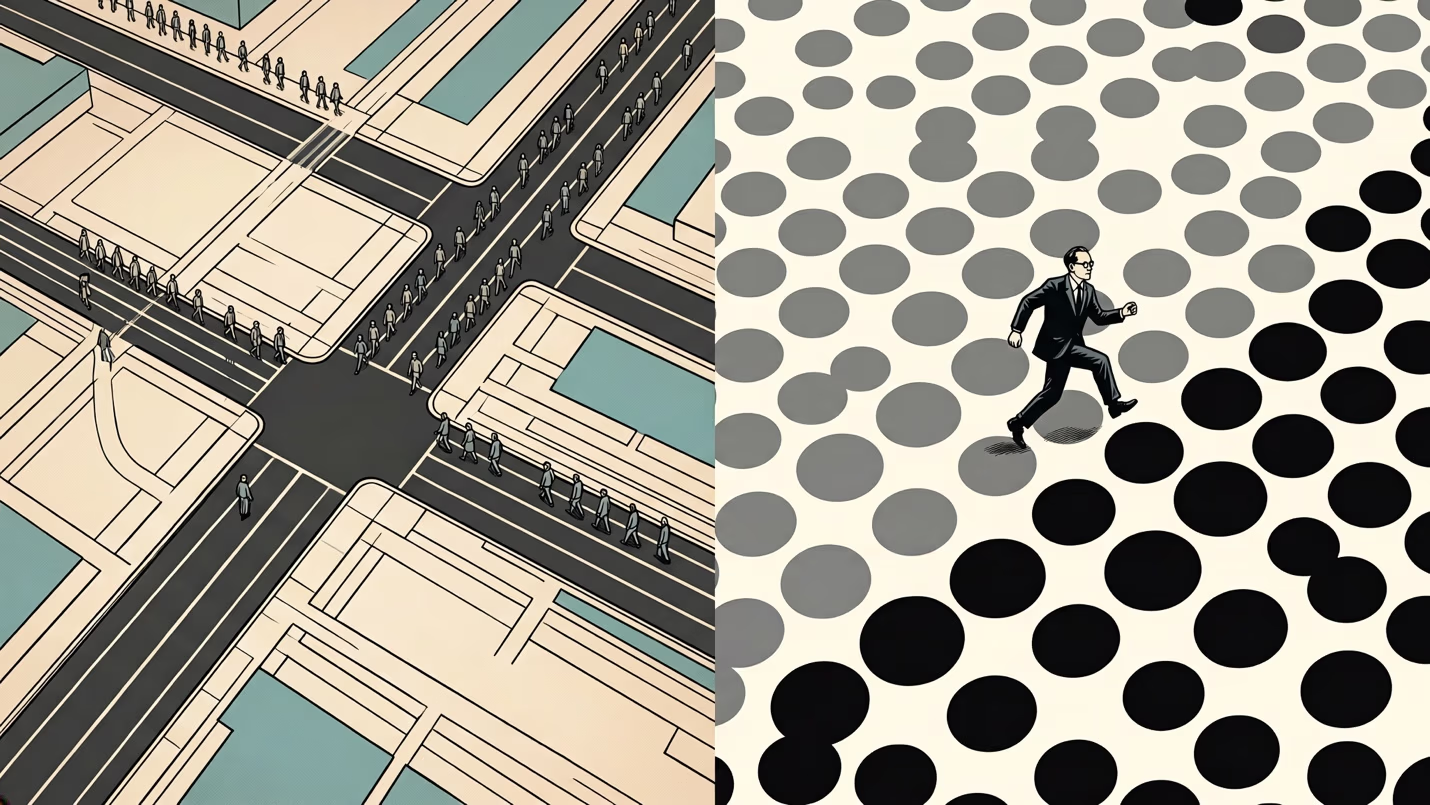

The English Charlie Chaplin was so struck by this strange lack of sociability of North Americans in public places that he based his entire saga on the little man who goes out and finds nobody to talk with. Chaplin's films stress the failure of policemen to chat, and also of waiters and employers, and even of fellow workers.
“Inside on the Outside, or the Spaced-Out American” (1976), in Marshall McLuhan: The Man and His Message (1989), p 142
Year: 1976
The mobile home is a very obvious repeat of the covered wagon. Nothing could be more going out to be alone. Only the paradox there is that you are using the American home which is social space as a form of solitude.
Scharfe interview (1976), transcript, p 3
Year: 1976
It goes without saying that there is very little privacy in the North American home because we do not seek it there but, rather, outside in our cars.
“Inside on the Outside, or th Spaced-Out American” 1976, p 5 of typescript; reprinted in Marshall McLuhan: the Man and His Message (1989)
Year: 1976