Viewing chapter Print (61 quotes)
The MECHANIZATION of writing mechanized the visual-acoustic metaphor on which all civilization rests; it created the classroom and mass education, the modern press and telegraph. It was the original assembly-line.
Marshall McLuhan
Counterblast, (1969), p 15
Year: 1969
But at the same time, print technology has homogenized man, creating mass militarism, mass mind and mass uniformity. Print gave man private habits of individualism and a public role of absolute conformity.
“Playboy Interview: Marshall McLuhan: A Candid Conversation with the High Priest of Popcult and Metaphysician of Media.” By Eric Norden. Playboy Magazine, March (1969), p 70, reprinted in The Essential McLuhan (1995), p 259
Year: 1969
Print created national uniformity and government centralism, but also individualism and opposition to government as such.
The Gutenberg Galaxy: The Making of Typographic Man, (1962), p 235
Year: 1962
By the time of the power press in the early 19th century, the newspapers were rapidly changing the character of politics by creating public opinion. In a new country like America the new medium of the press created the first instance of a state founded on public opinion. English political forms, predating the press, still depend much less on public opinion, as do those of Canada.
Counterblast, (1969), 125
Year: 1969
The mask of the printed page revealed the paradigms of precision and quantity to the new science, setting the stage for Gailelo and the Royal Society alike.
“Roles, Masks and Performances” (1971), p 528
Year: 1971
Print as a means of retrieving the past was unrivaled in scope and intensity, and made available the entire world of antiquity, which had been only slightly accessible in manuscript form. It also made available the entire world of scholasticism, which, for the most part, had been an oral form of culture based on sententious aphorism.
From Cliché to Archetype with Wilfred Watson (1970), p 189
Year: 1970
Joyce reminds us that all forms of publication are a form of miming and replaying of events as a process of social catharsis and cleansing. It is a function that Eliot refers to as the poet’s major concern: since our concern was speech and speech compelled us to purify the dialect of the tribe. …
“Understanding Megascenes,” Print: America’s Graphic Design Magazine, July/August 1970, Vol XXIV: IV, 20-21
Year: 1970
Feudalism was an emotional system of corporate loyalties tied to a shared image, like a primitive totem symbol. Feudalism melted before the impact of gunpowder and printing.
Culture is Our Business, (1970), p 54
Year: 1970
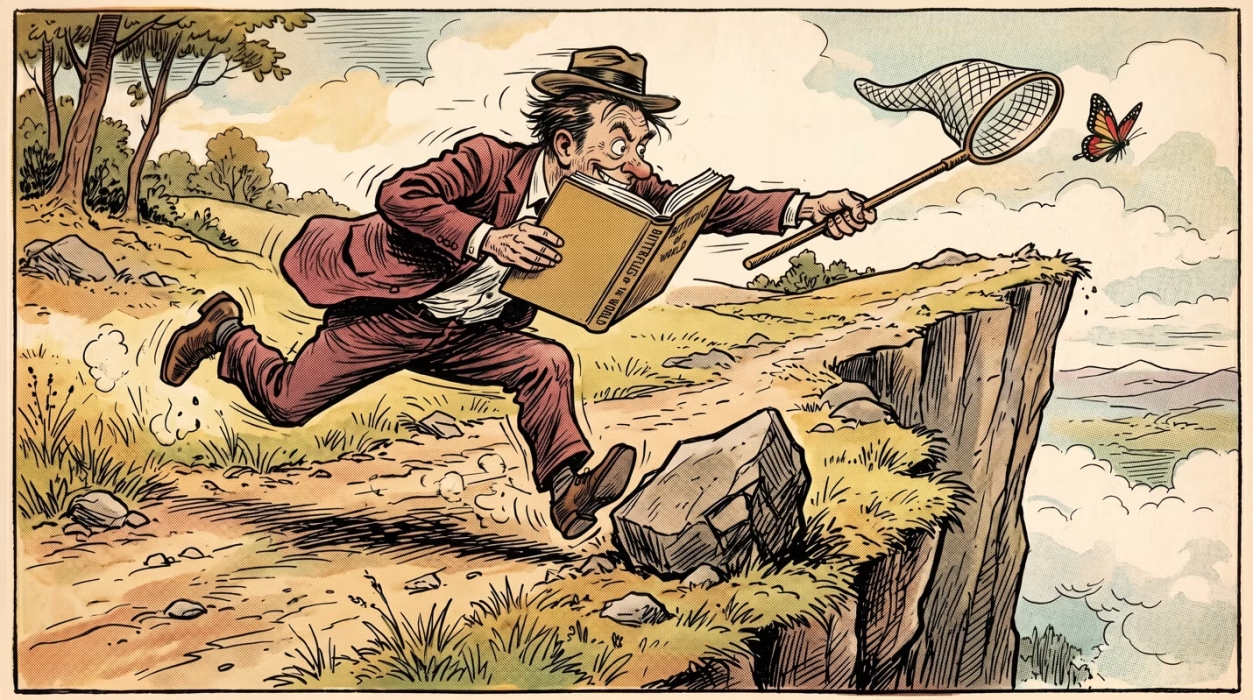

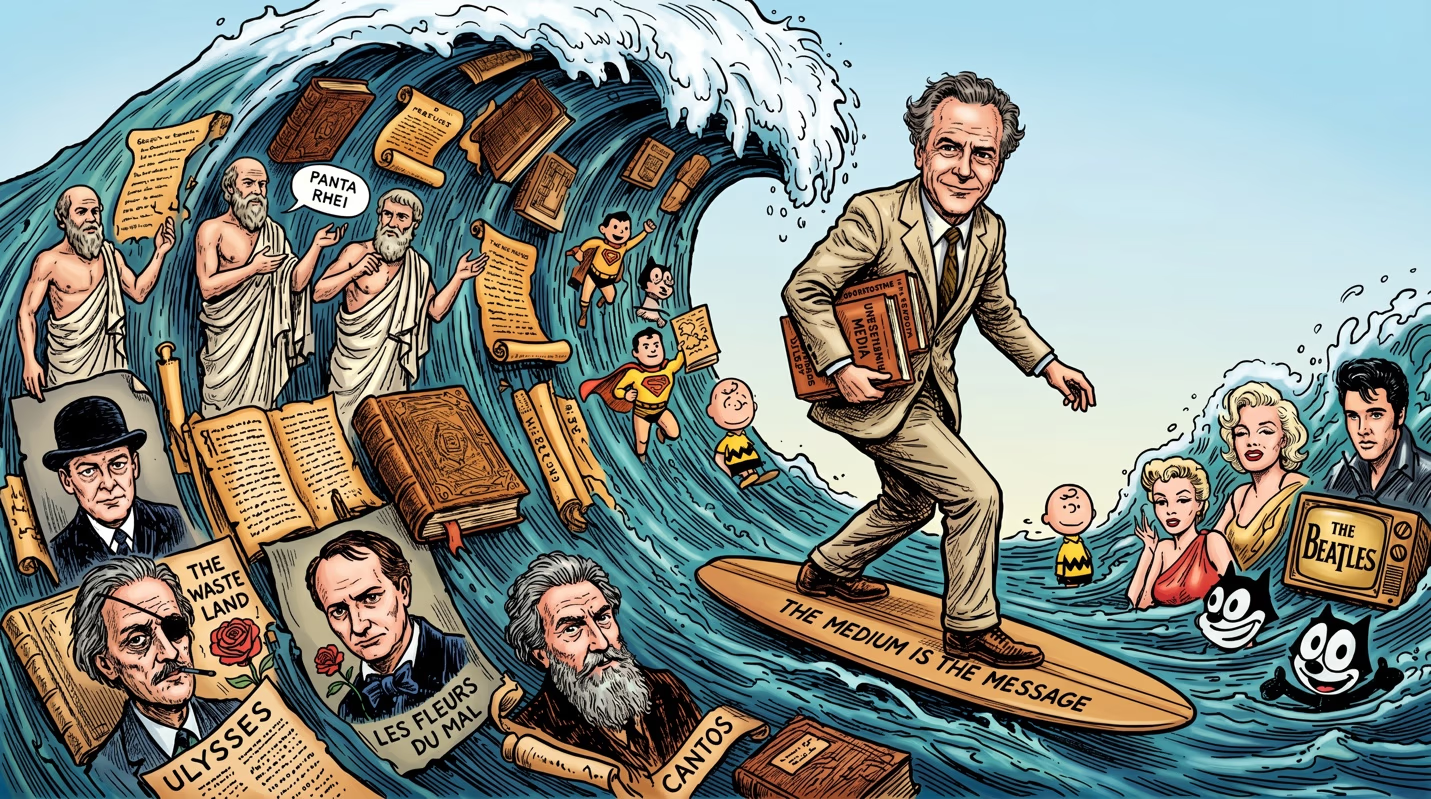
Print changed not only the quantity of writing, but the character of language & the relations between author & public.
“Classroom Without Walls” (1957)
Year: 1957
Machiavelli saw the new private morality created by the new specialist technology of print as creating new political goals.
From Cliché to Archetype with Wilfred Watson (1970), p 46
Year: 1970
Chapters:
Anticipating Change | Technology
It was not until printing extended the visual faculty into very high precision, uniformity, and intensity of special order that the other senses could be restrained or depressed sufficiently to create the new awareness of infinity.
Understanding Media (1964), MIT/Routledge edition, p 115
Year: 1964
Printing upset the balance of oral and written speech; photography upset the balance of ear and eye.
“Five Sovereign Fingers Taxed the Breath”, in Shenandoah The Washington And Lee University Review, Vol. VII, No. 1, Autumn (1955), p 51, reprinted in Explorations 4, (1955), p 32, Explorations in communication: an anthology (1960), p 208
Year: 1955
Chapter:
Balance
Thus there arose from print a new kind of corporate life in the school and a new kind of privacy in the study.
New Media and The New Education, Paper presented at DAVI convention March (1960), reprinted as (Exhibit 1) in NAEB Report on Understanding New Media, June (1960), p i
Year: 1960
Schizophrenia may be a necessary consequence of literacy.
The Gutenberg Galaxy : The Making of Typographic Man , (1962), p 22
Year: 1962
Chapter:
Literacy
The printed book had encouraged artists to reduce all forms of expression as much as possible to the single descriptive and narrative plane of the printed word. The advent of electric media released art from this straitjacket at once, creating the world of Paul Klee, Picasso, Braque, Eisenstein, the Marx Brothers, and James Joyce.
Understanding Media, 1964, MIT/Routledge edition, p 54
Year: 1964
The new electronic interdependence recreates the world in the image of a global village.
The Gutenberg Galaxy : The Making of Typographic Man , (1962), p 36
Year: 1962
Chapter:
Global Village
The alphabet is an aggressive and militant absorber and transformer of culture, as Harold Innis was the first to show.
The Gutenberg Galaxy : The Making of Typographic Man , (1962), p. 56
Year: 1962
Chapter:
Alphabet
The invention of typography confirmed and extended the new visual stress of applied knowledge, providing the first uniformly repeatable ‘commodity’, the first assembly line, and the first mass-production.
The Gutenberg Galaxy : The Making of Typographic Man , (1962), p 124
Year: 1962
Scribal culture could have neither authors nor publics such as were created by typography.
The Gutenberg Galaxy: The Making of Typographic Man , (1962), p 149
Year: 1962
Typography tended to alter language from a means of perception and exploration to a portable commodity.
The Gutenberg Galaxy : The Making of Typographic Man , (1962), p 161
Year: 1962
Typography is not only a technology but is in itself a natural resource or staple, like cotton or timber or radio; and, like any staple, it shapes not only private sense ratios but also patterns of communal interdependence.
The Gutenberg Galaxy: The Making of Typographic Man, (1962), p 164
Year: 1962
With Gutenberg, Europe enters the technological phase of progress, when change itself becomes the archetypal norm of social life.
The Gutenberg Galaxy: The Making of Typographic Man, (1962), p 155
Year: 1962
Print, in turning the vernaculars into mass media, or closed systems, created the uniform, centralizing forces of modern nationalism.
The Gutenberg Galaxy: The Making of Typographic Man, (1962), p 199
Year: 1962
The subject of nationalism and print has been held back until now lest it usurp the entire book. It will be the easier to handle the complex of issues now that we have encountered similar groupings of issues in quite different areas of experience. The present volume to this point might be regarded as a gloss on a single text of Harold Innis: “The effect of the discovery of printing was evident in the savage religious wars of the sixteenth and seventeenth centuries. Application of power to communication industries hastened the consolidation of vernaculars, the rise of nationalism, revolution, and new outbreaks of savagery in the twentieth century.”
The Gutenberg Galaxy: The Making of Typographic Man, (1962), p 216 *Quote mentioned: The Bias of Communication, (1951), p. 29,
Year: 1962
Nobody will question that it was the medium of print that then gave the vernaculars new functions, and utterly changed the uses and relevance of Latin.
The Gutenberg Galaxy: The Making of Typographic Man, (1962), p 224
Year: 1962
Print altered not only the spelling and grammar but the accentuation and inflection of languages, and made bad grammar possible.
The Gutenberg Galaxy: The Making of Typographic Man, (1962), p 231
Year: 1962
Nobody ever made a grammatical error in a non-literate society.
The Gutenberg Galaxy: The Making of Typographic Man, (1962), p 238
Year: 1962
[Print] is a delirium. It is a transforming and metamorphosing drug that has the power of imposing its assumptions upon every level of consciousness. But for us in the 1960s, print has much of the quaint receding character of the movie and the railway train. In recognizing its hidden powers at this later date we can learn to stress the positive virtue of print but we can gain insight into the much more potent and recent forms of radio and television also.
The Gutenberg Galaxy: The Making of Typographic Man, (1962), p 259-260
Year: 1962
... print demanded both personal fragmentation and social uniformity, the natural expression of which was the nation-state.
“Playboy Interview: Marshall McLuhan: A Candid Conversation with the High Priest of Popcult and Metaphysician of Media.” By Eric Norden. Playboy Magazine, March (1969), p 60, reprinted in Essential McLuhan (1995), p 244
Year: 1969
The alphabet, when pushed to a high degree of abstract visual intensity, became typography. The printed word with its specialist intensity burst the bonds of medieval corporate guilds and monasteries, creating extreme individualist patterns of enterprise and monopoly.
Understanding Media, 1964, MIT/Routledge edition, p 23
Year: 1964
Chapters:
Alphabet | Individual
Typography extended its character to the regulation and fixation of languages.
The Gutenberg Galaxy, 1962, p 229
Year: 1962
The divorce of poetry and music was first reflected by the printed page.
The Gutenberg Galaxy, 1962, p 200
Year: 1962
Chapter:
Poetry
Hence, self-expression was of little interest. Typography, however, created a medium in which it was possible to speak out loud and bold to the world itself, just as it was possible to circumnavigate the world of books previously locked up in a pluralistic world of monastic cells. Boldness of type created boldness of expression.
Understanding Media (1964), MIT/Routledge edition, p 178
Year: 1964
The bureaucratic organization of print cliche with uniform products and prices gives rise to capitalism as well as to the corporate activities of the scientist. This became more and more pronounced during the seventeenth and eighteenth centuries. Adam Smith and Ben Franklin are sufficient exemplars of the glorification of fragmentation applied to industry and morals alike.
Print provoked the development of nationalism, because, for the first time, everyone could see their mother tongue and not just hear it. In fact, people's consciousness of their national identity took root in a visual ground. The world of print is visual.
“Keys to the Electronic Revolution,” Interview, Pierre Babin, 1977, in The Medium and the Light (1999), p 47
Year: 1977
Chapter:
Specialism
The psychic and social consequences of print included an extension of its fissile and uniform character to the gradual homogenization of diverse regions with the resulting amplification of power, energy, and aggression that we associate with the new nationalism.
Understanding Media, 1964, MIT/Routledge edition, p 175
Year: 1964
Print split apart words and music; but printed scores made possible the elaborate instrumentation of seventeenth- and eighteenth-century music.
Counterblast, 1969, p 92
Year: 1969
Perhaps even the mechanization of writing [print] greatly as it modified the experience of the Western world, was a minor event when set between writing itself.
“Prob. of Reading,” handwritten unpublished essay, circa 1952
Year: 1952
Behind us are five centuries during which we have had unexampled access to aspects of private consciousness by means of the printed page. But now anthropology and archaeology give us equal ease of access to group postures and patterns of many cultures, including our own.
“Myth and Mass Media” (1960), reprinted in Media Research (1997), p 9
Year: 1960
The oligarchic reign of these figures was swiftly liquidated by printing, a technique that shifted attention from the audience to the mental state of the individual reader.
“Myth and Mass Media” (1960), reprinted in Media Research (1997), p 9
Year: 1960
Print simply wiped out the main modes of oral education that had been devised in the Greco-Roman world and transmitted with the phonetic alphabet and the manuscript throughout the medieval period. And it ended that 2500-year pattern in a few decades.
“What Fundamental Changes Are Foreshadowed In The Prevailing Patterns Of Educational Organization And Methods Of Instruction By The Revolution In Electronics?”, paper presented to Discussion Group 16 at the Fourteenth National Conference on Higher Education, March 3, 1959, p 2
Year: 1959
And just as print profoundly altered the structure of the phonetic alphabet and repatterned the educational processes of the Western world, so did the telegraph· reshape print, as did the movie and radio and television.
“What Fundamental Changes Are Foreshadowed In The Prevailing Patterns Of Educational Organization And Methods Of Instruction By The Revolution In Electronics?”, paper presented to Discussion Group 16 at the Fourteenth National Conference on Higher Education, March 3, 1959, p 2
Year: 1959
My theory is only acceptable to Thomists for whom consciousness as analogical proportion among the senses from moment to moment, is quite easy to grasp. But print technology actually smashes that analogical awareness in society and the individual.
Letter to Walter J. Ong, Nov. 18, 1961, in Letters of Marshall McLuhan (1987), p 280
Year: 1961
One effect of writing was to make possible cities, roads, armies, and empires. The letters of the alphabet were indeed the dragon's teeth. The printed book not only fostered nationalism but made it possible to bring the world of the past into every study.
“Sight, Sound and the Fury”, in The Commonweal, April 9, 1954, p 10
Year: 1954
Time measured not by the uniqueness of private experience but by abstract uniform units gradually pervades all sense life, much as does the technology of writing and printing.
Understanding Media, 1964, MIT/Routledge edition, p 204
Year: 1964
Any individual who manipulates the public for his private good may also feel the cleansing power of publicity.
Understanding Media, 1964, MIT/Routledge edition, p 216
Year: 1964
Chapter:
Celebrity and Fame
Supported by the Gutenberg technology, the power of the dunces to shape and befog the human intellect is unlimited.
The Gutenberg Galaxy, 1962, p 262
Year: 1962
The same spirit of private enterprise that emboldened authors and artists to cultivate self-expression led other men to create giant corporations, both military and commercial.
Understanding Media, 1964, MIT/Routledge edition, p 172-173
Year: 1964
God the clockmaker and engineer of the universe is no more an essential visual image to the West than is the identity card or the visual classification as an image of private personal status.
Through the vanish point with Harley Parker, 1968, p 254
Year: 1968
The printed book… created the solitary student. It set up the rule of private interpretation against public disputation. It established the division between “literature and life.”
“Sight, Sound and The Fury,” in Commonweal, April 9, 1954, Vol. 60, No. 1, p 7
Year: 1954
Print, by definition uniform and repeatable, not only created the very concept of “commodity” but made possible markets for such uniform and repeatable commodities. That the operation of the forms and matrices of the print assembly line when extended to all forms of production should also have shaped our attitudes to elite activities is quite natural. In England and America alike the elites have been lotus-eaters, elegant consumers of imported goods simply because a print-oriented world is a consumer world.
“Popular/Mass Culture, Speech” (1960), in Understanding Me (2003), p 15
Year: 1960
[The printed word is] the architect of nationalism.
Understanding Media (1964), MIT/Routledge edition, p 170
Year: 1964
Print teaches consumer habits and outlook as well. Print teaches the habit of sequential analysis and of fragmentation of all motion into static units. Print teaches habits of privacy and self-reliance and initiative. It provides a massive visual panorama of the resources of our mother tongue which preliterate people know only by ear. In fact, print is not only access to our culture and technology, it is our culture and technology.
“Electronic Revolution: Revolutionary Effects of New Media” (1959), reprinted in Understanding Me (2003), p 3
Year: 1959
Chapter:
Reading
The print-made split between head and heart is the trauma which affects Europe from Machiavelli to the present.
The Gutenberg Galaxy, 1962, p 170
Year: 1962
Print, then, challenged the corporate patterns of medieval organization as much as electricity now challenges our fragmented individualism.
Understanding Media, 1964, MIT/Routledge edition, p 176
Year: 1964
A fixed point of view becomes possible with print and ends the image as a plastic organism.
The Gutenberg Galaxy, 1962, p 126
Year: 1962
The MECHANIZATION of writing mechanized the visual acoustic metaphor on which all civilization rests. It created the classroom and mass education, the modern press and the telegraph. It was the original assembly line.
“Five Sovereign Fingers Taxed the Breath”, in Explorations in Communication. An Anthology with Edmund Carpenter (1960), p 208
Year: 1960
Chapter:
Writing
And whereas private, Western man shuns and deplores the invasion of his privacy by the historian or by the psychologist, the tribal or corporate man feels no such reluctance in checking the psychic and social effects of technology.
“The Future of the Book�� (1972), in Understanding Me (2003), p 177
Year: 1972
Thoughts transposed into type are in effect published, and publication removes the expression of those thoughts from the intimate and personal sphere. Publication is a self-invasion of privacy.
Counterblast (1969), p 103
Year: 1969
The need for clannish protection of information grew out of the extreme slowness of movement of such information. The diplomatic pouch has never been in a hurry.
Take Today with Barrington Nevitt, 1972, 92
Year: 1972
Nothing is as simple as yesterday’s solution, and nothing so complicated as tomorrow’s problems.
From the “Lists of One-Liners and Longer Jokes” kept at the Centre for Culture and Technology by Magaret Stewart and George Thompson, 1973 (with additions made later)
Year: 1973
The inventor of writing changed the entire psychological outlook of mankind.
“Prob. of Reading,” handwritten unpublished essay, circa 1952, p 1
Year: 1952