Viewing chapter Problem Solving (20 quotes)
It might be possible to solve any problem by organizing our ignorance; there’s always one guy who’s so ignorant he can’t help but see the answer. That’s called discovery.
Quoted by Thomas W. Cooper from a 1976 Seminar in his dissertation, Pioneers in Communication: The Lives and Thought of Harold Innis and Marshall McLuhan, University of Toronto, 1979, p 207
Year: 1976
In the age of the information hunter, feed-back yields to feedforward, the point of view becomes the probe. Problems become discoveries.
Culture Is Our Business, (1970), p 80
Year: 1970
Chapter:
Hunters of Information
Thus, in the scientific order, it was not the "answers" that presented the problem in the case of the atom bomb , but the question: "Can the atom be split?" Working backwards, as always, in the conditions of electric information, one need only know the right question in order to find the right answer.
Politics as Theatre, in Performing Arts in Canada 10 (4), p 15 (Winter 1973)
Year: 1973
Chapter:
Bomb
When Jove had a migraine, it turned out to be Minerva.
Culture Is Our Business, (1970), p 27
Year: 1970
Chapter:
Breakdown as Breakthrough
Alexander Graham Bell, while trying to remove defects from the telegraph, invented the telephone.
Culture Is Our Business, (1970), p 28
Year: 1970
Chapter:
Breakdown as Breakthrough
All discoveries in art and science result from an accumulation of errors.
Culture is Our Business (1970), p 28
Year: 1970
Chapter:
Breakdown as Breakthrough
This strange gap between the specialist, visual world and the integral, auditory world needs to be better understood today above all, for it contains the key to an understanding of what automation and cybernetics imply.
“Cybernation and Culture” (1966), pp 97-98
Year: 1966
The consultant has become a new type of job. The man who asks questions now is more important than the man who has the answers.
Jean Pare interview, in Forces magazine a Hydro Quebec publication, No.22, (1973), p 19
Year: 1973
Chapter:
Jobs
For our problems, like our means and opportunities, are of a scope beyond those of any previous age.
“Symbolist Communication,” a review of A Reading of George Herbert by Rosemond Tuve in Thought, Autumn (1952), p 457
Year: 1952
Chapters:
Advice | He’s Doubtful and Hopeful
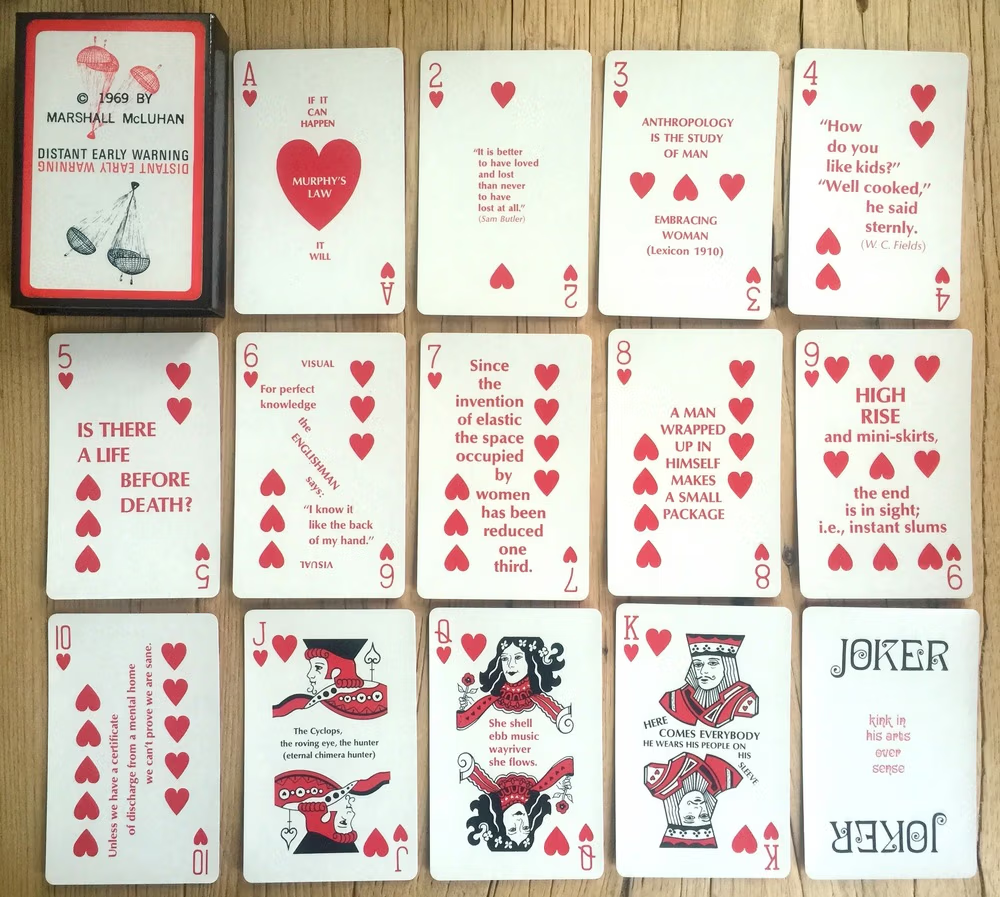
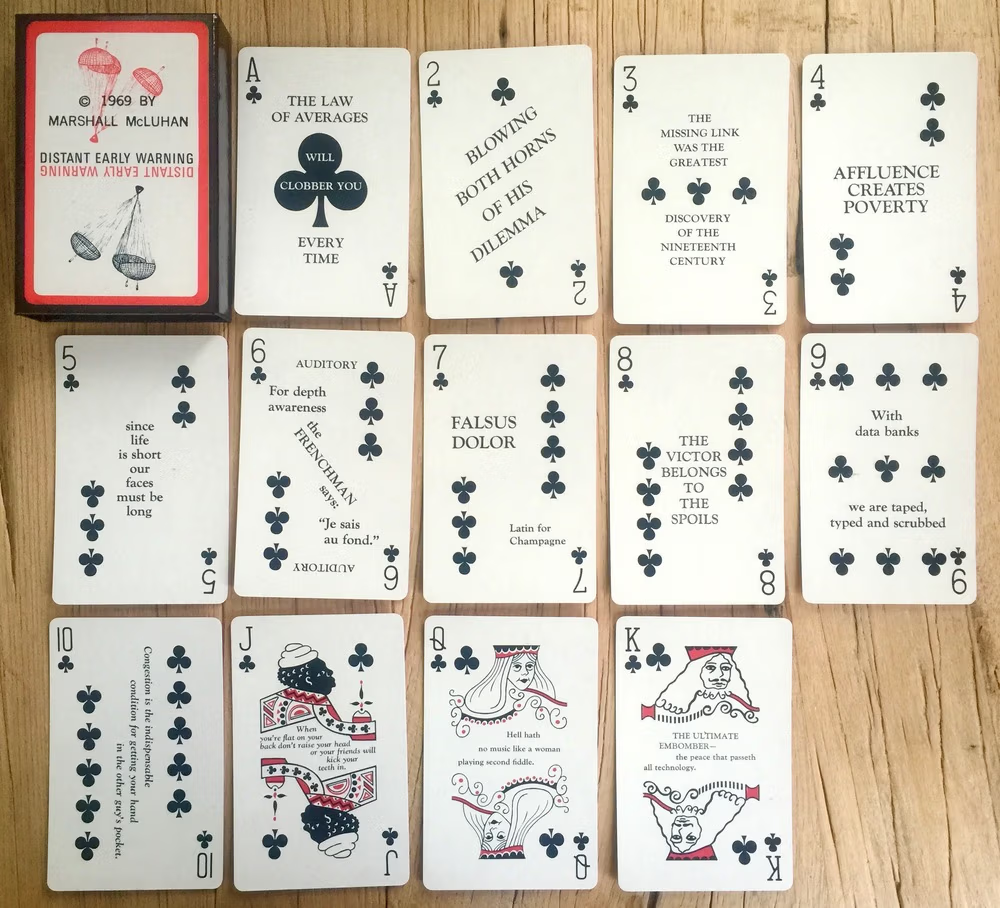
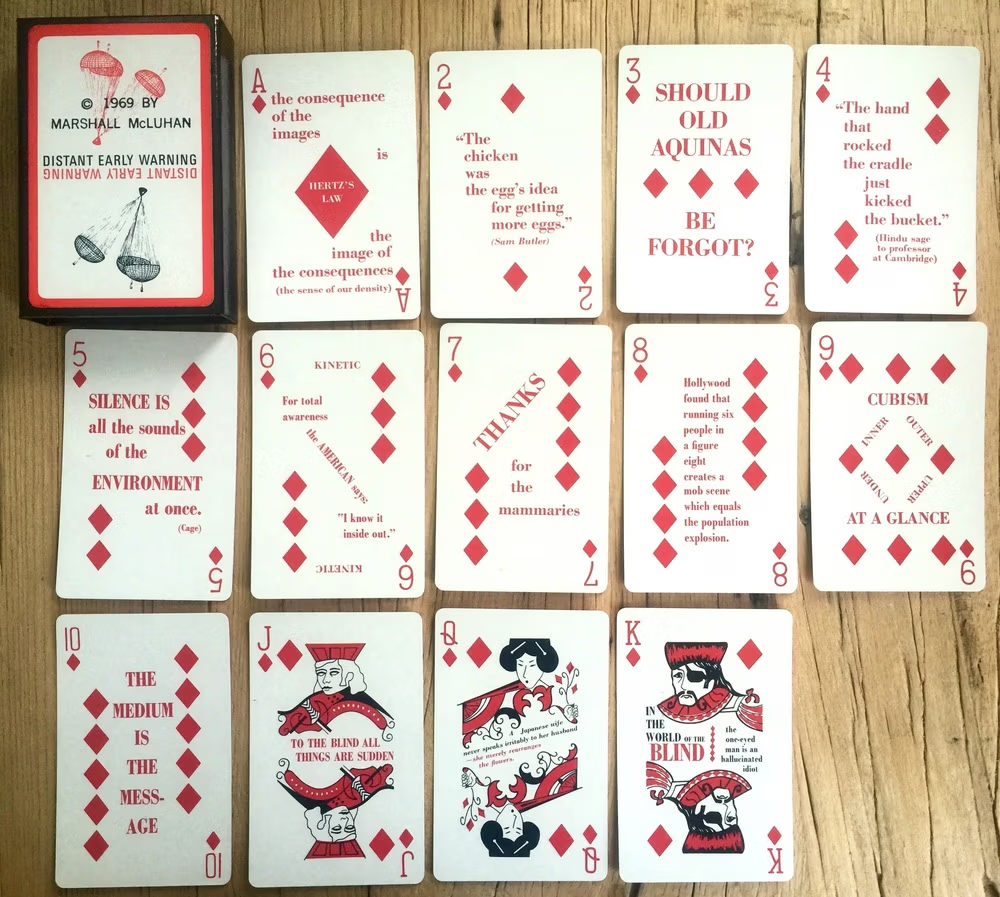
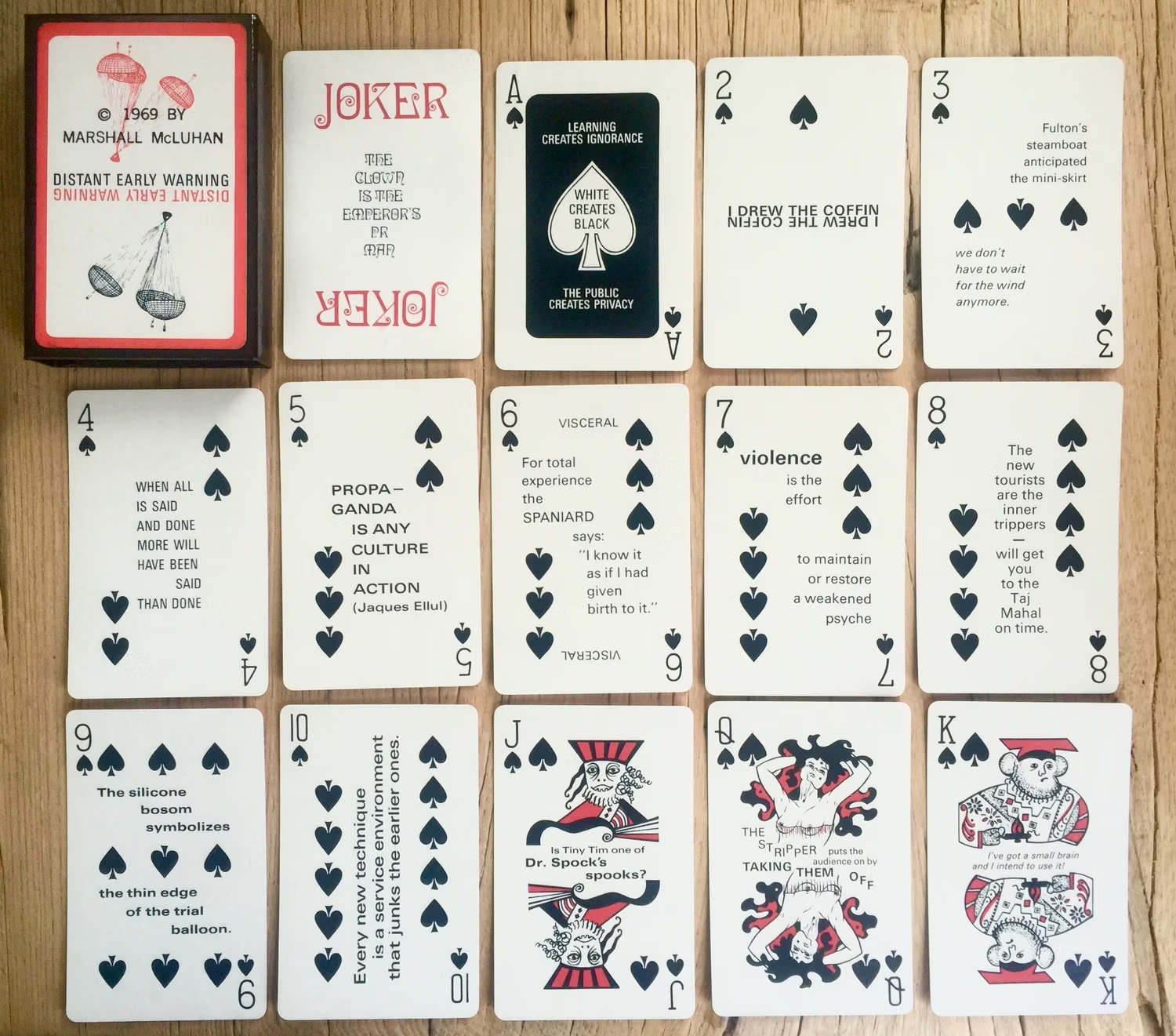
Our problem is to get more films into this school. Relate that problem to the aphorism on the card. He was amazed at the variety of solutions that immediately appeared. In a word, the deck has turned out to be a superior form of operations research, although intended merely for fun.
Letter to Ann Landers, December 17, 1969, in Letters of Marshall McLuhan (1987), p 393
Year: 1969
Chapter:
Media Education
At present, when the problem of identity has become a major hang-up in the cultures of the world as a result of technological and environmental changes (with corresponding loss of identity images, both private and corporate), the twin gestalt offers a major beach-head into the identity crisis which psychologists need desperately.
“Letter to Ann Landers, December 17, 1969”, in Letters of Marshall McLuhan (1987) p 393
Year: 1969
When you’re looking for new answers to new questions, it’s knowledge itself that blocks progress.
“Living in an Acoustic World,” Public Lecture at the University of South Florida, 1970. “McLuhan Speaks” Transcript, p 8
Year: 1970
For example, both Hitler and Gandhi, and many others in this century, were made possible by the electric P.A. system and by radio. Anybody who wants to moralize about radio has to dump Gandhi and Hitler into the same pot.
Letter to Monday Morning, 1970
Year: 1970
The immediate need and future of education is not in the dissemination of knowledge, but of ignorance. The open university of the U.K. made the ordinary mistake of putting the old curriculum and old classroom on the new TV media. The immediate need is for these media to bring, to the microphone and the studio, people from every field of knowledge and endeavour to explain to the public not their knowledge, but their ignorance; not their expertise, but their hang-ups; not their breakthroughs, but their breakdowns.
Convocation address U. of Alberta, November 20th, 1971
Year: 1971
Most human attention is allocated to the 90% area which is the area of problems. The 10% area is the area of irritation and also of opportunity. It was the genius of Harold Innis that he refused to be distracted by the 90% area of problems. He went straight to the 10% core of opportunity and sought insight into the causes that underlay the whole situation. For example, he writes: "We are perhaps too much a part of the civilization which followed the printing industry to be able to detect its characteristics. Education in the words of Laski became the art of teaching men to be deceived by the printed word.
“Introduction to The Bias of Communication” (1962), reprinted in Theories of Communication with Eric McLuhan (2011), p 107
Year: 1962
For solutions lie not outside, but inside the problems themselves. We can find them by recognizing their process patterns. Both the approach and the patterns are recurring topics of this book.
Take Today with Barrington Nevitt (1972), p 247
Year: 1972
In the “Fourth World” of organized ignorance, media technology may bring a drastic reversal of historic patterns of problem solving.
“At the Flip Point of Time – The Point of More Return?” (1975), p 1
Year: 1975
I propose a means of bridging this gap between the world of the genius and the child. It is this: instead of broadcasting our learning, let us advertise our problems; instead of giving the answers, let us give the questions. Twentieth century man has been called one who runs down the street shouting: “I have the answers. What are the questions?”
From an untitled, undated 4-page typescript in praise of ignorance (early 1970s), p 2
Year: 1970
Chapters:
Advice | Questions He Asks
You can’t solve problems using the in-crowd. There’s always some guy sufficiently ignorant of the problem to see the solution.
Reported from a Monday Night Seminar by Thomas Cooper, cited in his Wisdom Weavers (2025)
Year: 2025