Viewing chapter Putting On (32 quotes)
The new political showman has to literally as well as figuratively put on his audience as he would a suit of clothes and become a corporate tribal image — like Mussolini, Hitler and F. D. R. in the days of radio, and Jack Kennedy in the television era.
“Playboy Interview: Marshall McLuhan: A Candid Conversation with the High Priest of Popcult and Metaphysician of Media.” By Eric Norden. Playboy Magazine, March (1969), p 61, reprinted in Essential McLuhan (1995), p 247
Year: 1969
The judge puts on his robes (and, in England, his wig) by way of assuming the corporate authority of the community. So bedecked, he is not a private person, and he is not allowed to speak to anybody as a private person until he has removed his costumes…The stripper puts on her audience by taking off her clothes. Thus clad, she is not a private person. Backstage, in whatever situation, she is a private person. Stripped of her audience, she is nobody.
Take Today with Barrington Nevitt (1972), p 274
Year: 1972
An actor puts on his audience as a poet puts on his language. A stripper puts on her audience as she takes off her clothes.
Culture Is Our Business, (1970), p 131
Year: 1970
The robes of judge invest him with a role, not a job. He puts on the community, not a dress.
“Megascene Section: The Mini-State and the Future of Organization,” in The Dew-Line Newslettter, Vol. 1, #7, January, 1969
Year: 1969
A stripped backstage is naked but when she is in front of an audience she is wearing her public.
Quoted in “Streaking: A Mad Dash to Where?: A Form of Assault” by Robert D. McFadden, NY Times Mar 8, 1974
Year: 1974
The Beatles do this. They are a group of people who suddenly were able to put on their audience and the English language with musical effects—putting on a whole vesture, a whole time, a Zeit.
The Medium Is the Massage (1967), pp 113-114
Year: 1967
Dress is private and individual, and one can "dress up" or " dress down," but costume is corporate putting on of a society itself.
“Roles, Masks and Performances (1971) in McLuhan Unbound (2017), p 19
Year: 1971




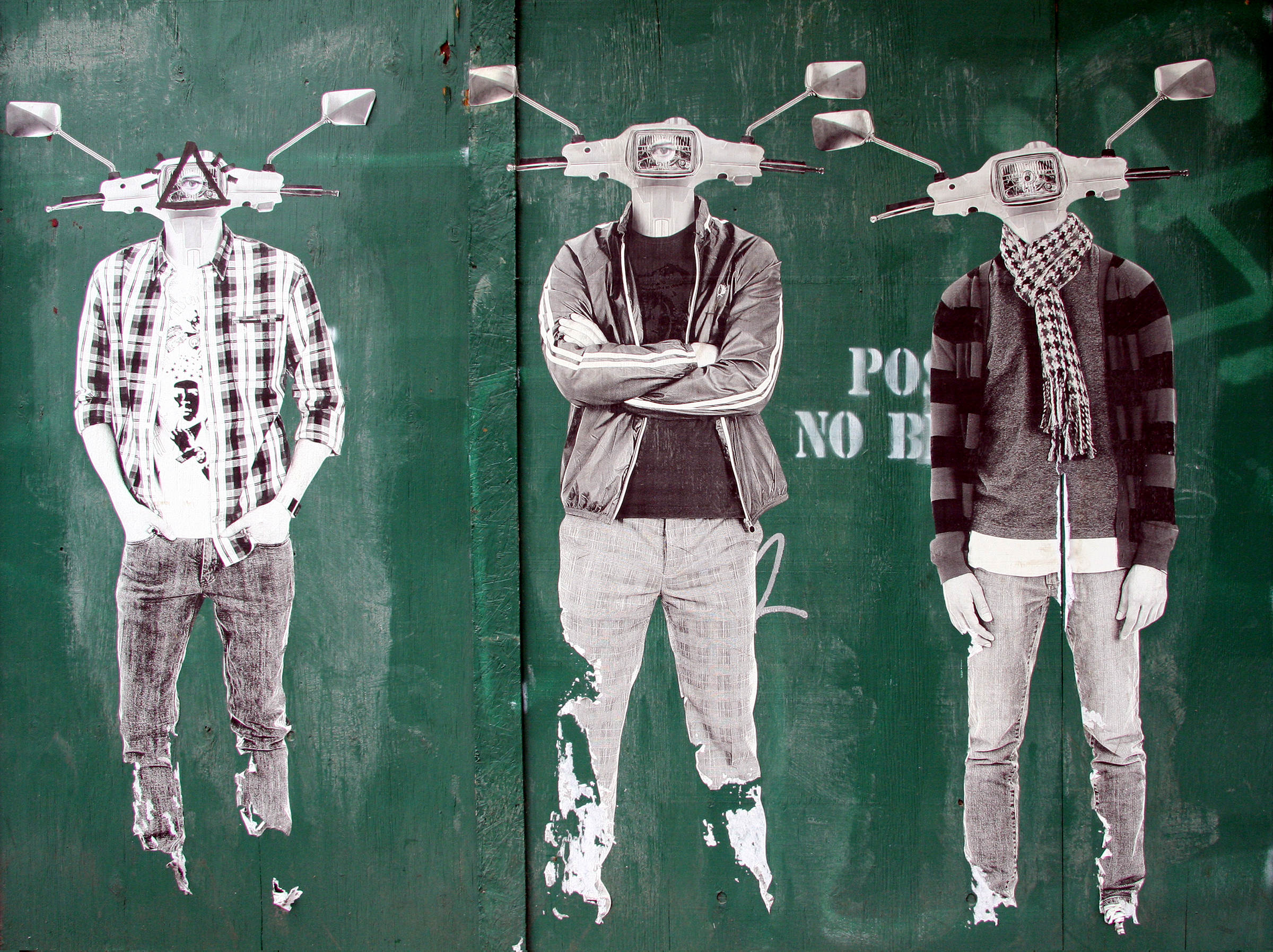


It is natural to speak of a "period costume" since it is not private but corporate dress.
“Roles, Masks and Performances (1971) in McLuhan Unbound (2017), p 19
Year: 1971
…you see, when you put on a mask you're no longer seeking a private goal, if you've put on a little masquerade mask, like this, it means, you're prepared to play fun and games, and its corporate and festive and it's the difference.
Said on Dick Cavett Show, 1970, transcript, 10.50
Year: 1970
To get into a role as opposed to merely having a job, is to put on the corporate social power of one's culture.
From Cliché to Archetype, with Wilfred Watson (1970), p 204
Year: 1970
What the young are obviously telling us is this: we want beards, we want massive costumes and vestments for everybody. We do not want any of this simple, plain, individual stuff. We want the big corporate role.
“Electric Consciousness and the Church” (1970), in The Medium and the Light (1999), p 83
Year: 1970
Chapter:
Youth
So, it's like the mini, the mini skirt is a tribal corporate costume, powerful, the midi is merely a private dress, it's not corporate and this is the mystery of the mini and the midi.
Said on Dick Cavett Show, 1970, transcript, 11:40
Year: 1970
The reader ‘puts on” the poem as a mask. He becomes its “content” by adjusting himself to use the poem as a means of perceiving the world. This new means of perceiving is the meaning of the poem for him. The user is always the content of any medium, whereas the message is the totality of effects whether intended or not. Both James Joyce and T.S. Eliot understood that we can have the experience of any medium, be it print or radio or TV, without discovering the meaning until long afterwards.
“Medium Meaning Message” (1974), p 30
Year: 1974
The nude is in role. The naked person is like Lear, someone who has been dressed down and stripped of his role. The strip-teaser takes off her clothes in order to put on her audience. On stage she may be nude, but the moment she steps backstage she is naked. The audience is her mask.
“Roles, Masks, and Performances,” New Literary History, Vol. 2, No. 3, Performances in Drama, the Arts, and Society, Spring, 1971
Year: 1971
“You’re putting me on” is very important to an understanding of our time, because to “put somebody on” is to rob him of a part of himself.
“Understanding Canada and Sundry Other Matters”, interview in Mademoiselle Magazine, January 1967, p 115
Year: 1967
What is the effect on a person who speaks into a phone that is bugged or tapped? Simply this, such a person speaks as if to a highly specialized audience. He “puts on” his audience. He wears a corporate mask like any other speaker. Private discourse ends. In the long run, the effect of bugging phones, like the effect of computer data banks, is to obliterate all private individuality.
“McLuhan on Russia” 1971, p 192
Year: 1971
Chapter:
Surveillance
Charles Chaplin assembled a mask made up of bookkeeper, music hall entertainer, gallant and romantic searcher, then with genius added a touch of Pavlova… His footwork he acquired from the Ballet Russe. This touch transformed all the other components of his image, creating an overall effect of artistic spirituality and lent great power to the crass everyday features of his mask. None of the components in his mask correspond to anything that was the private C. Chaplin. Rather he chose carefully…just those items which gave him maximum corporate appeal.
“Public and Private Sectors” (1964), pp 5-6
Year: 1964
You can put people on by holding their attention as power, or they can put you on as power for them, as in Orson Welles´s Invasion from Mars´ broadcast.
“Technology and the Human Dimension” (interview with Louis Forsdale, 1974), in MM: The Man and His Message (1989), p 13
Year: 1974
Everyone will be involved in role-playing, including those few elitists who interpret and/or manage large-scale data patterns and thus control the functions of a speed-of-light society.
“Ma Bell Minus the Nantucket Gam”, with Bruce Powers, in Journal of Communication, Summer, 1981, p 199
Year: 1981
The wearer drops his private identity in order to assume a corporate identity.
“International Motley and Religious Costume”, 1972, in The Medium and the Light, 1999, p 75
Year: 1972
I suggest that there are no American symphony conductors, Leonard Bernstein having grown up in his early years at least in Vienna, that an American conductor, no matter how much he knows about orchestras or publics, is not able to dramatize himself in the way of putting on the whole orchestra as his private mask or corporate mask, nor is he able to put on the whole public as a mask, whereas a European doesn't even think about this as a problem.
“TV as a New Mythic Form”, 1970, in Understanding Me, 2003, p 168
Year: 1970
Insofar, however, as this "put on" is a kind of takeover of a corporate social role, it is inevitably represented as usurpation and deprivation by those who have to forego some of their private power and function in order to make this corporate role possible.
“International Motley and Religious Costume” (1972), in The Medium and the Light, (1999), p 77
Year: 1972
The religious who put on some of the available corporate powers of their society in order to function in a role are seen by many job-holders as usurpers.
“International Motley and Religious Costume” (1972), in The Medium and the Light (1999), p 77
Year: 1972
The funny man as a professional clown puts on the corporate mask of a collective grievance. Jack Benny's stingy grimace and W. C. Fields' choleric profile serve to siphon off great stores of collective irritation and frustration in a society.
From Cliche to Archetype, 1970, p 133
Year: 1970
Chapter:
Playfulness
To speak with the mechanical precision of a machine has been an aspect of the comic mask worn by the corporate English upper class for some decades.
From Cliché to Archetype with Wilfred Watson (1970), p 145
Year: 1970
Where literate man regarded an alias or mask as deceiving, re-presenting something other than the true self, the tribesman often has several faces, carefully painted, each representing a self in a corporate role. When you wear a mask, you assume a corporate identity. You "put on” the audience. Unlike a job, a role is total: one assumes it, identifies completely with it, steps into it.
“McLuhan Looks at Fashion” (1968) in On the Nature of Media, 2016, p 147
Year: 1968
There is something rather mysterious about the process of the “pout on” which is inseparable from communication. Badelaire’s famous phrase “hypocrite lecteur mon sembable, mon frere” captures the entire process. The reader is hypocrite in the very act of putting on the author’s poem as his mask, for in reading the poem he is perceiving the world in a very special way…
“AT the Moment of Sputnik –” (1974), typescript p 9
Year: 1974
When we read a poem or listen to a song, we put on an extension of our language. Such extensions bring into relation to us the experiences of multitudes of lives. These experiences can be the means of enlarging or sharpening and enriching our private perceptions. However, when we “put on” an entire service environment such as radio or TV, something more seems to happen…
“Putting on the Media” (1971), p 7
Year: 1971
Chapter:
New Criticism
When you put on a man’s ignorance you put him on totally. Such is the power of the news leak. It has all the character of everybody’s ignorance and therefore can be ignored by nobody.
“Representation without Taxation,” unpublished essay on xerography, 1971, typescript, p 6
Year: 1971
Chapter:
Ignorance
If you put on a corporate voice the moment you step outside it means that you put on the speech that belongs to your class. And we don’t do that. Therefore we don’t have a class system. Class has more to do with voice than it has to do with economics.
Carl Scharfe interview (1976), transcript p 4
Year: 1976
In TV news, you are the studio on the air, not just a private person being put on a medium. In other words, you, as user, are putting on the medium. Instead of reporters, you have only performers. The audience as actor and as user puts on the whole medium as his mask of power. It is an extension of himself.
“Sharing the News” (1971), p 3
Year: 1971
The business of any performer… is to put on the audience, not to speak to the audience.
Quoted from an L.A. Times interview by Nick Ripatrazone in Digital Communion: Marshall McLuhan’s Spiritual Vision for a Virtual Age, 2022, pp 64-65 of the epub edition
Year: 2022