Viewing chapter Questions He Asks (50 quotes)
It is more important to know what the right questions are than what the right answers are.
Marshall McLuhan
Jean Pare interview, in Forces magazine a Hydro Quebec publication, No.22, (1973), p 19
Year: 1973
I propose a means of bridging this gap between the world of the genius and the child. It is this: instead of broadcasting our learning, let us advertise our problems; instead of giving the answers, let us give the questions. Twentieth century man has been called one who runs down the street shouting: “I have the answers. What are the questions?”
Marshall McLuhan
From an untitled, undated 4-page typescript in praise of ignorance (early 1970s), p 2
Year: 1970
We might ask ourselves what is the consequence of living in one age and thinking in another.
“The Nerves of Government”, 1964, p 3
Year: 1964
Is it natural that one medium should appropriate and exploit another?
McLuhan: Hot and Cool, edited by Gerald Emanuel Stearn, 1967, p. 156. This question also serves as the title of an essay in this book, beginning on p 151
Year: 1967
How many parts of the body are extended in a single computer?
“Social Impact of the Computer”, March 20-23,1979, speech in Monaco, typescript, p 3
Year: 1979
What happened to the book after the newspaper? To the book after the movie? To the book after radio and television? Nobody seems to know.
“The Medium Is the Message” (1960), in McLuhan Unbound #17, (2017), p 14
Year: 1960
Chapter:
Media Study
What are some of the advantages of the ideogram over our alphabet?
Projects and Questions -Writing, in NAEB Report on Understanding New Media, June (1960), p 40
Year: 1960
By contrast, does a form of writing that favors attention to one-thing-at-a-time foster instability and change?
Projects and Questions -Writing, in NAEB Report on Understanding New Media, June (1960), p 40
Year: 1960
Chapter:
Media Study
How often do you change your mind, your politics, your clothes?
The Mechanical Bride, 1951, p 73
Year: 1951
Chapter:
Change
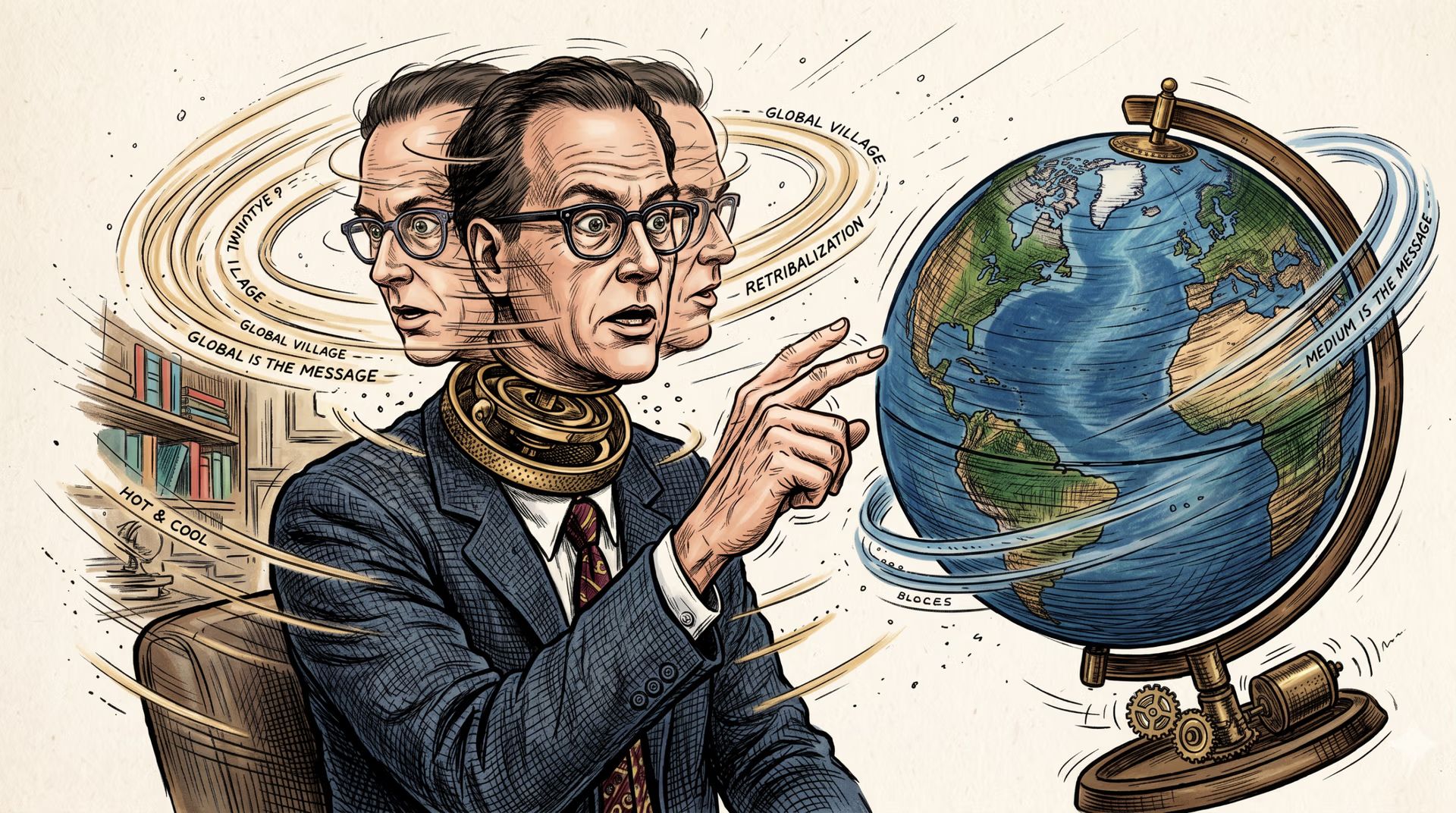
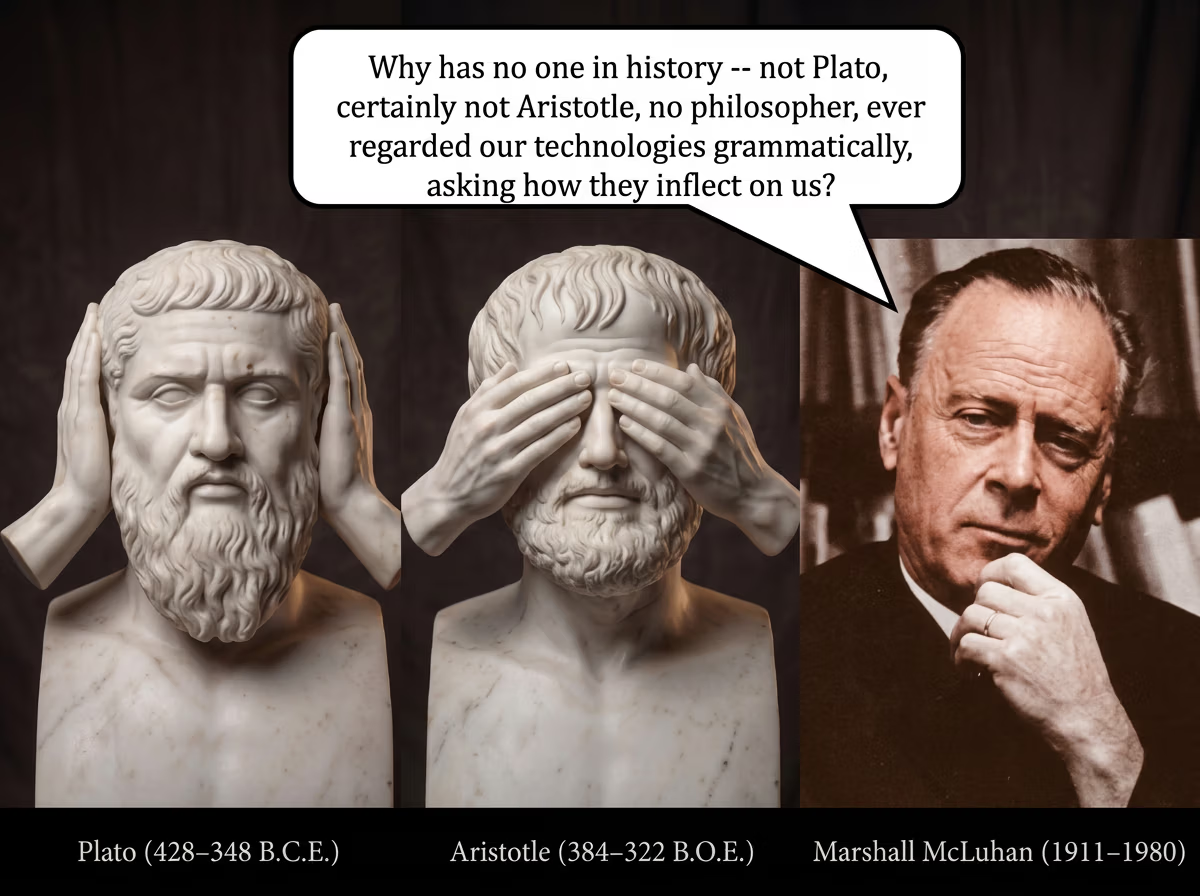
Why should pre-literate people have no concept of words as referring to things, but only of words as being things?
Projects and Questions -Writing, in NAEB Report on Understanding New Media, June (1960), p 40
Year: 1960
Is the man of the ear a conservative, and the man of the eye a liberal?
NAEB Report on Understanding New Media, June (1960), p 40
Year: 1960
Is it possible for a mathematical proposition or demonstration to have content?
Projects and Questions -Writing, in NAEB Report on Understanding New Media, June (1960), p 41
Year: 1960
Is the print, engraving, cartoon, etc., a low or high-definition form of statement?
Projects and questions – Prints, in NAEB Report on Understanding New Media, June (1960), p 60
Year: 1960
Chapter:
Cartoons, Comics
How would a large population know how to feel about a large number of ever-changing matters without a daily press?
Projects and Questions -Press, In NAEB Report on Understanding New Media, June (1960), p 73
Year: 1960
Chapter:
News
What effect did the photograph have on the manner of writing newspaper stories?
Projects and Questions – Photography, in NAEB Report on Understanding New Media, June (1960), p 81
Year: 1960
What was the effect of photography on international affairs?
Projects and Questions – Photography, in NAEB Report on Understanding New Media, June (1960), p 81
Year: 1960
Did Technicolor movies make travel unnecessary?
Projects and Questions – Photography, in NAEB Report on Understanding New Media, June (1960), p 81
Year: 1960
Is there more participation, less passivity in film clips than in a whole movie?
Projects and Questions – Photography, in NAEB Report on Understanding New Media, June (1960), p 81
Year: 1960
What has been the effect pf the photograph on human attire from the tintype onward?
Projects and Questions – Photography, in NAEB Report on Understanding New Media, June (1960), p 81
Year: 1960
Why did the telegraph, the telephone and the phonograph become so tightly intertwined in their origin and development?
Projects and Questions- Phonograph, in NAEB Report on Understanding New Media, June (1960), p 109
Year: 1960
What has been the effect of the phonograph on the development of the orchestra?
Projects and Questions- Phonograph, in NAEB Report on Understanding New Media, June (1960), p 109
Year: 1960
Why should the early phase of the phonograph have created a hardening of the musical categories?
Projects and Questions- Phonograph, in NAEB Report on Understanding New Media, June (1960), p 109
Year: 1960
How does the LP [the long-playing record] alter the roles of the phonograph?
Projects and Questions- Phonograph, in NAEB Report on Understanding New Media, June (1960), p 109
Year: 1960
Why should the broken lines of the television mosaic emphasize the sculptural contours of objects?
Projects and Questions -Television, in NAEB Report on Understanding New Media, June (1960), p 133
Year: 1960
Chapter:
Television
When does a mechanical code of transmission of information itself become a language? Under what conditions does a language revert to a code of transmission? With our new coding devices today [such as movies]… we are setting about to establish whether these means of transmission have themselves so deeply altered human sensibilities and reshaped human institutions as to have acquired the status of new languages.
“The Medium Is the Message”, (1960), p 22
Year: 1960
What happens when the ad makers take over all the popular myths and poetry?
Are ads themselves the main form of industrial culture?
“Freedom-American Style” in The Mechanical Bride, (1951), p 117
Year: 1951
Chapter:
Advertising
Why has sculpture traditionally been spoken of as the voice of silence?
Projects and Questions, in NAEB Report on Understanding New Media, June (1960), p 133
Year: 1960
Speech as organized stutter is based on time. What does speech do to space?
NAEB Report on Understanding New Media, June (1960), p 133
Year: 1960
If speech is organized stutter, is [unspeaking] stutter disorganized speech?
NAEB Report on Understanding New Media, June (1960), p 133
Year: 1960
The book itself was the first mechanical mass medium. What is really being asked, of course, is: Can books monopoly of knowledge survive the challenge of the new languages? The answer is, no. What should be asked is: What can print do better than any other medium and is that worth doing?
Mass Media and Retention , in NAEB Report on Understanding New Media, June (1960), p 157
Year: 1960
How much of sixteenth-century Protestantism was political ploy and how much doctrinal conviction?
“Liturgy and the Media” (1973), p 14
Year: 1973
[Commenting on the Lord Calvert’s whiskey “Men of Distinction” ad]
Is it what’s in the jigger that makes them bigger?
The Mechanical Bride, (1951) p 56
Year: 1951
Is not Poe's anomalous combination of Romantic self-knowledge and rationalistic procedure somewhat the result of his anomalous Southern experience? Did not the curious time-lag created in the South by the belated strength of Jeffersonian rationalism produce a remarkable fusion of reason and romantic angst? In Europe that fusion never occurred in the same stark way because Rousseauistic attrition of the Enlightenment intervened. But in Edgar Poe one observes the unmediated union as it were of the attitudes of Voltaire and Novalis, of Shaftesbury and Lord Byron.
“Footprints in the Sands of Crime”, in The Sewanee Review (1946), p 634
Year: 1946
Chapter:
Poe, Edgar Allan
[Questions he often asked students and friends upon seeing them afresh]
What’s on your mind? What have you learned since we last talked? Heard any good jokes?
David Nostbakken, in Paolo Granata’s Monday Night Webinar, June 8, 2020
Year: 2020
[Father John] Culkin recalled that, whenever he returned from a conference, McLuhan always asked him the same two questions. “Did you learn anything? Get any new jokes?”
Reported from McLuhan’s Funeral, Holy Rosary Church, Toronto, January 3, in the Toronto Star, January 4, 1981, p A13
Year: 1981
It is more important to know what the right questions are than what the right answers are.
“Jean Pare interview”, in Forces magazine a Hydro Quebec publication, No.22, (1973), p 19
Year: 1973
Chapter:
McLuhanisms & Zingers
Personally, I have always found questions more interesting than answers, and probes more exciting than product.
Letter to John Polanyi, January 4, 1974, in Letters of Marshall McLuhan (1987), p 487
Year: 1974
A BOOK IS THE DEATH OF A TREE… What is a TV program the death of?
McLuhan Hot and Cool (1967), p 117
Year: 1967
How far was the rapid development of complex musical composition the result of ease in visualizing musical structures as a result of written and printed scores?
Review of Paul Klee (1953), p 78
Year: 1953
Is TV a massive Bauhaus program of re-education for the North American sense life? That is to query whether the TV image is, in effect, a haptic, tactile, or synthetic mode of interplay among the senses, a fulfillment on a popular plane of the estehtic program of Hildebrand, Berenson, Wolfflin, Paul Klee and Giedion.
“Inside the Five Sense Sensorium” (1961), p 50
Year: 1961
How much behaviorism is needed to make a big mental proletariat behave?
The Mechanical Bride (1951), p 26
Year: 1951
What happens when the ad makers take over all the popular myths and poetry?
The Mechanical Bride (1951), p 117
Year: 1951
Chapter:
Advertising
If there were not coverage of any sort of war, no reports, no information, how would this change the nature of war?
“Information Hunt Looms Big” (1967), p 5
Year: 1967
Chapter:
War
Can anyone make the news save in print? On TV can anyone be said to have made the Cavett show or the “Today” show? If not, why not?
“Sharing the News” (1971), p 8
Year: 1971
Can all of these forms of visual experience now be by-passed by acoustic and discarnate Man of the present electric world environment ?
Liturgy And Media” in The Critic, Vol.31, No. 3, January-February (1973), p 23, reprinted in reprinted in The Medium and the Light: Reflections on Religion (1999), p 131
Year: 1973
One might ask how many parts of the body are extended in a single
computer, quite apart from the computer circuit itself which is an extension
of our central nervous system.
“Social Impact of the Computer,” 1978, pages 9b and 10 of typescript of a speech he delivered at the World Convention on Payment Systems and Electronic Funds Transfer, Monte Carlo, 20-23 March, 1979. Typescript, p 3
Year: 1978
Chapter:
Computer
Does the interiorization of media such as letters alter the ratio among our senses and change mental processes?
The Gutenberg Galaxy, 1962, p 28
Year: 1962
For Vico contains Wordsworth, Freud, and Malinowski by anticipation in answering the questions: "exactly how do people so remote in time or culture or condition as
Lucy Gray or Ivanhoe or a neurotic or a Trobriander feel? What is the world they know?"
“Inside Blake and Hollywood”, 1947, reprinted in McLuhan Unbound (2017)
Year: 1947
Why should the broken line of the television mosaic emphasize the sculptural contours of objects?
McLuhan Hot and Cool, 1967, p 158
Year: 1967
Chapter:
Television
This raises a major issue for us all to study: Namely, when does a mechanical code of transmission of information itself become a language? Under what conditions does a language revert to a code of transmission? With our new coding devices today such as movies and TV, tapes, discs, radio, teletype and so on, we are setting about to establish whether these means of transmission have themselves so deeply altered human sensibilities and re-shaped human institutions and attitudes as to have acquired the status of new languages.
From a speech to the NAEB, Sept. 23, 1959, reprinted in Cameron McEwen’s blog, McLuhan’s New Sciences.
Year: 1959
What use is there made of radio in the movie, because the form is then translated into another medium and some of its characteristics are high-lighted. What happens to a telephone in a Broadway play? What use is there made of telephone in drama which tells you a lot about the telephone?
“The Electronic Revolution in North America”, 1959, p 10
Year: 1959
Chapters:
Media Reprocess Media | Radio
What is your concept of the happening in relation to museums? Are museums happenings in the new sense of the word?
The Museum as Large-Room Pinball Machine, Marshall McLuhan, Harley Parker, and Museum Professionals, 1967, full transcript of a seminar at the City Museum of New York, October, 1967, edited by William Buxton, U. of Alberta Press, 2026, p 174
Year: 1967
Chapter:
Museum