Viewing chapter Replay (31 quotes)
Experience is play, and meaning is replay and re-cognition.
“The Quantum Leap from Science to Art”, in Take Today with Barrington Nevitt, 1972, p 142
Year: 1972
Chapters:
Cognition and Recognition | Playfulness
Instant replay enhances awareness of the cognitive process. It obsolesces the representational, the chronological, in that it doesn't matter in what sequence the events occurred.
“Man and Media,” lecture delivered at York University, Toronto, (1979), in Understanding Me (2003), p 288
Year: 1979
This is a rather startling aspect of the instant replay; you can have the meaning, the structure, minus the experience of the event. And it flips into corporate pattern recognition, which is easily associated with tradition. The instant replay is, perhaps, the most remarkable development of our time, and one of the most profound and metaphysical.
“Man and Media,” lecture delivered at York University, Toronto, (1979), in Understanding Me (2003), p 288
Year: 1979
Chapter:
Pattern Recognition
Is not the instant replay the externalizing of the cognitive principle itself? For the replay would seem to offer both cognition and re-cognition; the same pattern of reversal, in the transition from the industrial to the electric age, appears in the role of Sputnik (1957) in placing the planet inside a man-made environment.
"The Implications of Cultural Uniformity", in SUPERCULTURE: American Popular Culture and Europe, 1975, p 54
Year: 1975
Chapter:
Cognition and Recognition
Courtney suggests that dramatic play begins with impersonation when a child is nearly a year old. It is an act of externalization of the internalized perceptions, that is, a kind of re-cognition, a re-play. Re-play may be a form of cognition; it is also a form of interpretation, a dramatic performance involving actors and audience.
“Roles, masks and Performances” (1971), reprinted in McLuhan Unbound (2017), p 15
Year: 1971
Chapters:
Cognition and Recognition | Playfulness
Now, in the case of playback, you are in the presence of the artistic process. An artist always says: How could I get that effect? I must go back and replay it. So what has happened to football since the replay is that the public now demands that the game be changed so that they an see the process by which the effects are attained. The games are even halted until the replays are completed on TV. It isn’t just halted for the ads, but for the replays.
“Speaking Freely,” interview with Edwin Newman on WNBC-TV, December 27, 1970; transcript, p 9
Year: 1970
Experience translated into a new medium literally bestows a delightful play-back of earlier awareness.
Understanding Media, 1964, MIT/Routledge edition, p 211
Year: 1964
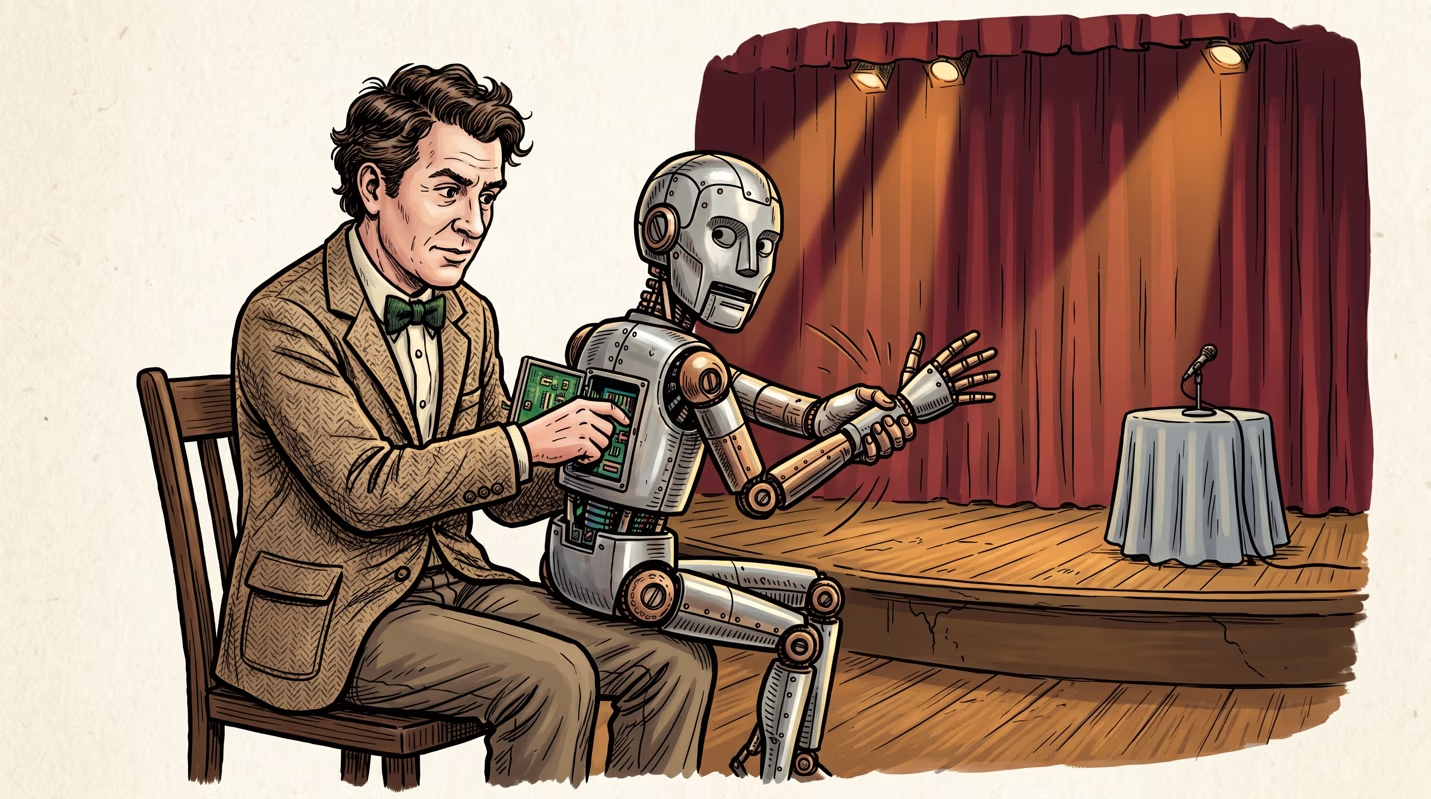
The population of the world is both the cast and content of this new theater. The repertory of the theater consists of a perpetual HAPPENING, which can include the retrieval or REPLAY of any previous happenings that men choose to experience.
Take Today with Barrington Nevitt (1972), p145
Year: 1972
The dominant technologies of one age become the games and pasttimes of a later age. In the twentieth century the number of past times that are simultaneously available is so vast as to create cultural anarchy.
From Cliché to Archetype with Wilfred Watson (1970), p 99
Year: 1970
I think the instant replay is probably the most powerful experience that you will ever have in your lifetime.
Addressing students in the class of his brother, Maurice McLuhan, at the Sheridan School of Art & Design, Mississauga, Ontario, in January, 1975 (caught on video by Richard Kerr-Ed.).
Year: 1975
One feature of TV that seems not to appear in the printed form is the re-run.
Whether it be a game or a contest, a documentary or movie TV offers means of retrieval and recovery, both of events, and of the public that went with the event. The print form provides access to those who wish to re-read or study, but those opportunities are only for the specialist, the archeologist and the researcher. For TV, however, there is not past. What it retrieves is the eternal present.
“Sharing the News” (1971), p 8
Year: 1971
One of the conflicts of a progressive and rapidly changing world concerns the use of surrounding services which have been obsolesced by daily innovations and discoveries. A vast new industry has been born from this conflict, and its name is 'Camp', and its motto is: 'Throw something lovely away today. Help beautify junkyards'. Despite the grotesque aspect of 'Camp' as the incessant revival of that which has scarcely had a chance to register its appearance or existence, it has already been itself obsolesced by the popular technology of the video replay. The instant replay, available mainly to the audiences of sporting events, offers, as it were, the meaning minus the experience, reversing Mr. Eliot's observation that “we had the experience but missed the meaning”. The instant replay is the meaning in that it is less concerned with the input of experience than with the process of perception.
“The Implications of Cultural Uniformity” (1973), in Superculture: American Popular Culture and Europe, (1975), p 44
Year: 1973
However, in the new age of the instant replay, news takes on a totally new dimension that is almost metaphysical. A ball game or a horse race can now be replayed for its meaning, as it were, minus the experience. During the actual experience the issue may have been in doubt, but, as the poet explains, “we can have the experience and miss the meaning.” In fact, such is the nature of experience that it is almost inevitable that we miss the meaning. The “meaning” or the relation of ourselves to a particular event, may not come home to us until much later.
“At the Moment of Sputnik—” (1974), typescript, p 10
Year: 1974
But in an instant replay, in effect you say: Let us stop this action, halt it, arrest, hold it. Then you say: Now what has just happened in this game, had this effect? Let us se how we achieved this effect. Let us replay that action, and observe how this particular effect was obtained. Now, this is the attitude of every artist to every artistic production. He says, in effect: hold that action – I want to capture it in another medium.
Speaking Freely,” interview with Edwin Newman on WNBC-TV, December 27, 1970, transcript, pp 8- 9
Year: 1970
The public sometimes bring their own sets, to watch the replays during the game!
“Speaking Freely,” interview with Edwin Newman on WNBC-TV, December 27, 1970, transcript, p 9
Year: 1970
Note that in sports, the “play back” is cool. This is recognition, not cognition.
Letter to A.E. Manatas, April 28, 1970 [LAC]
Year: 1970
Experience translated into a new medium literally bestows a delightful play-back of earlier awareness.
Understanding Media, 1964, MIT/Routledge edition, p 211
Year: 1964
The replay is post-mortem, an instant post-mortem, not of a fact but of a process. It is not matching—which visual man would do—but making. Now, visual man was hung up on the idea of matching as a criterion of Truth. Under electric conditions, at the speed of light, there can never be matching, only making.
“Technology and the Human Dimension”, Louis Forsdale Interview, 1974 , in MM: The Man and His Message (1989), p 19
Year: 1974
Chapters:
Matching and Making | Dropout
“Camp” is popular because it gives people a sense of reality to see a replay of their lives.
“Interview with MM: His Outrageous Views About Women,” in Miss Chatelaine, September 3, 1974, p 2
Year: 1974
Now, in the case of playback, you are in the presence of the artistic process. An artist always says: How could I get that effect? I must go back and replay it. So what has happened to football since the replay is that the public now demands that the game be changed so that they can see the process by which the effects are attained. The games are even halted until the replays are completed on TV. It isn’t just halted for the ads, but for the replays.
“Speaking Freely,” interview with Edwin Newman on WNBC-TV, December 27, 1970, transcript, p 9
Year: 1970
When a visitor stepped into an antique store, he asked: “What’s new?” His jocular query draws attention to the fact that we live in the age of the fake antique, which is itself a form of the replay. Is not “news” itself a replay of he newspaper medium of events that have occurred in some other medium, and does not this replay quality in reporting urge us to narrow the margin between the event and the replay? Does this not make us define news as “the latest”?
“At the Moment of Sputnik—” (1974, typescript p 10
Year: 1974
[Asking a famous quarterback the effect of the instant replay] …and he said, We now have to play the game in such a way that the audience can watch the actual process that we’re performing…. They’re not any longer interested just in the effect of the play, they want to see the nature of the play…
Speech at Monday Conference (ABC-TV Australia), August, 1977, transcript, p 10
Year: 1977
Dear Miss Koenig:
May I suggest a possible title to replace [your magazine title] WEEK-END? The word RE-PLAY. This word, with all its connotations of sports and recreation, has some hidden suggestions that are quite powerful and meaningful. For example, a re-play is also re-cognition, and re-cognition, unlike cognition, is a moment of pattern recognition. That is, a moment when the meaning of experience comes home to us. Most people have experiences for which meanings are a long time in arriving. Without the RE-PLAY, the experience of the preceding week might never achieve any meaning.
Letter to Rhoda Koenig, LIFE STYLE MAGAZINE, May 30, 1972
Year: 1972
All physical, psychic and social processes merge in constant play and replay. There are no more spectators in lab or life, only participants in the Global Electric Theatre.
“Symposium” (1973), typescript p 10
Year: 1973
Chapter:
Paradox
I want to point out, one of the strange things about the movie when it was new, at the beginning of the century, it seemed hilarious, it seems comic, simply because it was so perfect, a repeat of ordinary experience ordinary living. It became, the movie in its early phase, was a parody of life, an imitation of life in a comic sense, because it just went along para hados [in parallel] against or along beside the track of real life. The picture track, the movie picture track and the track of real life, were almost interchangeable and this creates a very comic effect. Realism, when new, is comic. Hilarious. Go back to the days of Samuel Pepys and Daniel Defoe and you'll see what I mean. But with the coming of realism, prose realism, it was a new mythic form that created a very comic and satirical world. This was the great age of satire, realistic forms created a comic and satiric effect in the case of peep´s diary and in the case of Defoe, Robinson Crusoe sort of thing. One of the reviewers of Robinson Crusoe said “Mr. Defoe has represented the British Isles as totally depopulated”. This I found very valuable and comical sidelight, on the effect of realism on people for whom realism was new.
Videotaped Fordham lecture, “Joyce and Film” (1968), (Youtube), Transcript, 31:24
Year: 1968
Chapter:
Movies
Because for rational beings to see or re-cognize their experience in a new material form is an unbought grace of life. Experience translated into a new medium literally bestows a delightful playback of earlier awareness. The press repeats the excitement we have in using our wits, and by using our wits we can translate the outer world into the fabric of our own beings. This excitement of translation explains why people quite naturally wish to use their senses al l the time. Those external extensions of sense and faculty that we call media we use as constantly as we do our eyes and ears, and from the same motives.
Understanding Media, 1964, MIT/Routledge edition, p 211
Year: 1964
Chapter:
News
It is perfectly expressed in Henry Ford's dream of a rural-village Utopia to be achieved by mass production-- the nostalgia for a past which evades the inner logic of the inventions of the world to which it has contributed so much.
The Mechanical Bride, 1951, p 5
Year: 1951
If you are seeing a replay, it is very different from seeing the play. The replay shows you how the play was made. The instant replay is drawing more and more attention to the
actual process of how the game is played... how the play is put together.
“It Will Probably End the Motorcar” (1976), p 27
Year: 1976
A ball game or a horse race can now be replayed for its meaning, as it were, minus the experience.
“At the Moment of Sputnik” (1974), typescript, p 10; also “Man and Media” (1979) in Understanding Me, (2003), p 277
Year: 1974
Referees and judges may wait for the replay in order to render a decision. They have had the experience and are merely waiting for the meaning or the relation of the experience to themselves and to others.
At the Moment of Sputnik-- 1974 p 10 of typescript
Year: 1974
It is time to ask ourselves: "What is news.' When a visitor stepped into an antique store, he asked: "What´s new.” His jocular query draws attention to the fact that we live in the age of the fake antique, which is itself a form of the replay.
“At the Moment of Sputnik” (1974), in MM: Man and His Message (1989), p 79
Year: 1974