Viewing chapter Space (41 quotes)
The new multi-sensuous world is one of making in which space is not a cavity to be filled but a possibility to be shaped.
Marshall McLuhan
“Environment as Programmed Happening”, 1967, p 18
Year: 1967
...an enclosed space…is one in which all spatial qualities have been reduced to visual terms.
Understanding Media (1964), MIT/Routledge edition, p 327
Year: 1964
Chapter:
Visual Space
A hundred years ago, the painters abandoned pictorial space, the space of perspective, in favor of what they call “automorphic” space; a space in which each person, each thing, makes its own world.
Letter to Edward S. Morgan, May16, 1959, in Letters (1987), p 254
Year: 1959
After Gutenberg the new visual intensity will require light on everything and its idea of space and time will change to regard them as containers to be filled with objects or activities. But in a manuscript age when the visual stood in close relation to the audio-tactile. Space was not a visual container. There was scarcely any furniture in a medieval room, as Sigfried Gidion explains in Mechanization Takes Command.
The Gutenberg Galaxy: The Making of Typographic Man, (1962), p 107
Year: 1962
But the absurdity of speaking of space as a neutral container will never trouble a culture which has separated its visual awareness from the other senses. Yet, says [Sir Edmund] Whittaker (p. 100 [of Space and Spirit]) “in Einstein’s conception, space is no longer the stage on which the drama of physics is performed: it is itself one of the performers; for gravitation, which is a physical property, is entirely controlled by curvature, which is a geometrical property of space.”
The Gutenberg Galaxy: The Making of Typographic Man, (1962), p 253; Sir Edmund Whittaker, Space and Spirit: Theories of the Universe and the Arguments for the Existence of God (1946)
Year: 1962
The formal perspective in Lear is presented as a very unpleasant experience—the breaking out of the warm, familiar multisensory spaces into fragmented visual space. This is a change from corporate to private space.
Through the Vanishing Point with Harley Parker (1968), p 75
Year: 1968
Chapter:
Perspective, Point of View
Father Hopkins, the English poet, may have been trying to substitute syllabic for prosodic stress in English poetry, just as Frank Lloyd Wright seems to have substituted American space for European space in architecture.
Liturgy And Media” in The Critic, Vol.31, No. 3, January-February (1973), p 20, reprinted in The Medium and the Light: Reflections on Religion (1999), p 125-126
Year: 1973
Chapters:
Living Unity | Poetry
Each object and each set of objects engenders its own unique space by the relations it has among others visually or musically. When this awareness recurred in the Western world, it was denounced as the merging of all things in a flux.
Understanding Media, 1964, MIT/Routledge edition, p 148
Year: 1964
Chapter:
Music
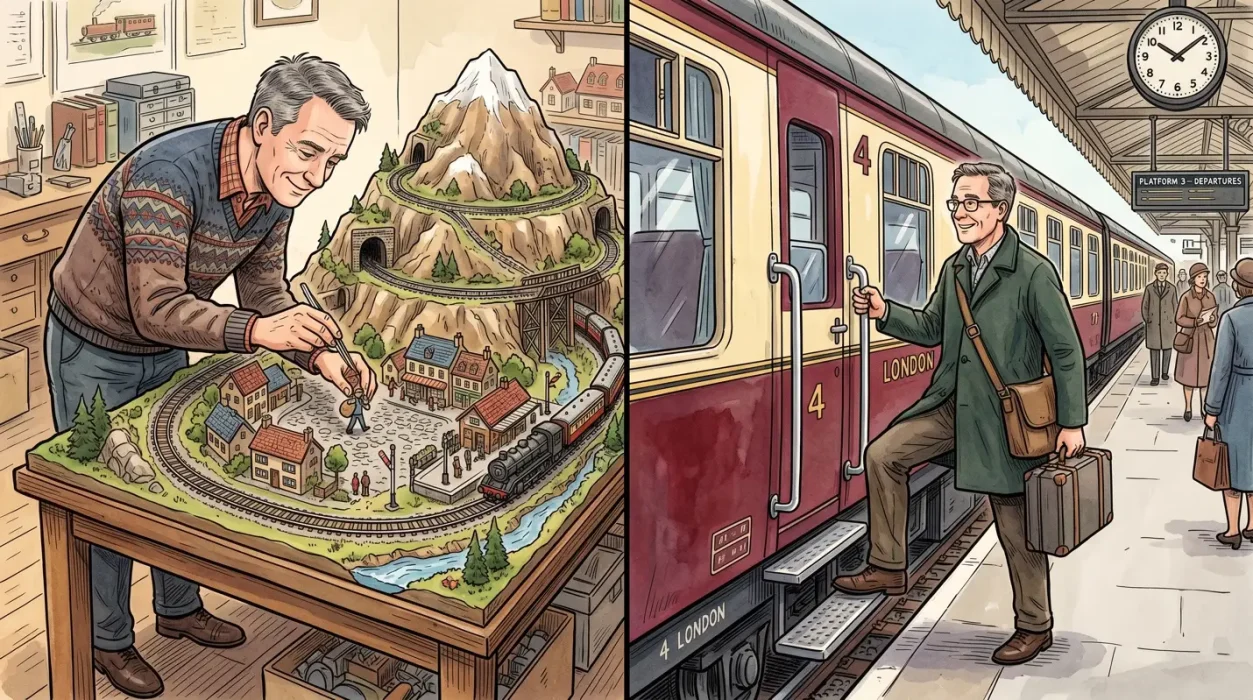



In Einstein’s world, matter, through its gravitational interactions, creates “space” which, in turn, reactions back on this matter. Lineal, connected, infinite, static Euclidean space gives way to a dynamic, resonating, non-lineal, non-Euclidean, finite, closed universe which folds back on itself – “On a clear day you can see the back of your head.”
“Alphabet, Mother of Invention” with Robert K. Logan, in Et Cetera, 1977, p 381
Year: 1977
The nineteenth century zoo had been a space that contained captive animals. The twentieth century zoo…they now study [the animals] as creating their own kinds of space or “territoriality.”
Contribution, To Everything There Is a Season (1967), p 312
Year: 1967
Art, or the graphic transition of a culture, is shaped by the way space is perceived. Since the Renaissance the Western artist perceived his environment primarily in terms of the visual. Everything was dominated by the eye of the beholder. His conception of space was in terms of a perspective projection upon a plane surface consisting of formal units of spatial measurement. he accepted the dominance of the vertical and the horizontal—of symmetry—as an absolute condition of order. This view is deeply embedded in the consciousness of Western art.
The Medium Is the Massage (1967), pp 56-57
Year: 1967
For medieval man, as for the native, space was not homogenous and did not contain objects. Each thing made its own space, as it still does for the native (and equally the modern physicist).
Understanding Media (1964), MIT/Routledge edition, p 162
Year: 1964
What Eliot has done for the revaluation of English letters from this point of view [exploring causes and effects of the split between thought and feeling], [Sigfried] Giedion has done for the successes and failures of the past four centuries in the organization of interior and exterior space.
Review of Mechanization Takes Command (1949), p 600
Year: 1949
Each object and each set of objects engenders its own unique space by the relations it has among others visually or musically.
Understanding Media (1964), MIT/Routledge edition, Page 148
Year: 1964
Chapter:
Music
There used to be a time when people would dance around a space doing fox trots and waltzes. On the new dance floor this doesn’t happen. Space has changed. You couldn’t ask anyone doing a frug or a watusi for the next dance or for any dance. The dancers make their own space, their own world.
“Television in a New Light,” in The Meaning of Commercial Television, ed., Stanley Donner, 19677, p 95
Year: 1967
What silence is to sound darkness is to visual space.
A Historical Approach to the Media, 1955, p 106
Year: 1955
Chapter:
Acoustic Space
Our new forms of sports will include the audience in the action. It used to be that 'pastimes are past times'. Sports and games were a civilized nostalgia replay of an earlier mode of culture as ritualized art form…
Attribute?
Visual space is a continuous and connected thing. It's like that. People think that natural space or the space around you is visual. It isn't. Acoustic space is a sphere whose center is everywhere and whose margin is nowhere. Tactile space is a resonant interval. When you touch something, you create resonance, you don't create connections. There's nothing logical. To keep in touch means to keep tuning in.
J. Kirsch interview, 1976, p 16
Year: 1976
The Mohawk is at home in high steel because he has no visual orientation, no point of view. He doesn't get dizzy on a girder on the 40th floor because he doesn't focus on distant points either vertically or horizontally.
a Review of P.E. Trudeau’s Federalism and French Canadians, NY Review of Books, 1967
Year: 1967
"Real" is an idea borrowed from the visual world. The word "phony" -- which means "unreal" in English slang -- originally meant "as unreal as a telephone conversation.
“I Never Study-” (1978)
Year: 1978
Chapter:
Telephone
Connections are visual in character as is also the case with logic and dialectic and such visual connections are alien to the character of hte news mosaic for which the interval is the constitutive factor.
Paper to Conference of lnformatlon Management Systems, 1974, p 4
Year: 1974
[Lewis] Carroll's narrative [Alice's Adventures Under Ground] is entirely dedicated to the proposition that space and time are not uniform nor continuous, but do respond to the character and forms of objects and people.
Review of Alice's Adventures Under Ground (1965), typescript, p 1
Year: 1965
To Carroll the attenuation of the figure increases toward the top of the figure graphically reinforcing Alice’s concern with her poor little unchanged feet. [Illustrator] Tenniel does not respond with this sensitivity to the text, trapped as he is in his visual assumptions.
Review of Alice's Adventures Under Ground (1965), typescript, p 2
Year: 1965
There are no connections in resonant [acoustic] space. There are only interfaces and metamorphoses.
The Papal Interval 1970, 1969, p 3 (unpublished typescript)
Year: 1970
The igloo and the pueblo hut are not enclosed space; they are plastically modelled forms of space, very close to sculpture.
“Cybernation and Culture” (1966), p 97
Year: 1966
Chapter:
Sculpture, Sculptural
Man's orientation to space before writing is nonspecialist. His caves are scooped-out space. His wigwams are wrap-around, or proproreceptive space, not too distant from the Volkswagen and the space capsule.
Cybernation and Culture (1966), p 97
Year: 1966
Auditory space contains nothing and is contained in nothing. It is quite unvisualizable, and, therefore, to the merely print-oriented man, it is "unintelligible."
The Five Sense Sensorium (1961), p 52
Year: 1961
There are no connections in resonant space. There are only interfaces and metamorphoses.
The Papal Interval (1969), unpublished typescript, p 3
Year: 1969
The child doesn't hesitate to go right over the edge of the paper in his drawings. It makes no difference to him.
Conversation with Harley Parker, Innis Herald, April 1978, p 8
Year: 1978
The Eskimos have no upside-down... there seems to be some relation between right-side-up and literacy.
“Reading and the Future of Private Identity” , for International Reading Association, May 4th, (1973), reprinted in McLuhan Studies, Vol 1, (1996) p 5
Year: 1973
Chapter:
Acoustic Space
On a visit to NASA, I asked Al Sheppard whether there was any upside-down in outer space. He replied, after some moments of reflection: "Where your feet are, that's down."
“Reading and the Future of Private Identity” (1973), p 5
Year: 1973
Visual space, as elucidated by Euclidean geometry, has the basic characters of lineality, homogenity, and stasis. These characteristics are not found in any of the other senses.
The Brain and the Media, 1978, p I
Year: 1978
Have you noticed that one cannot visualize geometric figures except in a void? this characteristic is an essential clue to understanding Euclidean space. It is not the whole of nature, it is an abstraction, an imaginative invention.
Bruce Powers interview, 1979, p I
Year: 1979
The isolation of visual space from the indiscriminate complex of other sensory spaces has happened only once in history. The numerous other alphabets are utterly lacking in the power of phonetic fission with its isolated manifestation of visual space.
“Literature and Scientific Knowledge”, 1976, p 4
Year: 1976
Chapter:
Visual Space
What we now think of as the basis of our whole civilization -- namely uniform, connected, and continuous space, rational space, rational order -- was, in the sixteenth century, a barbaric intruder into their order. Visual space was considered the destroyer of all human order. Now we think ofit as the basis of all human order.
“TV in a New Light”, 1967, p 88
Year: 1967
Americans... insist that the visual and the real are one. To question this is to undermine the American way of life.
Letter to Maurice Stein, May 15, 1964
Year: 1964
In our visual culture the can-can is erotic. To Russian tactile-audile culture where even "spying": is done by ear, the can-can is merely vulgar, as Kruschev explained during his recent Hollywood visit.
Pop Art Avant-Garde? 1964, p 217
Year: 1964
There used to be a time when people would [dance] fox trots and waltzes. On the new dance floor this doesn't happen. Space has changed. [With the frug or the watusi] the dancers make their own space, their own world.
The Meaning of Commercial TV, 1967, p 65
Year: 1967
Iconic space is discontinuous, and nonuniform, and nonconnected. It is a space in which the objects create their own environment.
“New Media and the Arts” (1964), p 240
Year: 1964
Chapter:
Iconic
…monument is tactile space; and it is also sculpture, it is not enclosed, and it doesn't enclose anything. It "resonates." It makes a space, creating air waves of space around it.
Prospect, 1962, p 363
Year: 1962
“Ballet is not only a social mask, but as a method of organizing human energies it must avoid pictorial space in favor of frontal plane in order to maximize audience participation.
Through the Vanishing Point with Harley Parker, 1968, p 183
Year: 1968
Chapter:
Eliot, T.S.
I think many of you have read [Edward] Hall’s Hidden Dimension, which simply refers to the fact that much of what is completely hidden is that which ordinarily surrounds us, with which we live day by day. We deliberately refuse to perceive this, in order to feel more comfortable. …., He has fascinating illustrations of this principle. One that first comes to mind is the Arab world, where he discovered that good taste in personal relations is at a distance of eight inches. Unless you can smell the other person every moment you see him and speak to him, he considers you hostile. Good taste there means smelling the person you speak with at all times, not just looking at him and not just handling him, but smelling. Hall calls [the ideal proximate distance for relations] “the hidden dimension” and I think there is a distance which is ideal for every artifact and view. There is a distance that will reveal it, that will turn you on and make you feel that this is an exciting breakthrough. This distance is not the same for any two people or any two artifacts. But it is possible to discover it by experiment. What you’re really saying is: How can we arrange a museum or an art gallery so it gives people that sensation of power, of tremendous new discovery, of insight and perception? I think it is possible. That’s what Harley [Parker] was trying to do with his juxtaposition, trying to rub one thing against the other to release the sense of discovery.
The Museum as Large-Room Pinball Machine, Marshall McLuhan, Harley Parker, and Museum Professionals, 1967, full transcript of a seminar at the City Museum of New York, October, 1967, edited by William Buxton, published by U. of Alberta Press, 2026, p 156
Year: 1967
Chapters:
Environment | Museum