Viewing chapter Teaching (22 quotes)
… the business of the teacher is to save the student’s time.
Introduction to the 1964 edition of The Bias of Communication by Harold Innis; also in Explorations, June, 1969
Year: 1964
It is easier to teach the arts (especially contemporary arts) to those who are participants in our technological culture than to those who sit on the sidelines registering distaste and incomprehension.
Letter to Norbert Wiener, May 28, 1951 (LAC)
Year: 1951
Chapters:
Education | Technology
Perhaps it is not that the educator has been shouldered aside by men of action so much as he has been swamped by high-powered imitators. If education has now become the basic investment and activity of the electronic age, then the classroom educator can recover his role only by enlarging it beyond anything it ever was in any previous culture.
“The Post-Literate Man”, 1973, Cycles 7, p 232
Year: 1973
Chapter:
Education
It is these [teachers] who must confront, in every classroom in the land, students who have accommodated themselves to the tactile and nonpictorial modes of symbolist and mythic structures, thanks to the TV image.
Understanding Media (1964), MIT/Routledge edition, p 324
Year: 1964
(After expressing gratitude for Wain’s book of poems, A Word Carved on a Sill, 1956)
In fact, I wish you could get out an L.P. disc of those poems. The sooner professors of literature become disc-jockeys the better!
Letter of an unknown precise date to John Wain, in 1956, quoted in “The Incidental Thoughts of MM,” in Dear Shadows (1986), p 100
Year: 1956
Many educators think that the problem in education is just to get the information through, get it past the barrier, the opposition of the young, just to move it and keep it going. I don’t have much interest in that theory. My theory or concern is what these media do to the people who use them. What did writing do to the people who invented it and used it? What do the other media of our time do to the people who use them? Mine is a transformation theory, how people are changed by the instruments they employ. I wish there were a lot more people in this field of transformation, but there are extremely few, and I would be embarrassed to mention more than two or three.
“Living in an Acoustic World,” Speech at the University of Florida, 1974, Transcript: 14:00
Year: 1974
“It is like setting up a distinction between didactic and lyric poetry on the ground that one teaches and the other pleases. It has always been true that whatever pleases teaches much more effectively.
“Classroom TV,”. Study Pamphlets In Canadian Education (1957), p 4
Year: 1957
Chapter:
Education

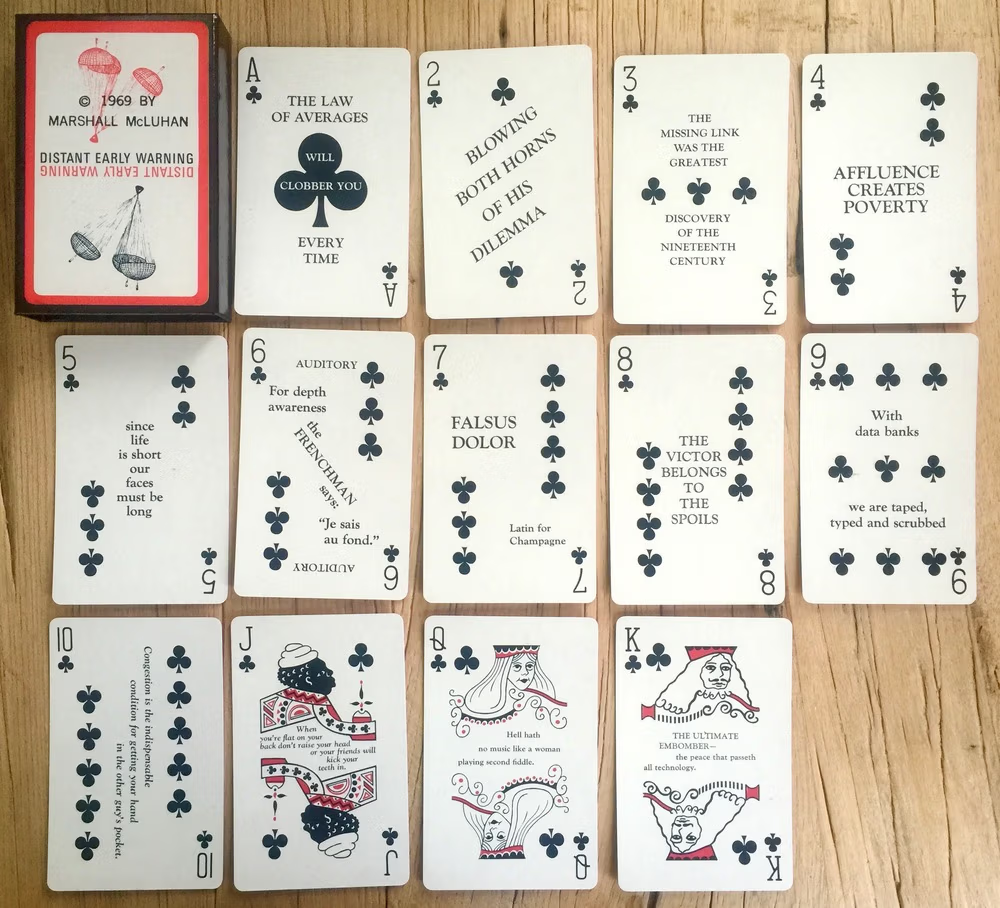
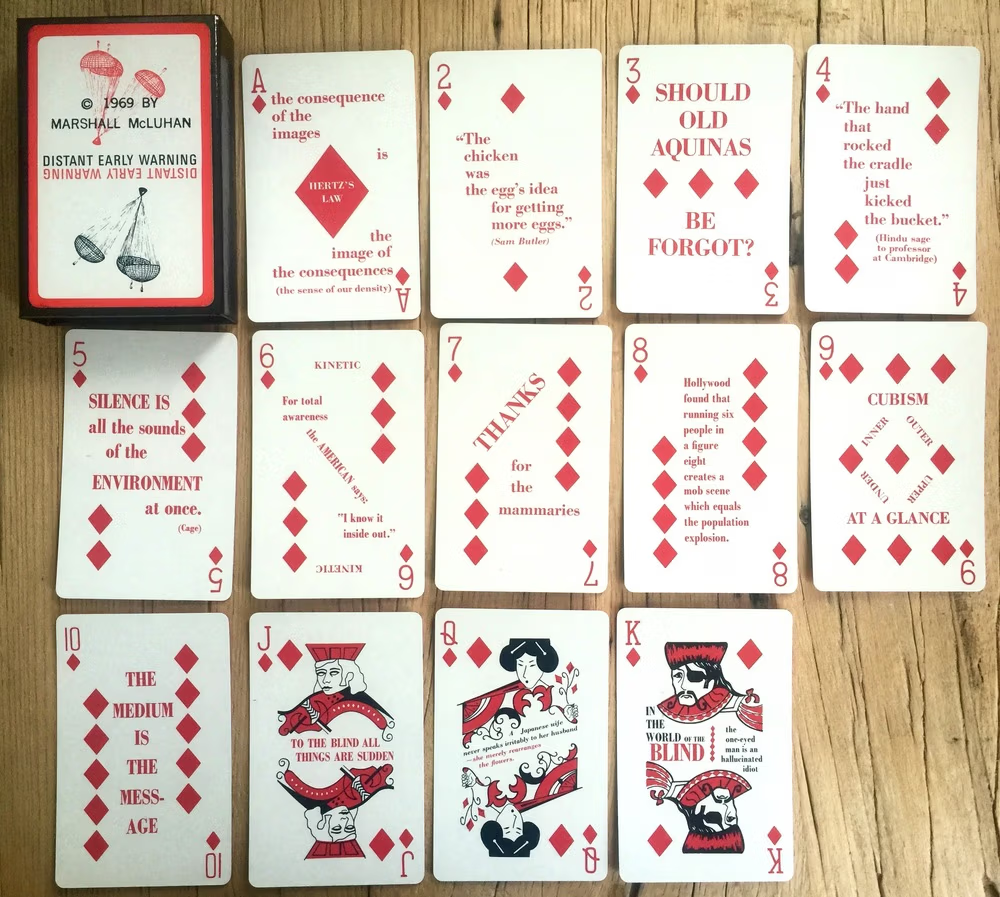

“After all, so far as providing a climate for instruction, press, radio, movies, magazines, and TV already constitute a· new tropical jungle within which the classroom teacher attempts to carry on teaching as usual.
“Classroom TV,” Study Pamphlets In Canadian Education. (1957), p 6
Year: 1957
After much experimentation we discovered that the most effective means of involvement for students is to proceed as follows: a group of three or four students, text in hand, select any poem. Read it over casually. Then, clockwise, take it one sentence for each person and record and play it back at once. Discuss and play back. Up to this point more than fifteen minutes should elapse. Then tackle another poem in the same way at once. Then another. By the time three poems have been done, the group is cohesive and enthralled in a quite magical way. The young people who have shown no interest in poetry until that moment are suddenly most interested in poetry and want to go on and on. The ages of the group can range from ten upwards. This process seems to have some of the character of progressive jazz, or, as Eric puts it, “it creates a group awareness of structures rather than semantics.”
Letter to John Wain, July 21, 1965, in Letters of Marshall McLuhan (1987) p 323
Year: 1965
We teachers are not justified in attempting to harrass or distract them further by exhortations merely to read.
“What the Mass Media Mean for Teachers of English,” Address to the 45th Convention of the National Council of Teachers of English, 24, November. 7, 1955, p 3
Year: 1955
It is easy now in teaching the poetry of Gray and Collins, and of Wordsworth, Coleridge, Scott, Byron, Shelley and Keats, to train the camera on their verses. In so doing, teacher and student alike will quickly discover a great deal about this earlier poetry that is new and exciting today.
“Camera Eye on Poetry” (1955), unpublished typescript, p 1
Year: 1955
Every poem is an ambush or a trap. And until the reader springs the trap and falls astonished into another world he hasn’t made contact with the poem. In [“The Solitary Reaper”] Wordsworth breaks into a new world. He isolates and defines a state of mind that nobody ever discovered before or since. The camera eye assisted by sound effects will help student and teacher to discover the magic formula that will open the secret world that is every great poem.
“Camera Eye on Poetry” (1955), unpublished typescript, p 5
Year: 1955
But our schools hing the new media as new languages, and so we do not speak these new languages, even though we can discern some of their meaning.
“What the Mass Media Mean for Teachers of English,” Address to the 45th Convention of the National Council of Teachers of English, 24, November. 7, 1955, p 7
Year: 1955
Chapter:
Media Study
We must first master and then teach these new languages in all their minute particularity and riches. In so doing we have available on an unprecedented scale the resources of comparison and contrast.
“Educational Effects of Mass Media of Communication” (1956), p 403
Year: 1956
Chapters:
Electric, Electronic | Media Study
Painting is essentially an imitative art; it cannot subsist for a moment on empty generalities: the critic, therefore, who had been used to this sort of substantial entertainment, would be disposed to read poetry with the eye of a connoisseur, would be little captivated with smooth, polished, unmeaning periods, and would turn with double eagerness and relish to the force and precision of individual details, transferred, as it were, to the page from the canvas. But since English became a University subject (in the past fifty years or less) it has been customary not only to study poetry and letters without reference to technique and effect but in isolation from the other arts and sciences.
“New Media as Political Forms,” Explorations 3, 1954, p 122
Year: 1954
Were we to teach our math and physics by telephone, even a highly literate and abstract Westerner could eventually compete with the European physicists.
Understanding Media (1964), MIT/Routledge edition, p 267
Year: 1964
Chapters:
Telephone | Untapped Potentials
The need for more and more profound teachers because of the very medium of television is shdowed in the panel show, at least to the extent that it seems more natural, ever since radio, than a single source of comment and information. Two or more teachers in dialogue with each other and with class or audience created exactly that sense of lightl llthrough rather than light on, which is the nature of ht etelevision image or mosaic as c0ompared with movie or print. In the same way with the panel, the voice comes through the audience rather than to the audience.
“Electronic Revolution”, 1959, in Understanding Me (2003), p 10
Year: 1959
The telegraph is not the mechanization of writing but the electrification of writing.
Attribution?
FLAG - locate source, said to be from 1956
FLAG - locate source, said to be from 1956
Year: 1956
One of the major pressures of TV has been to encourage the "teaching machine." In fact, these devices are adaptations of the book in the direction of dialogue. These teaching machines are really private tutors, and their being misnamed on the principle that produced the names "wireless" and "horseless carriage" is another instance in that long list that illustrates how every innovation must pass through a primary phase in which the new effect is secured by the old method, amplified or modified by some new feature.
Understanding Media (1964), MIT/Routledge edition, p 292
Year: 1964
Chapter:
Television
The revolution has already taken place at home. TV has changed our sense-lives and our mental processes. It has created a taste for all experience in depth that affects language teaching as much as car styles.
Understanding Media (1964), MIT/Routledge edition, p 332
Year: 1964
Chapter:
Television
The teaching of reading and literature; therefore, has now to assume the job of directing perception and of training judgment.
“What the Mass Media Mean for Teachers of English” (1955), p 3
Year: 1955
Chapters:
Reading | Training of Perception
Since, however, this new cultural gradient is the world, the milieu, in which I must live and which prepares the students I must teach, I have every motive to understand its constituents, its components, and its operations. I move around through these elements as I hope any scientist would through a world of disease and stress and misery.
McLuhan Hot and Cool, 1967, p 280
Year: 1967