Viewing chapter Today’s Transition (140 quotes)
The victor belongs to the spoils.
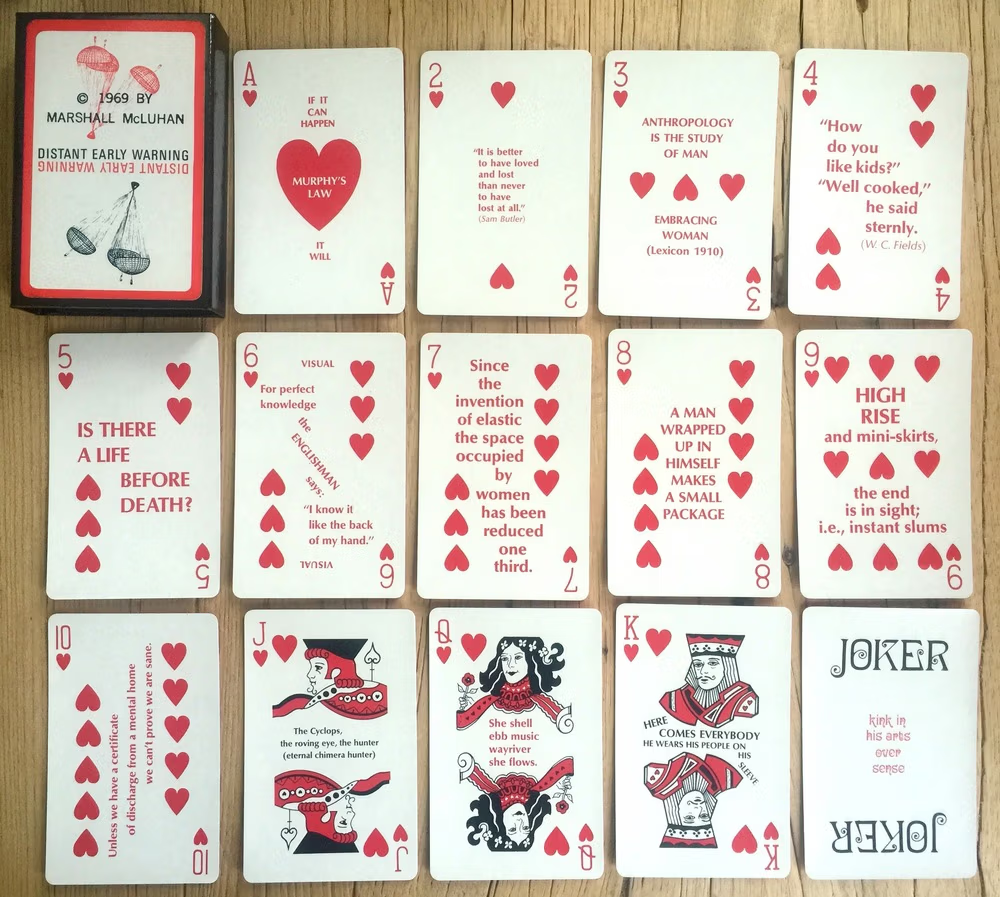
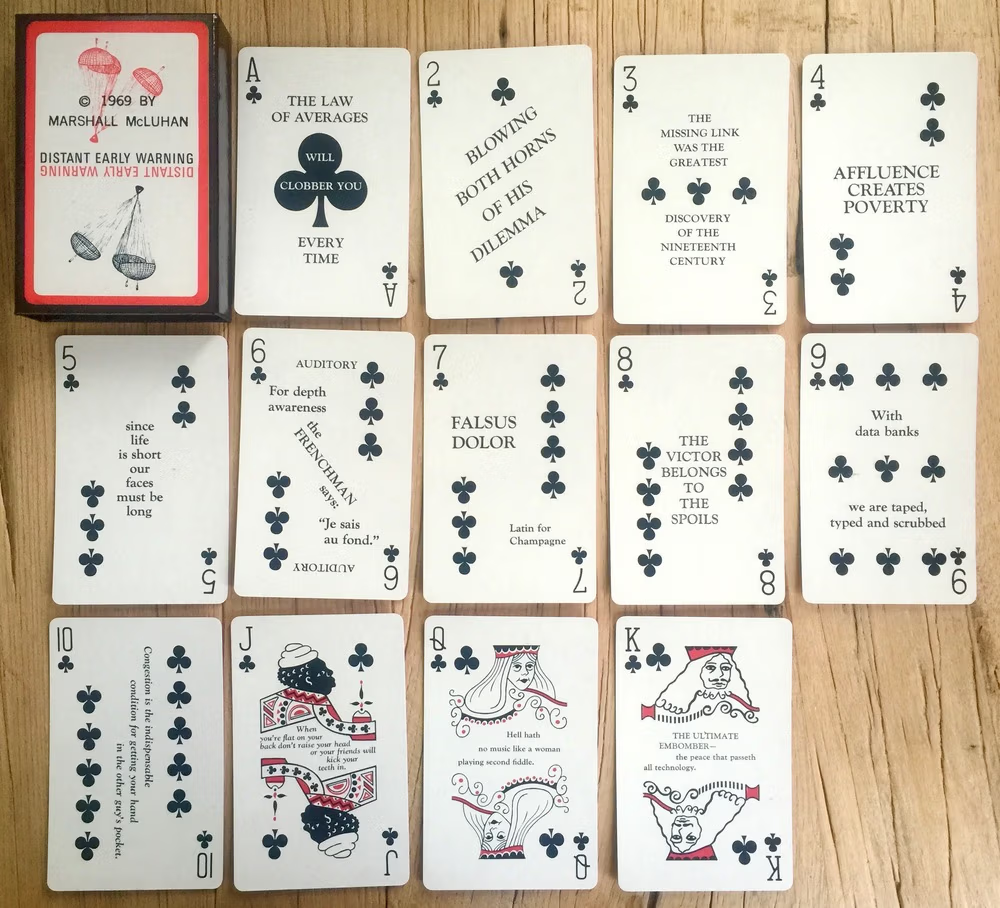
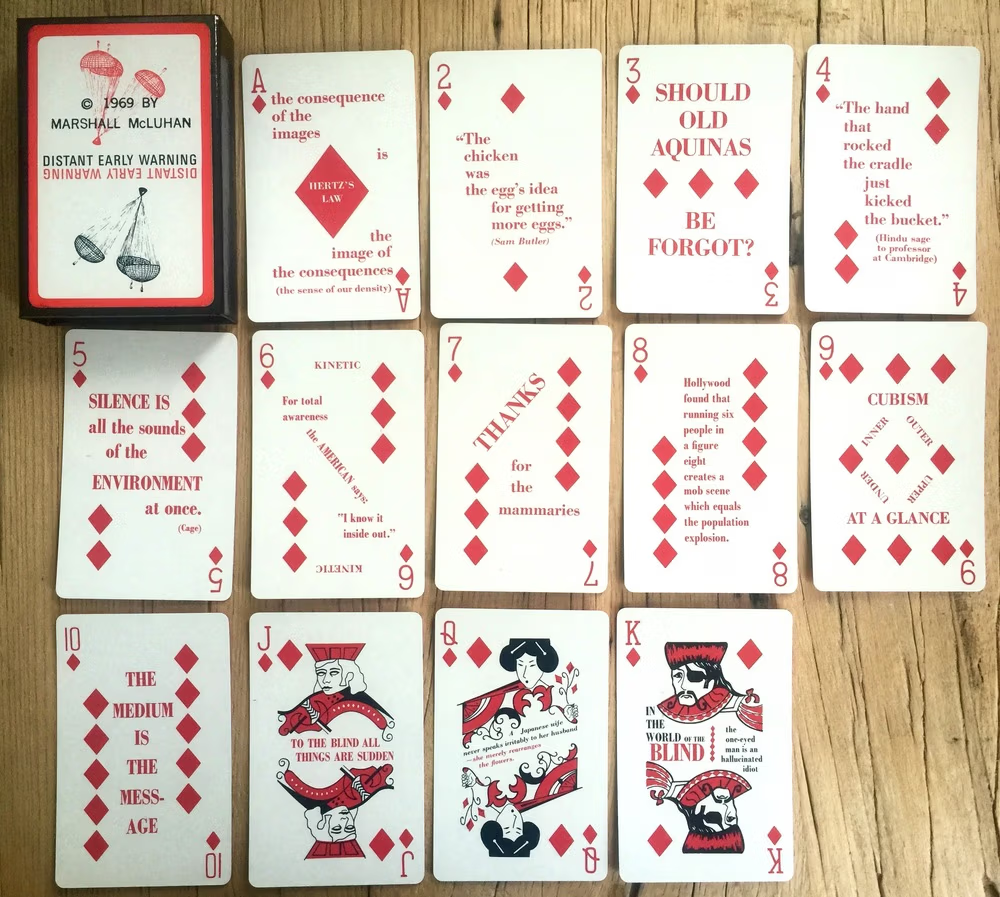
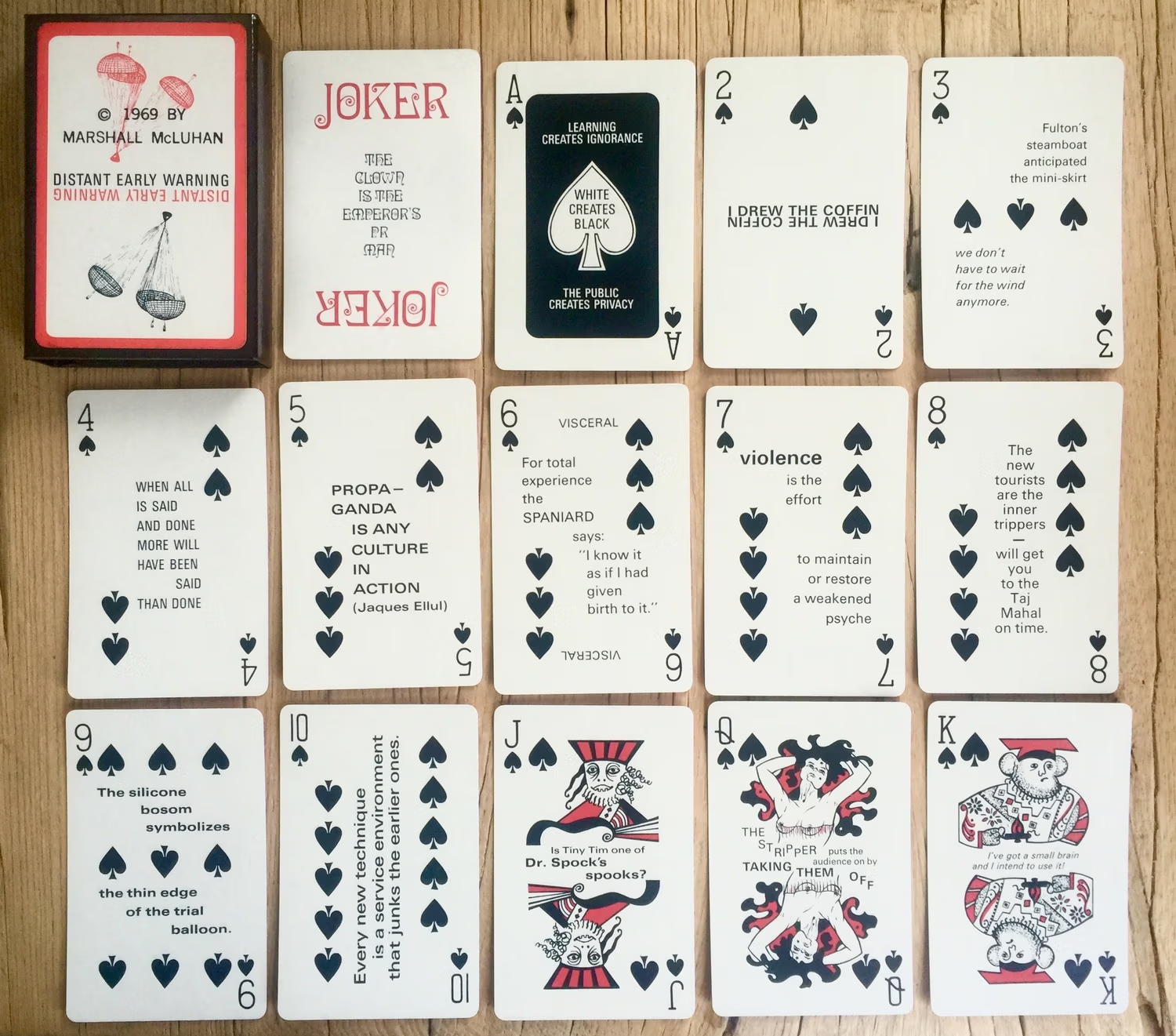
Dewline deck, 1969, 8 of Clubs
Year: 1969
Chapters:
Extension Theory | Today’s Transition
All identity images, private and corporate, dissolve. Violent struggle to regain these images ensues
Culture Is Our Business ,(1970), p 66
Year: 1970
Chapter:
Identity
By surpassing writing, we have regained our WHOLENESS, not on a national or cultural, but cosmic, plane. We have evoked a super-civilized, sub-primitive man.
“Five Sovereign Fingers Taxed the Breath”, in Shenandoah The Washington And Lee University Review, Vol. VII, No. 1, Autumn (1955), p 51, reprinted in Explorations 4, (1955), p 32. Explorations in communication: an anthology (1960), p 208
Year: 1955
Chapters:
From Tribal to Literate | Postliteracy
When Alice went through the vanishing point of the visual world, breaking the hardware of the looking-glass world, she became involved in a series of rapid metamorphoses, not unrelated to her tears.
Culture Is Our Business (1970), p 68
Year: 1970
Chapters:
Goodbye Linearity | Transform
In the sixteenth century religion went inward and private with Gutenberg’s hardware. Liturgy collapsed. Bureaucracy boomed. Today liturgy returns. Bureaucracy fades.
Culture Is Our Business (1970), p 82
Year: 1970
Today we live on the frontier between five centuries of mechanism and the new electronics, between the homogenous and the simultaneous. It is painful but fruitful.
The Gutenberg Galaxy: The Making of Typographic Man, (1962), p 141
Year: 1962
That is, the recovery of primitive organic values in art and architecture is the central technological pressure of our time.
The Gutenberg Galaxy : The Making of Typographic Man (1962), p 67
Year: 1962
Chapter:
Values & Value Judgments
The antithetic electric power of instant information that reverses social explosion into implosion, private enterprise into organization man, and expanding empires into common markets, has obtained as little recognition as the written word. The power of radio to retribalize mankind, its almost instant reversal of individualism into collectivism, Fascist or Marxist, has gone unnoticed. So extraordinary is this unawareness that it is what needs to be explained. The transforming power of media is easy to explain, but the ignoring of this power is not at all easy to explain. It goes without saying that the universal ignoring of the psychic action of technology bespeaks some inherent function, some essential numbing of consciousness such as occurs under stress and shock conditions.
Understanding Media, 1964, MIT/Routledge edition, p 304
Year: 1964
The painter learns how to adjust relations among things to release new perception, and the chemist and physicist learn how other relations release other kinds of power. Less and less, in the electric age, can we find any good reason for imposing the same set of relations on every kind of object or group of objects. Yet in the ancient w o r l d the only means of achieving power was getting a thousand slaves to act as one man. During the Middle Ages the communal clock extended b y the bell permitted high coordination of the energies of small communities. In the Renaissance the clock combined with the uniform respectability of the new typography to extend the power of social organization almost to a national scale.
Understanding Media (1964), MIT/Routledge edition, p148
Year: 1964
Chapter:
Acoustic Space
The civilized man imagines that he is going to help the native by stripping off the native’s world of myth and legend, ritual and superstition. The paradox is that in the electric age we ourselves are moving into, returning to, the acoustic world of simultaneous involvement and awareness, experiencing the surfacing of the subliminal life…. We had imagined that we could simply strip off the acoustic culture of these primitives or these natives in order to civilize them, but the same stripping off of our civilization is taking place at the same time, by means of the new electric technology. We are losing our civilizatn even faster than we stripped off the institutions of the Indians and the Africans.
Man and Media,” lecture delivered at York University, Toronto, (1979), in Understanding Me (2003), p 296
Year: 1979
The new corporate identity of electronic man has arrived so suddenly that it still coexists with private and individual identity.
“Mr. Nixon and the Dropout Strategy”, in The New York Times, July 29, (1973), p E13
Year: 1973
With television both sight and sound were out of the wire and our culture stepped free of mechanization for the first time since the invention of writing, 5,000 years ago.
From his 1955 Report to the Ford Foundation (LAC), quoted in W. T. Gordon’s Marshall McLuhan: Escape into Understanding (1997), p 163
Year: 1955
I think the best distinction might be found in the phrase, "with it." You know how today we speak of being with it... meaning we've understood completely, we've got the message as it were....in every way possible. But in the older book or print culture people weren't with it....they were away from it....by themselves with their own private point of view. You have no point of view when you're with it...because you accept a thing totally. And we're with it because these new media of ours....the ones you talked about in the appliance store....have made our world into a single unit....the world is now like a continually sounding tribal drum, where everybody gets the message....all the time. A princess gets married in England and boom boom boon go the drums and we all hear about it; an earthquake in North Africa, a Hollywood star gets drunk....away go the drums again. I use the word tribal...probably the key word.
“The Teenager and The Media”, Explorations for CBC May 18th, (1960) Printed as Exhibit 2--Television Script, in NAEB Report on Understanding New Media, June (1960), p xxiii
Year: 1960
Perhaps the terrifying thing about the new media for most of us is their inevitable evocation of irrational response. The irrational has become the major dimension of experience in our world.
“Culture without Literacy”, in Explorations #1, December (1953), p 126 reprinted in Essential McLuhan, (1995), p 311, additional reprint in Media Research Technology, Art and Communication (1997), p 136, and McLuhan Unbound #6, (2017)
Year: 1953
Chapters:
Anxieties Caused By Change | Divided by Media | From Tribal to Literate | Hardware / Software | Time | Warnings
PLAYBOY: You said a few minutes ago that all of contemporary man’s traditional values, attitudes and institutions are going to be destroyed and replaced in and by the new electric age. That’s a pretty sweeping generalization. Apart from the complex psychosocial metamorphoses you’ve mentioned, would you explain in more detail some of the specific changes you foresee?
McLUHAN: The transformations are taking place everywhere around us. As the old value systems crumble, so do all the institutional clothing and garbage they fashioned. The cities, corporate extensions of our physical organs, are withering and being translated along with all other such extensions into information systems, as television and the jet—by compressing time and space—make all the world one village and destroy the old city- country dichotomy. New York, Chicago, Los Angeles—all will disappear like the dinosaur. The automobile, too, will soon be as obsolete as the cities it is currently strangling, replaced by new antigravitational technology. The marketing systems and the stock market as we know them today will soon be dead as the dodo, and automation will end the traditional concept of the job, replacing it with a role, and giving men the breath of leisure. The electric media will create a world of dropouts from the old fragmented society, with its neatly compartmentalized analytic functions, and cause people to drop in to the new integrated global-village community.
Playboy Interview (1969), in Essential McLuhan (1995), po 253-254
NOTE: Check for errors/correct page before changing it to full citation please
Year: 1969
Chapter:
Transform
The day of the individualist, of privacy, of fragmented or “applied” knowledge, of “points of view” and specialist goals is being replaced by the over-all awareness of a mosaic world in which space and time are overcome by television, jets and computers—a simultaneous, “all-at-once” world in which everything resonates with everything else as in a total electrical field, a world in which energy is generated and perceived not by the traditional connections that create linear, causative thought processes, but by the intervals, or gaps, which Linus Pauling grasps as the languages of cells, and which create synesthetic discontinuous integral consciousness.
“Playboy Interview: Marshall McLuhan: A Candid Conversation with the High Priest of Popcult and Metaphysician of Media.” By Eric Norden. Playboy Magazine, March (1969), p 70, reprinted in Essential McLuhan (1995), p 258
Year: 1969
Chapter:
Simultaneity
What could be more practical for a man caught between the Scylla of a literary culture and the Charybdis of post-literate technology to make himself a raft of ad copy?
The Gutenberg Galaxy : The Making of Typographic Man , (1962), p 77
Year: 1962
Chapters:
From Tribal to Literate | Hardware / Software
Whatever may prove to be the weaknesses of Teilhard de Chardin's work, he will always have the credit of having correctly defined the major change of our age. In The Phenomenon of Man he observes:
It has been stated over and over again. Through the discovery yesterday of the railway, the motor car and the airplane, the physical influence of each man, formerly restricted to a few miles, now extends to hundreds of leagues or more. Better still, thanks to the prodigious biological event represented by the discovery of electro-magnetic waves, each individual finds himself henceforth (actively and passively) simultaneously present, over land and sea, in every comer of the earth.
“The Humanities in the Electronic Age” (1961), in McLuhan Unbound (2017), p 12
Year: 1961
The printed book had encouraged artists to reduce all forms of expression as much as possible to the single descriptive and narrative plane of the printed word. The advent of electric media released art from this straitjacket at once, creating the world of Paul Klee, Picasso, Braque, Eisenstein, the Marx Brothers, and James Joyce.
Understanding Media, 1964, MIT/Routledge edition, p 54
Year: 1964
May not the upshot of our technology be the awakening from the historically conditioned nightmare of the past into a timeless present? Historic man may turn out to have been literate man.
“Culture Without Literacy,” 1953, reprinted in McLuhan Unbound (2002), p 7
Year: 1953
Ordinary human instinct causes people to recoil from the new environments and to rely on the rear-view mirror as a kind of repeat or ricorso of the preceding environments, thus insuring total disorientation at all times ... The visual space creates a kind of human identity that is extremely fragmented. To retain such an image of the self requires persistent violence, both to one's self and to others. As Joyce put it, 'Love thy label as thyself.' Labels as classification are extreme forms of visual culture.
Through the Vanishing Point with Harley Parker (1968), Preface, pp xxiii-xxiv
Year: 1968
There are many ways in which the book and literate values are threatened by the mere fact of the electric service environment.
“The Future of the Book” (1972), in Understanding Me (2003), p 175
Year: 1972
The implication of discarnate, disembodied existence in an information world is one for which our educational system has not quite prepared us.
Man and Media,” lecture delivered at York University, Toronto, (1979), in Understanding Me (2003), p 288
Year: 1979
The civilized man imagines that he is going to help the native by stripping off the native’s world of myth and legend, ritual and superstition. The paradox is that in the electric age we ourselves are moving into, returning to, the acoustic world of simultaneous involvement and awareness, experiencing the surfacing of the subliminal life…. We had imagined that we could simply strip off the acoustic culture of these primitives or these natives in order to civilize them, but the same stripping off of our civilization is taking place at the same time, by means of the new electric technology. We are losing our civilization even faster than we stripped off the institutions of the Indians and the Africans.
Man and Media,” lecture delivered at York University, Toronto, (1979), in Understanding Me (2003), p 296
Year: 1979
What I wish to show is that today we experience, in reverse, what pre-literate man faced with the advent of writing.
“An Historical Approach to the Media of Communication” (1955), speech given at Columbia University, July 26, 1955, typescript, p 2
Year: 1955
With television both sight and sound were out of the wire and our culture stepped from the grip of mechanization for the first time since the invention of writing, 5,000 years ago.
From his 1955 Report to the Ford Foundation, quoted in W. Terrence Gordon’s Marshall McLuhan: Escape into Understanding (1997), p 163
Year: 1955
One way of stating our condition is to say that in the electronic age our entire technology has achieved the freedom and flexibility that had formerly been available only in the verbal universe. The metaphoric parallels and discontinuities — parataxis and syntaxis — by which mankind had first learned to structure acoustic space and create a subtle world of oral and interpersonal relations is now possible visually and spatially as well.
From his 1955 Report to the Ford Foundation, quoted in W. Terrence Gordon’s Marshall McLuhan: Escape into Understanding (1997), p 164
Year: 1955
Chapters:
From Tribal to Literate | Hardware / Software
For dialogue is not light on, but light through, which is the difference between film and TV.
“The New Media and the New Education,” The Basilian Teacher, December, 1961, p 97, Portions originally published as “Grammars for the Newer Media.” In Communication in General Education: College Composition and Communication, 1960
Year: 1961
The items of news and advertising that exist under a newspaper dateline are interrelated only by that dateline. They have no interconnection of logic or statement. Yet they form a mosaic or corporate image whose parts are interpenetrating.
“The Agenbite of Outwit”, In Location Magazine, Vol. 1, No. 1, (1963), reprinted in Marshall McLuhan Essays Media Research: Technology Art Communication, (1997), p 123
Year: 1963
Chapters:
Hardware / Software | Interval
The ways of thinking implanted by electronic culture are very different from those fostered by print culture. Since the Renaissance most methods and procedures have strongly tended towards stress on the visual organization and application of knowledge.
Our electronic world now calls for a unified global field of awareness; the kind of private consciousness appropriate to literate man can be viewed as an unbearable kink in the collective consciousness demanded by electronic information movement.
“The Agenbite of Outwit”, In Location Magazine, Vol.1, No.1, (1963), p 123; reprinted in Marshall McLuhan Essays Media Research: Technology Art Communication, (1997), p 125
Year: 1963
The dichotomy between linear and radial expression is not really as radical as might appear, but it has in such terms as "continuous": versus "discontinuous" or "statement" versus "suggestion" divided the allegiance of poets, critics, and readers from the time of Coleridge to the present. It certainly had much to do with the intellectual divergence between Coleridge and Wordsworth, between Browning and Tennyson, and between Pound and Eliot.
“Coleridge as Artist” (1957), in The Interior Landscape (1969), p 117
Year: 1957
Chapters:
From Tribal to Literate | Hardware / Software
Until Newton the Senecans had dominated the literary scene from Montaigne to Pascal and from Donne to Pope. Their preoccupation was with the literary techniques for arresting and projecting some phase of the human mind: to arrest in order to project, and to project in order to contemplate. Like the inventors of cinema at the beginning of this century they hit upon the technique of stylistic discontinuity as a means of arresting a moment of consciousness. The movie camera takes a thousand still shots in order to capture the aspects of a brief moment. The style coupé and the “cutting period” attempted something comparable in the essay and the poem. But to have carried this art further than Pope was probably impossible. At any rate the advent of Newton’s Optics diverted artistic effort from poetic statement to the use of external landscape as a means of projecting and controlling states of mind under the guidance of two major concepts. The first of these derived from the study of the visual harmonics of the spectrum which led to a revival of the classic images of the harps of Aeolus and Memnon. If the surfaces of matter were varied prisms for revealing the qualities of light, then the entire visible and audible world could be conceived as a species of visual music. The second concept is related to the first. For, if the external world is attuned to the mind of man then the whole of Nature is a language and the poet is a pontifex or bridge between the two worlds.
“Coleridge as Artist” (1954), in The Interior Landscape (1969), pp 119-120
Year: 1954
The old hidden ground then emerges as a new rear-view figure, for all to see. Computers are still serving mainly as agents to sustain precomputer effects.
“The Argument: Causality in the Electric World”, in Technology and Culture, Vol.14, No. 1, January (1973), p 10, reprinted in McLuhan Unbound # 3, (2005). p 18
Year: 1973
The private psyche may be an artificial monster of the most precious discovery. It is demonstrable that it had a historical origin and that this "artifact" may have a contemporary demise in this electronic age of discarnate togetherness.
Liturgy And Media" in The Critic, Vol.31, No. 3, January-February (1973), p 21, reprinted in The Medium and the Light: Reflections on Religion (1999), p 128
Year: 1973
Can all of these forms of visual experience now be by-passed by acoustic and discarnate man of the present electric world environment?
Liturgy And Media” in The Critic, Vol.31, No. 3, January-February (1973), p 23, reprinted in reprinted in The Medium and the Light: Reflections on Religion (1999), p 131
Year: 1973
Omnipresence has become an ordinary human dimension.
“Jean Pare interview”, in Forces magazine a Hydro Quebec publication, No.22, (1973), p 8
Year: 1973
The loss of the old abstract visual space is the message of all modern arts, music, literary, plastic and architectural.
“Understanding McLuhan—and fie on any who don’t.” in The Globe and Mail, September 10th, p. 7 (full p. with picture). Response to “Misunderstanding McLuhan” by Richard Schickel in The Globe and Mail, Friday, August 31st, 1973
Year: 1973
Chapters:
From Tribal to Literate | Hardware / Software
The pursuit of “objectives” has been [Western civilized man’s] aim against all obstacles: the Western dream of conquest, one-upsmanship…With electricity, when we found the old kind of conquest too simple, we suddenly realized that it wasn’t a challenging goal after all. Now, when we can press a button and blow up the whole world, we realize that goals aren’t really compatible with community… So now we’re beginning to ask, but what’s the quality of life that goes with this easy conquest? What sort of human satisfactions are we developing in these conditions of endless rivalry? What sort of people do we want to be?
“Technology and the Human Dimension”: Interview with Louis Forsdale (1974), in Marshall McLuhan: The Man and His Message (1989), p 19
Year: 1974
Chapters:
From Tribal to Literate | Hardware / Software
And, while your voice is there, you and the people you speak to are here, at the same time. Electric man has no bodily being, he is literally discarnate. But a discarnate world, like the one we now live in, is a tremendous menace to an incarnate Church, and its theologians haven't even deemed it worthwhile to examine the fact.
“Keys to the Electronic Revolution”, Conversation with Pierre Babin (1977), in The Medium And The Light (1999), p 50
Year: 1977
When you are on the air you are, in a way, everywhere at once. Electric man is a "super angel." When you are on the telephone you have no body.
“Keys to the Electronic Revolution” Pierre Babin interview (1977), in The Medium and the Light (1999), p 50
Year: 1977
The sender goes on the air and is instantaneously everywhere without a body. Electricity creates the angelic or discarnate being of electronic man, who has no body.
“Man and Media,” lecture delivered at York University, Toronto, (1979), in Understanding Me (2003), p 288
Year: 1979
We have been through the three stages of alarm, resistance, and exhaustion that occur in every disease or stress of life, whether individual or collective. At least, our exhausted slump after the first encounter with the electric has inclined us to expect new problems. However, backward countries that have experienced little permeation with our own mechanical and specialist culture are much better able to confront and to understand electric technology. Not only have backward and nonindustrial cultures no specialist habits to overcome in their encounter with electromagnetism, but they have still much of their traditional oral culture that has the total, unified "field" character of our new electromagnetism. Our old industrialized areas, having eroded their oral traditions automatically, are in the position of having to rediscover them in order to cope with the electric age.
Understanding Media (1964), MIT/Routledge edition, pp 26-27
Year: 1964
When the globe becomes a single electronic computer, with all its languages and cultures recorded on a single tribal drum, the fixed point of view of print culture becomes irrelevant and impossible, no matter how precious.
“Letter to David Riesman, February 18th, 1960”, in Letters of Marshall McLuhan (1987), p 261
Year: 1960
Chapters:
From Tribal to Literate | Hardware / Software
The hidden ground of the entire development [today] is the new speed of information movement, for it is this movement at the speed of light which not only transforms our image of ourselves but involves us in the lives of others in a completely new way.
“Letter to Franklin R. Gannon, June 12, 1973”, in Letters of Marshall McLuhan (1987), p 477
Year: 1973
Today the great principle of classical physics and economics and political science, namely that of the divisibility of each process, has reversed itself by sheer extension into the unified field theory; and automation in industry replaces the divisibility of process with the organic interlacing of all functions in the complex. The electric tape succeeds the assembly line.
“Reversal of the Overheated Medium,” in The Essential McLuhan (1995), p 169
Year: 1995
Organic interdependence means that disruption of any part of the organism can prove fatal to the whole. Every industry has had to "rethink through" (the awkwardness of this phrase betrays the painfulness of the process), function by function, its place in the economy. But automation forces not only industry and town planners, but government and even education, to come into some relation to social facts.
Understanding Media (1964), MIT/Routledge edition, p 353
Year: 1964
Only Graeco-Roman man has ever had this visual faculty in isolation, and today it is threatened, not by any single factors such as television or radio, but by the electric speed of information movement in general. Electric speed is approximately the speed of light, and this constitutes an information environment that has basically an acoustic structure. At the speed of light, information is simultaneous from all directions and this is the structure of the act of hearing. i. e. the message or effect of direct information is acoustic, even when it is read in a newspaper with a mosaic of world-wide items under a single date-line.
“Letter to Barbara Ward, February 9, 1973”, in Letters of Marshall McLuhan (1987), p 466
Year: 1973
This is where William Burroughs comes in with his Naked Lunch. When we invent a new technology, we become cannibals. We eat ourselves alive since these technologies are merely extensions of ourselves. The new environment shaped by electric technology is a cannibalistic one that eats people. To survive one must study the habits of cannibals.
“The Hot and Cool Interview”, in Media Research (1997), p 67
Year: 1997
MIKE McMANUS: You say, too, that between today's child who has been raised electronically — and who must still live in a literate world, because we are still in a literate world — that there's a 2400-year gap between that boy or girl and his parents...
McLUHAN: And his parents, who grew up in a literate society. Well, the alphabet, the phonetic alphabet, the beginnings of western literacy, came in about 500 B.C. And since then, between then and now is approximately 2400 or 2500 years. And we are the first post-literate generation, as it were. We have by-passed the literate world of hardware and the lineal left hemisphere technology. We have by-passed it by moving once more, again, into the altogether world, the holistic world, of the right hemisphere people, who are the third-world people. So what is happening to our own children is we're watching them become third-world.
“Mike McManus TVO interview”, 1977, transcript 9:28
Year: 1977
Chapter:
Hardware / Software
MIKE McMANUS: Now, these children that are more groupy and less private, are they also more passionate or more violent?
McLUHAN: I think that the sheer dislocation of their lives has put them through a very violent course, indeed. They have been ripped off.
McMANUS: But they're kind of rudderless.
McLUHAN: They don't have goals. Because, at the speed of light, what is a goal? You're already there. You name it, and you're there.
“Mike McManus TVO interview”, 1977, transcript 11:03
Year: 1977
Chapter:
Hardware / Software
The paradox today is that the ground of the latest Western technologies is electronic and simultaneous, and thus structurally right-hemisphere and "Oriental" and oral in its nature and effects. This situation began with the telegraph more than a century ago. Still, the overwhelming pattern of procedures in the Western world remains lineal, sequential, and connected in political and legal institutions, and also in education and commerce, but not in entertainment or art. A formula for complete chaos!
Laws of Media: The New Science with Eric McLuhan, (1988), p 80
Year: 1988
Chapters:
Goodbye Linearity | Hardware / Software | Hemispheres of the Brain | Retribalizing | Warnings
…we live in an electric simultaneous world, where most of the relationships between men are now invisible.
"Televised interview by Father Patrick Peyton”, on the program, Father Peyton’s Family Theatre (1972), Transcript, p 2
Year: 1972
Chapters:
Hardware / Software | Media Effects
Meantime, in both new attire and new dwellings, our unified sensibility cavorts amidst a wide range of awareness of materials and colors which makes ours one of the greatest ages of music, poetry, painting, and architecture alike.
Understanding Media (1964), MIT/Routledge edition, p 122
Year: 1964
Chapter:
Hardware / Software
Contemporary awareness had to become integral and inclusive again, after centuries of dissociated sensibilities.
Understanding Media (1964), MIT/Routledge edition, p 250
Year: 1964
Chapter:
Hardware / Software
With a parallel increase of accessibility of all cultures to all cultures and of all subject matters to all others, the redesigning of the educational establishments of the Western world is equally urgent not as an ideal but as a necessity.
“Popular / Mass culture” (1960), in Understanding Me (2003), p 19
Year: 1960
Chapters:
Education | Hardware / Software
Electric circuitry has overthrown the regime of 'time' and 'space' and pours upon us instantly and continuously the concerns of all other men. It has reconstituted dialogue on a global scale. Its message is Total Change.
The Medium Is the Massage (1967), p 16
Year: 1967
Chapters:
Change | Hardware / Software
Until recently our institutions and arrangements, social, political, and economic, had shared a one-way pattern. We still think of it as "explosive," or expansive; and though it no longer obtains, we still talk about the population explosion and the explosion in learning. In fact, it is not the increase of numbers in the world that creates our concern with population. Rather, it is the fact that everybody in the world has to live in the utmost proxiMIT/Routledgey created by our electric involvement in one another's lives. In education, likewise, it is not the increase in numbers of those seeking to learn that creates the crisis. Our new concern with education follows upon the changeover to an interrelation in knowledge, where before the separate subjects of the curriculum had stood apart from each other. Departmental sovereignties have melted away as rapidly as national sovereignties under conditions of electric speed.
Understanding Media (1964), MIT/Routledge edition, pp 35-36
Year: 1964
Chapters:
Education | Hardware / Software
After three thousand years of explosion, by means of fragmentary and mechanical technologies, the Western world is imploding. During the mechanical ages we had extended our bodies in space. Today, after more than a century of electric technology, we have extended our central nervous system itself in a global embrace, abolishing both space and time as far as our planet is concerned. Rapidly, we approach the final phase of the extensions of man - the technological simulation of consciousness, when the creative process of knowing will be collectively and corporately extended to the whole of human society, much as we have already extended our senses and our nerves by the various media.
Understanding Media (1964), MIT/Routledge edition, pp 3-4
Year: 1964
Chapter:
Hardware / Software
Our time is a time for crossing barriers, for erasing old categories—for probing around. When two seemingly disparate elements are imaginatively poised, put in apposition in new and unique ways, startling discoveries often result.
The Medium is the Massage (1967), p 10
Year: 1967
Chapters:
Hardware / Software | Probe
After 2500 years of alphabetic and typographic culture, it is not easy for us to adjust suddenly to the non-visual, inner space of the interval and to the ferment of the "interface".
To make the transition from the "outer trip" of the visually-oriented man to the "innertrip" of the audile-tactile world, is to shift from West to East.
"Backward" and non-literate cultures and individuals take readily to non-visual or electric technology, which is the world of the new quantum mechanics or of the resonating chemical bond.
The DEW-Line Newsletter, Vol 1, # 5 (NOVEMBER 1968)
Year: 1968
Chapters:
Retribalizing | West and East
But it was by means of electricity applied to the wheel that the wheel merges once more with animal form. In fact, the wheel is now an obsolete form in the electric-missile age. But hypertrophy is the mark of obsolescence, as we shall see again and again. Just because wheel is now returning to organic form in the twentieth century it is quite easy for us to understand how primitive man “invented” it. Any creature in motion is a wheel in that repetition of movement has a cyclic and circular principle in it. Thus the melodies of literate societies are repeatable cycles.
The Gutenberg Galaxy: The Making of Typographic Man, (1962), p 44
Year: 1962
As an example, the popular detective story depends on a technique of analysis and reconstruction which depends on the discontinuity of newspaper reportage. This discontinuity in turn is related to the technique of cinematic montage and also to the most successful contemporary methods of scientific analysis and to advanced technique in historiography, archaeology, and anthropology.
“Advertising as a Magical Institution” from The Commerce Journal, Toronto, (1952), reprinted in On the Nature of Media (2016), p 21
Year: 1952
It needs to be understood that only short discontinuous shots of such a work as Joyce's are possible. Linear or continuous perspectives of analogical structures are only the result of radical distortion, and the craving for “simple explanations” is the yearning for univocity.
“James Joyce: Trivial and Quadrivial” Thought: Fordham University Quarterly, Vol. 28, No 1, (1953), in The Interior Landscape (1969), pp 36-37
Year: 1953
Perhaps the terrifying thing about the new media for most of us is their inevitable evocation of irrational response. The irrational has become the major dimension of experience in our world.
“Culture without Literacy”, in Explorations #1, December (1953), p 126 reprinted in Essential McLuhan, (1995), p 311, additional reprint in Media Research Technology, Art and Communication (1997), p 136, and McLuhan Unbound #6, (2017)
Year: 1953
Chapters:
Anxieties Caused By Change | Divided by Media | From Tribal to Literate | Hardware / Software | Time | Warnings
… a mass society is one in which personal diversity is encouraged while at the same time everybody reacts and interacts simultaneously to every stimulus.
“Playboy Interview: Marshall McLuhan: A Candid Conversation with the High Priest of Popcult and Metaphysician of Media”. By Eric Norden. Playboy Magazine, March (1969), p 72, reprinted in Essential McLuhan, (1995), p 261
Year: 1969
For a century it has been evident in North America that great frustration of mind and purpose has resulted from the gap between official and unofficial education. Official institutional instruction at all levels has tried to maintain the priority of traditional verbal and written culture. Unofficial culture has been mainly non-verbal and visual. Unofficially the young have responded spontaneously and enthusiastically to the new technological environment. Their sensibilities have been shaped by the new machine forms which are themselves the product of the artistic imagination in mathematics and physics. But these forms and the popular culture linked to them have no official recognition in the traditional curriculum of verbal culture... There does exist, then, a two-way bridge between the traditional and technological worlds which are at war in Western culture. But it has been officially ignored or condemned. To travel this bridge requires of the traveler an acquaintance with the language and techniques of poetry on the one hand, and of the language and techniques of painting, architecture, and the visual world on the other. Few are prepared to acquire both languages and so the war between these worlds continues, waged witlessly in classroom.
“Space, Time and Poetry”, in Explorations 4, (1955), p 60, (2016) reprint, p 55, reprinted as McLuhan Unbound #13, (2017), p 11
Year: 1955
…the present age is a very great age, humanly speaking. But it is a great period dominated not so much by an idea of man as by a method of study. And that is why, paradoxically, its greatest achievements and practitioners in the arts and sciences can look both puny and superhuman at the same time.
Catholic Humanism and Modern Letters” The McAuley Lectures: Christian Humanism in Letters, Saint Joseph College, West Hartford Connecticut, (1954), p 50-51, reprinted in The Medium and the Light (1999), p 155.
Year: 1954
The handwriting is on the celluloid walls of Hollywood; the Age of Writing has passed. We must invent a NEW METAPHOR, restructure our thoughts and feelings.
“Five Sovereign Fingers Taxed the Breath”, in Shenandoah The Washington And Lee University Review, Vol. VII, No. 1, Autumn (1955), p 51, reprinted in Explorations 4, (1955), p 32, Explorations in communication: an anthology (1960), p 207-208, Also appears in alternative format as part of Verbi-Voco-visual Explorations, (1967), Counter Blast (1969), p 14, Essential McLuhan (1995), p 210
Year: 1955
Chapter:
Writing
The new media are not bridges between man and nature: they are nature.
“Five Sovereign Fingers Taxed the Breath”, in Shenandoah The Washington And Lee University Review, Vol. VII, No. 1, Autumn (1955), p 51, reprinted in Explorations 4, (1955), p 32 Explorations in communication: an anthology (1960), p 208, Also appears in alternative format as part of Verbi-Voco-visual Explorations, (1967), Counter Blast (1969), p 14, Essential McLuhan (1995), p 210
Year: 1955
When technology extends one of our senses, a new translation of culture occurs as swiftly as the new technology is interiorized.
The Gutenberg Galaxy : The Making of Typographic Man , (1962), p 40
Year: 1962
But lest it be inferred that this effect of print culture is a "bad thing," let us consider rather that homogeneity is quite incompatible with electronic culture. We now live in the early part of an age for which the meaning of print culture is becoming as alien as the meaning of manuscript culture was to the eighteenth century. "We are the primitives of a new culture," said Boccioni the sculptor in 1911. Far from wishing to belittle the Gutenberg mechanical culture, it seems to me that we must now work very hard to retain its achieved values. For the electronic age, as de Chardin insisted, is not mechanical but organic, and has little sympathy with the values achieved through typography, "this mechanical way of writing" (ars artificialiter scribendi), as it was called at first.
The Gutenberg Galaxy : The Making of Typographic Man , (1962), p 135
Year: 1962
An age in rapid transition is one which exists on the frontier between two cultures and between conflicting technologies. Every moment of its consciousness is an act of translation of each of these cultures into the other.
The Gutenberg Galaxy : The Making of Typographic Man , (1962), p 141
Year: 1962
Today we live on the frontier between five centuries of mechanism and the new electronics, between the homogenous and the simultaneous. It is painful but fruitful.
Gutenberg Galaxy : The Making of Typographic Man, (1962), p 141
Year: 1962
When we put our central nervous system outside us we returned to the primal nomadic state.
“The Agenbite of Outwit”, In Location Magazine, Vol. 1, No. 1, (1963), reprinted in Marshall McLuhan Essays Media Research: Technology Art Communication, (1997), p 124
Year: 1963
The aspiration of our time for wholeness, empathy and depth of awareness is a natural adjunct of electric technology, ...We are suddenly eager to have things and people declare their beings totally. There is a deep faith to be found in this new attitude - a faith that concerns the ultimate harmony of all being. Such is the faith in which this book has been written.
Understanding Media, 1964, MIT/Routledge edition, p 5
Year: 1964
Chapter:
Living Unity
From the time of the telegraph onward, however, Western man began to live an implosion. He began suddenly with Nietzschean insouciance to play the movie of his 2,500-year explosion backward. But he still enjoys the results of the extreme fragmentation of the original components of his tribal life. It is this fragmentation that enables him to ignore cause-and-effect in all interplay of technology and culture.
Understanding Media,1964, MIT/Routledge edition, p 270
Year: 1964
Our most immediate experience of this takeover of individual culture by the corporate and collective vision of tribal man is in our own homes.
“The Marfleet Lectures” , March 16-17 (1967), reprinted in Understanding Me (2003), p 122
Year: 1967
Innumerable confusions and a profound feeling of despair invariably emerge in periods of great technological and cultural transitions. Our “Age of Anxiety” is, in great part, the result of trying to do today’s job with yesterday’s tools—with yesterday’s concepts.
The Medium Is the Massage (1967), p 8
Year: 1967
Chapters:
Anxieties Caused By Change | Rear View Mirror
The medium, or process, of our time—electric technology—is reshaping and restructuring patterns of social interdependence and every aspect of our personal life. It is forcing us to reconsider and reevaluate practically every thought, every action, and every institution formerly taken for granted. Everything is changing—you, your family, your neighborhood, your education, your job, your government, your relation to “the others.”
The Medium Is the Massage (1967), p 8
Year: 1967
The family circle has widened. The worldpool of information fathered by electric media—movies, Telstar, flight—far surpasses any possible influence mom and dad can now bring to bear. Character no longer is shaped by only two earnest, fumbling experts. Now all the world’s a sage.
The Medium Is the Massage with Quentin Fiore (1967), p 14
Year: 1967
Chapter:
Youth
We actually live in a world environment that has the structure of our own subconscious lives.
The New Morality, 1967, p 176
Year: 1967
We are living today in the world of myth. We are still trying to think back in the old 19th century forms of story line. Myth means a simultaneous world of images overlaid. We live mythically; we think 19th century style.
“What the New Communications Will Mean to Public Relations” (1967), p 24
Year: 1967
Cultures like ours, poised at the point of transformation, engender both tragic and comic awareness in great abundance. It is the maximal interplay of diverse forms of perception and experience that makes great the cultures of the fifth century B.C., the sixteenth century, and the twentieth century.
Understanding Media, 1964, MIT/Routledge, p 154
Year: 1964
Chapter:
Between Two Ages
The modern mind, whether in its subconscious collective dream or in its intellectual citadel of vivid awareness, is a stage on which is enacted the entire experience of the human race. There are no more remote and easy perspectives, either artistic or national. Everything is present in the foreground. That fact is stressed equally in current physics, jazz, newspapers, and psychoanalysis.
The Mechanical Bride (1951), p 85
Year: 1951
Living at the speed of light, all pasts and all futures are simultaneously now; there is no past time for pastimes to replay or ritualize, no “outside” (or “inside”) our own time or world. Games, sports and entertainment alike will all become a form of fantasy life of “now” and “me.”
“Living at the Speed of Light” (1979), typescript, p 20
Year: 1979
Chapters:
History | Inner/Outer
TV kids have no goals in education or living. They play the total field. Everything. They are hunters, not planters. A planter has his little strip culture, his own little pattern, his own little specialty, his own little skill. With electricity the whole field comes back into play. The little strip cultures such as basket-weaving and pot-making are gone. Our kids have no goals because they understand the world they are living in are living in and you can't have goals in an electronic total-field world. You cannot have fixed objectives. What do you put in their place? Roles! Involvement-participation in depth-- in processes. Our youngsters understand this without fail. They understand that the new kind of world in which they live demands absolute participation in processes.
“Education in the Electronic Age”, in Interchange, Vol 1, No. 4, 1970, p 2
Year: 1970
Chapter:
Youth
The medium, or process, of our time—electric technology—is reshaping and restructuring patterns of social interdependence and every aspect of our personal life. It is forcing us to reconsider and reevaluate practically every thought, every action, and every institution formerly taken for granted. Everything is changing—you, your family, your neighborhood, your education, your job, your government, your relation to "the others." And they're changing dramatically.
The Medium Is the Massage with Quentin Fiore (1967), p 8
Year: 1967
With electric circuitry, all the mechanical enterprises of mankind tend to acquire reverse characteristics. Just as the educational establishment tends to shift its stress from instruction to discovery with the audience directly involved in the learning processes, so all mechanical industry tends to abandon packaging in favor of the tailor-made or custom-built service for the individual.
The Emperor´s Old Clothes (1966). In McLuhan Unbound (2017), pp 11-12
Year: 1966
Chapters:
Chiasmus, Flips, Reversals | He’s Hopeful
Today man has no physical body. He is translated into information, or an image… There are no connections in resonant space. There are only interfaces and metamorphoses.
“The Papal Connection”, 1970, unpublished typescript, p 3
Year: 1970
For with the telegraph, man had initiated that outering or extension of his central nervous system that is now approaching an extension of consciousness with satellite broadcasting.
Understanding Media, 1964, MIT/Routledge edition, p 252
Year: 1964
Chapter:
Propaganda
[The Third World is….] …the kind of world we need to understand in order to understand ourselves.
Lecture, “The Place and Function of Art in Contemporary Life” (1977); transcript, p 3
Year: 1977
Again, in a visual and highly literate culture, when we meet a person for the first time his visual appearance dims out the sound of the name, so that in self-defense we add- "How do you spell your name?" Whereas, in an ear culture, the sound of a man’s name the overwhelming fact, as Joyce knew when he said in Finnegans Wake, "Who gave you that numb?" For the name of a man is a numbing blow from which he never recovers.
Understanding Media (1964), MIT/Routledge edition, p 32
Year: 1964
There has been a sudden flip of form from the written and private patterns of information to the instant and all involving public forms of radio and television.
“McLuhan McLuhan McLuhan”, in New York Times, May 10, 1974, p 37
Year: 1974
For the first time in human history electric information is underneath the right hemisphere and pushing it up, up, up. The old dominance of the left hemisphere depended upon lineality in organized road systems and production systems and so on. All the lineal connected activities of man over the centuries supported the dominance of the left hemisphere, which is logical and, of course, legalistic. The dominance of that hemisphere has been enormously altered by the sudden environment of simultaneous information. The world has now got everywhere on this planet available to it simultaneous environments of information. The satellites are available everywhere and so are the telegraph and the telephone.
“The Medium Brings His Message to the Governor,” in Los Angeles Times, March 12, 1978, p F1
Year: 1978
East-West are shifting roles. East is going West, the Western world is going East. The East is going outer, the West is going inner. The East is going specialist, civilized; the West is going costumed, involved, role-playing, inner-tripping, integral and meditative.
“The Hardware-Software Mergers: How Successful Have They Been?” Speech at the conference, Reappraisal of the Educational Technology Industry, University of Chicago, November 16-118, 1969, Transcript, p 4
Year: 1969
Chapter:
West and East
[TV] has the power of translating the Western literate back into the world of non-literate synaesthesia, just as effectively as the phonetic alphabet can hoick the native out of his haptic matrix into a world of mechanistic individualism, and sequential cause-and-effect relations.
“Inside the Five Sense Sensorium” (1961), p 50
Year: 1961
Chapter:
Television
Make no mistake, the fusion of people who have known individualism and nationalism is not the same process as the fission of "backward" and oral cultures that are just coming to individualism and nationalism.
Understanding Media, 1964, MIT/Routledge, p 50
Year: 1964
…they [electric media] are a very nervous system! When you put an electric system as field around you, you enlarge your own nervous system.
“Technology and the Human Dimension” (interview with Louis Forsdale), 1974, in The Man and his Message, 1989, p 12
Year: 1974
Chapter:
Extension Theory
The simple faith of the salesman in the irresistibility of his line (both talk and goods) now yields to the complex togetherness of the corporate posture, the process and the organization.
Understanding Media, 1964, MIT/Routledge, p 232
Year: 1964
Chapter:
Corporate
With the development in the nineteenth century of many new technologies (cliches), the supremacy of unified print consciousness gave way to multiconsciousness.
From Cliché to Archetype with Wilfred Watson (1970), p 152
Year: 1970
If the work of the city is the remaking or translating of man into a more suitable form than his nomadic ancestors achieved, then might not our current translation of our entire lives into the spiritual form of information seem to make of the entire globe, and of the human family, a single consciousness?
Understanding Media, 1964, MIT/Routledge edition, p 61
Year: 1964
Most of us here can recall the days when children pushed hoops along sidewalks and roads. … children now nucleate their own space, ballet style… [and] respond with new sensory configurations and new attitudes to their world.
“Electronic Revolution: Revolutionary Effects of New Media” (1959), reprinted in Understanding Me (2003), p 2
Year: 1959
…these children of ours are older than Methuselah. At electric speeds of information, mankind now moves through a century or so of growth and experience every decade. (1972)
“Where It’s At” (1972), p 1
Year: 1972
In fact, this image of a unified ratio among the senses was long held to be the mark of our rationality, and may in the computer age easily become so again. For it is now possible to program ratios among the senses that approach the condition of consciousness. Yet such a condition would necessarily be an extension of our own consciousness as much as wheel is an extension of feet in rotation.
Understanding Media, 1964, MIT/Routledge edition, p 60
Year: 1964
For perspectivism, we substitute cubism, in which the spectator sees at once from inside and outside, from above and below. This insistence on an inclusive image or consciousness is strikingly at variance with the exclusive and specialist focus of the literary mind in its first phase.
“Printing and Social Change” (1959), in McLuhan Unbound, (2017), p 21
Year: 1959
Chapter:
Perspective, Point of View
…change is the only stable form we possess. At high speeds, it becomes like a self-regulating gyrostabilizer – a steadying form. And the faster we move, the more surely we’re moving toward an absolutely static society.
“Understanding Canada and Sundry other matters: Marshall McLuhan”, interview in Mademoiselle Magazine, January (1967), p 114
Year: 1967
Chapters:
Change | McLuhanisms & Zingers
In bringing the ancient and medieval worlds into fusion – or, as some would say, confusion – the printed book created a third world, the modern world, which now encounters new electric technology or a new extension of man.
Understanding Media, 1964, MIT/Routledge edition, p 171
Year: 1964
Consistently, the twentieth century has worked to free itself from the conditions of [print-induced] passivity, which is to say, from the Gutenberg heritage itself.
The Gutenberg Galaxy (1967), p 278
Year: 1967
The groundrule of that universe [logic and the sequential], upon which so much of our Western world is built, has dissolved.
The Medium Is the Massage with Quentin Fiore (1967), p 146
Year: 1967
Chapter:
Hemispheres of the Brain
Cash money and the compass, leading technologies of the fifteenth century, illustrate early figure-ground transformations of visual space archetypes to the acoustic, from the tangible to the intangible, from hardware dominance to software dominance—analogous to the present role of the computer. Current shift from visual space to acoustic space technologies in society is accelerating.
The Global Village with Bruce Powers, 1989, p 35
Year: 1989
Chapters:
Figure/Ground | Money
In such society, the separation of the individual from the group in space (privacy), and in thought ("point of view"), and in work (specialism), has had the cultural and technological support of literacy, and its attendant galaxy of fragmented industrial and political institutions.
Understanding Media, 1964, MIT/Routledge edition, p 107
Year: 1964
Chapter:
Privacy
…and it's true, the private identity, the private individual, has been swept aside by this huge surge of the unconscious up into the consciousness.
Televised debate with W. H. Auden and Buckminster Fuller, 1971, transcript: 12.44
Year: 1971
What we have today, instead of a social consciousness electrically ordered, however, is a private subconsciousness or individual "point of view" rigorously imposed by older mechanical technology.
Understanding Media, 1964, MIT/Routledge edition, p 108
Year: 1964
Electric circuitry is recreating in us the multi-dimensional space orientation of the “primitive”.
The Medium is the Massage with Quentin Fiore, 1967, p 56
Year: 1967
Chapter:
Retribalizing
The contained, the distinct, the separate—our Western legacy—are being replaced by the flowing, the unified, the fused.
“A Side”, in The Medium is the Massage audio version, LP 1967, 19:58
Year: 1967
As private identity dims, ethical absolutes wane in the private sector while becoming much more absolutist in the corporate or public sector.
“Letter to Claude Bissell” (May 10, 1973), in Letters of Marshall McLuhan (1987), p 475
Year: 1973
The Newtonian God—the God who made a clocklike universe, wound it, and withdrew—died a long time ago. This is what Nietzsche meant and this is the God who is being observed.
The Medium Is the Massage (1967), p 146
Year: 1967
The future of the book raises the question of whether men can ever programme their corporate social lives, in accordance with any civilized pattern, by any other means than that of the printed book”
“Do Books Matter?” (1973), in On the Nature of Media, (2016), p 211
Year: 1973
This process which began with telegraph has reached full proportions with television. Our teenagers assuming the artist outlook have rejected the consumer world. And even in business, as so popular a writer as John Kenneth Galbraith has testified, the old quarrel between art and commerce has ended in a wedding.
“Popular/Mass Culture,” Speech (1960), in Understanding Me (2003), p 15
Year: 1960
As we move into the world of the simultaneous out of the era of mechanism and of the lineal succession types of analysis, we not only move into the world of the artist, but we see the disappearance of the old oppositions between art and nature, business and culture, school and society. It really does not matter by which phase of our culture today we turn. The habit of simultaneous vision of all phases of process is what characterizes the articulate awareness of the field.
“Electronic Revolution,” (1959), speech, in Understanding Me (2003), pp 4-5
Year: 1959
That, whether verbalized or not, is the message and the logic, not of the mechanical age just past, but of the electronic age in which we stand as primitives of an underdeveloped and unknown culture.
“The Humanities In The Electronic Age” (1961), Reprinted as McLuhan Unbound # 7, (2005), p 7
Year: 1961
Chapters:
Dropout | Electric, Electronic | He’s Hopeful | Living Unity | McLuhanisms & Zingers | Retribalizing
We are re-entering the old tribal world but this time we are going to go through the tribal doubts and the tribal dreams, wide awake.
Video: “This Is Marshall McLuhan,” 1967, Transcript, 5:25
Year: 1967
Chapter:
Retribalizing
The Ford plant in Detroit was a late by-product of the Gutenberg Plant. The assembly line is liquidated by the computer. The prayer mat will succeed the Cadillac.
Counterblast (1969), p 76
Year: 1969
Chapter:
McLuhanisms & Zingers
Today the electric revolution, the wired planet and the information environment involve everybody in everybody to the point of individual extinction.
“Letter to Clare Westcott” (November 26, 1975), in Letters of Marshall McLuhan (1987), p 514
Year: 1975
Chapter:
Violence
In the seventies [the generation gap] widened from 25 years to 2500 years; from literacy to postliteracy, as parents who had grown up in a literate world faced postliterate children. In the amnesia of the Eighties, as the parents also lose their literacy and their forbidding and formidable identity profile, the young will feel free to come home again.
“Living at the Speed of Light” (1979), typescript, p 15
Year: 1979
We have all noticed how lineality has faded from the current scene. The chorus line, the stag line, the assembly line, all have gone the way of the clothes line.
“Inside the five Sense Sensorium,” Canadian Architect, Vol. 6, No. 6, pp. 49-54.
The stars are so big,
The moon is so small,
Stay as you are.
That,whether verbalized or not, is the message and the logic, not of the mechanical age, but of the electronic age in which we stand as the primitives of an undeveloped and unknown culture.
Speech to the Learned Societies Canada Conference in Montreal, June, 1961. Marshall McLuhan, The Humanities In The Electronic Age, a Speech to the annual meeting of The Humanities Association of Canada, Montreal , June (1961), First Published in The Humanities Association Bulletin , Vol. xxxiv, No.1, Fall (1961), p 4, Reprinted as McLuhan Unbound # 7, (2005),p 7
Year: 1961
Chapters:
Dropout | Electric, Electronic | He’s Hopeful | Living Unity | McLuhanisms & Zingers | Retribalizing
Electric energy is independent of the place or kind of work-operation, it creates patterns of decentralism and diversity in the work to be done. This is a logic that appears plainly enough in the difference between firelight and electric light , for example.
Understanding Media, 1964, MIT/Routledge edition, p 359
Year: 1964
Until recently our institutions and arrangements, social, political, and economic, had shared a one-way pattern. We still think of it as "explosive," or expansive; and though it no longer obtains, we still talk about the population explosion and the explosion in learning. In fact, it is not the increase of numbers in the world that creates our concern with population. Rather, it is the fact that everybody in the world has to live in the utmost proximity created by our electric involvement in one another's lives. In education, likewise, it is not the increase in numbers of those seeking to learn that creates the crisis. Our new concern with education follows upon the changeover to an interrelation in knowledge, where before the separate subjects of the curriculum had stood apart from each other. Departmental sovereignties have melted away as rapidly as national sovereignties under conditions of electric speed.
Understanding Media (1964), MIT/Routledge edition, pp 35-36
Year: 1964
Chapters:
Education | Hardware / Software
But it was by means of electricity applied to the wheel that the wheel merges once more with animal form. In fact, the wheel is now an obsolete form in the electric-missile age. But hypertrophy is the mark of obsolescence, as we shall see again and again. Just because wheel is now returning to organic form in the twentieth century it is quite easy for us to understand hanow primitive man “invented” it. Any creature in motion is a wheel in that repetitiosformn of movement has a cyclic and circular principle in it. Thus the melodies of literate societies are repeatable cycles.
The Gutenberg Galaxy: The Making of Typographic Man, (1962), p 44
Year: 1962
Henceforth, literature will be at war with itself and with the social mechanics of conscious goals and motivations. For the matter of literary vision will be collective and mythic, while the forms of literary expression and communication will be individualist, segmental, and mechanical. The vision will be tribal and collective, the expression private and marketable. This dilemma continues to the present to rend the individual Western consciousness. Western man knows that his values and modalities are the product of literacy. Yet the very means of extending those values, technologically, seem to deny and reverse them. Whereas Pope fully faced up to this dilemma in The Dunciad, Blake and the Romantics tended to devote themselves to one side of it, the mythic and collective. J. S. Mill, Matthew Arnold, and a great many others devoted themselves to the other side of the dilemma, the problem of individual culture and liberty in an age of mass-culture.
“The GALAXY RECONFIGURED or the Plight of Mass Man in and Individualist Society”, in The Gutenberg Galaxy: The Making of Typographic Man, (1962), p 269
Year: 1962
As we experience the new electronic and organic age with ever stronger indications of its main outlines, the preceding mechanical age becomes quite intelligible. Now that the assembly line recedes before the new patterns of information, synchronized by electric tape, the miracles of mass-production assume entire intelligibility. But the novelties of automation, creating workless and propertyless communities, envelop us in new uncertainties.
The Gutenberg Galaxy: The Making of Typographic Man, (1962), p 275
Year: 1962
Chapter:
Mechanization
The Renaissance made a clean sweep of the vast methodologies and dialectics of scholastic disputation. Today, we are making a clean sweep of all the merely private points of view achieved through five centuries of intense individualism.
“The Argument: Causality in the Electric World”, in Technology and Culture, Vol.14, No. 1, January (1973), p 16, reprinted in McLuhan Unbound # 3, (2005), p 19
Year: 1973
Yet we are now surrounded by a new environment, of integrated tasks, integrated knowledge, and that demands pattern recognition. The kind of contrast between those two situations creates an absurdity that has launched the theatre of the absurd. The theatre of the absurd itself is postulated on this kind of dichotomy between these two cultures that never seem to get any closer together.
“The Invisible Environment: The Future of an Erosion”, Perspecta, Vol.11, (1967), p 164, reprinted in On the Nature of Media, (2016), p 112
Year: 1967
Chapter:
Pattern Recognition
Have you noticed that the word “escapism” has almost disappeared from the language? “Involvement” has taken its place. Under electric conditions there can be no escape.
Letter to Claude Bissell, March 29, (1967), (LAC)
Year: 1967
Chapters:
Involvement | Retribalizing
The Western psyche is a fragile, specialized product of the phonetic alphabet, which stands in terror of any snooping for its credentials, whereas tribal men would welcome such study. The tribal man says, “Let’s see what will happen and then decide to stay away from it,” whereas Western man says Let’s try it anyway and see what happens.” Or again. The suddenness of the leap from hardware to software cannot but produce a period of anarchy and collapse in existing establishments, especially in the developed countries.”
Letter to Ted Carpenter, January 6, 1972, in Letters (1987), p 450
Year: 1972
There must always be an interplay between the rival claims of the individual and the group; but under electric conditions these claims tend to become a kind of internal dialogue in an increasingly corporate consciousness.
“Where the World Is Heading,” 1973, manuscript, p 4
Year: 1973
We are rapidly changings from a society where business was our culture to a society where culture will be our business.
Seeking attribution (used promotionally by Gingko Press)
"In the electronic age, we're living by music."
Recounted from a 1979 seminar, by B.W. Powe
Chapters:
Electric, Electronic | Music
One of the celebrated things about the radio generation was Gertrude Stein’s phrase, which Hemingway used as an epigraph for Farewell to Arms, “You’re the lost generation.” … Today people over twenty-one can’t adjust. We’re all in a “lost generation.” That is, in our sensory lives we will never make the switchover. Only those coming up through the nursery will.”
The Museum as Large-Room Pinball Machine, Marshall McLuhan, Harley Parker, and Museum Professionals, 1967, full transcript of a seminar at the City Museum of New York, October, 1967, edited by William Buxton, published by U. of Alberta Press, 2026, p 89
Year: 1967
Chapters:
Between Two Ages | Change