Viewing chapter Truth (12 quotes)
Truth is never a label; it is not something we match. Truth is something we make with all our senses in a conscious process of remaking the world as the world remakes us physically, psychically, and socially.
“The Argument: Causality in the Electric World”, in Technology and Culture, Vol.14, No. 1, January (1973), p 17 ,reprinted in McLuhan Unbound # 3, (2005), p 28
Year: 1973
Chapters:
Matching and Making | McLuhanisms & Zingers
A half-truth is an awful lot of truth! Most people never get that much.
Quoted by B.W. Powe, “MM: The Put-On,” in A Climate Charged (1984), p __
Year: 1984
Chapter:
McLuhanisms & Zingers
“The scientist lives in a world of matching, and his idea of proof or verification is just the matching evidence against evidence. When somebody doesn’t match but makes a new breakthrough, this is just as disturbing to the scientist as to the educator. It upsets the whole apple cart.
“The Communications Revolution,” Speech at Ohio State University (1960), transcript p 8
Year: 1960
Chapters:
Matching and Making | Propaganda
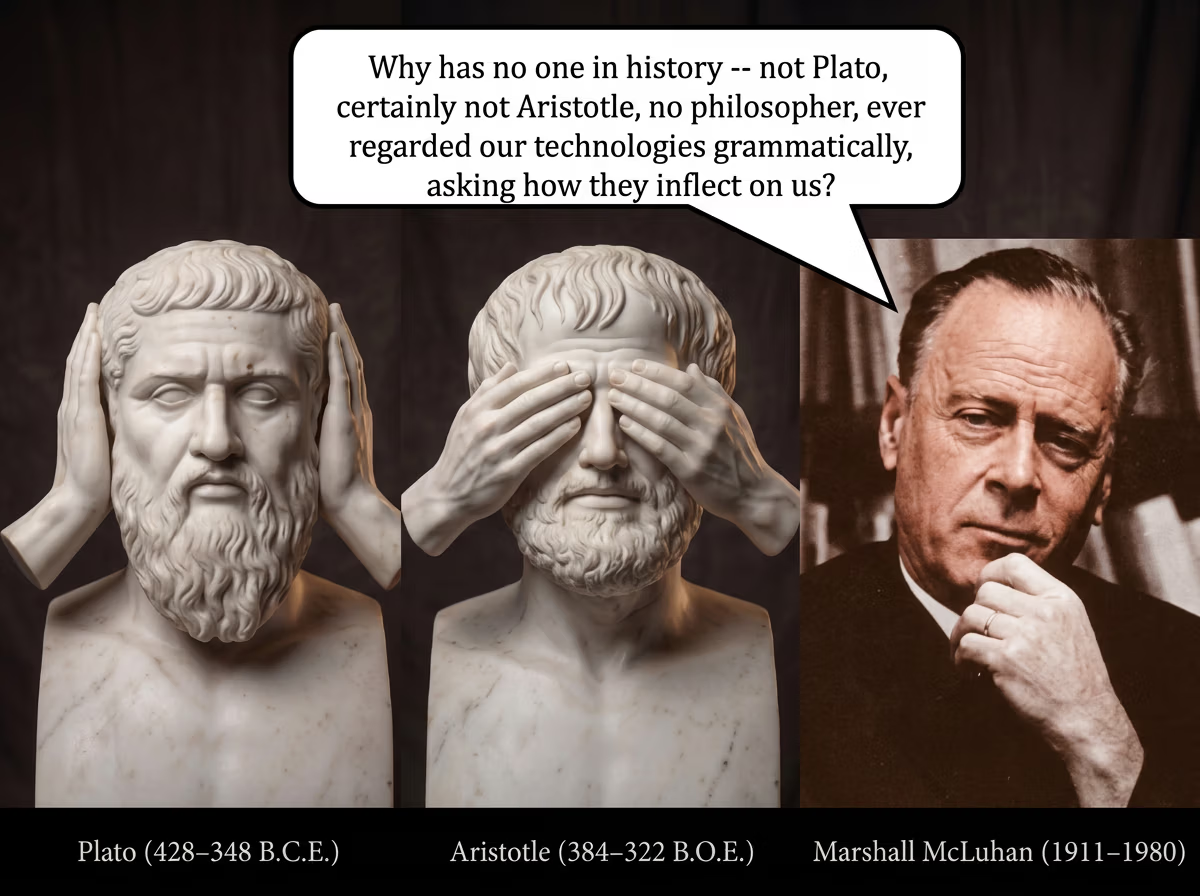
Visual man considers truth as simple matching of his thought against “reality”. The audile-tactile Jap or primitive man thinks of truth as involvement in the real, i.e., as making. Aristotle’s concept of mimesis is close to the old primitive idea of involvement. However, Aristotle saw that mimesis or repetition had the paradoxical effect of catharsis or release from involvement. If you wish to detent yourself from the particular conditions of one culture you have to construct an anti-environment. Art is such an environment and is intended for conscious contemplation. Technology is also art and creates new environments that have the exact opposite effects of art. These environments saturate and subdue consciousness. See Edward T. Hall’s The Silent Language and The Hidden Dimension.
Letter to Pat O’Neill, August 21, 1969 (LAC)
Year: 1969
The format and tone of some press styles may make the very concept of truth irrelevant. The most urgent and reliable facts presented in this way are a travesty of any reality.
Counterblast (1969), p 122
Year: 1969
Chapter:
News
Truth is not matching. It is neither a label nor a “mental reflection.” It is something we make in the encounter with a world that is making us. We “make sense”
not in cognition but in recognition or re-play.
Take Today with Barrington Nevitt (1972), pp 3-4
Year: 1972
This is the theme of The Gutenberg Galaxy where it is explained that the visually oriented person stresses matching over making in all experience. It is this matching that is often mistaken for truth in general.
Letter to Robert J. Leuver C.M.F., July 30, 1969, in The Medium and the Light (1999), p 93
Year: 1969

[In a newspaper] most trivial matters are given considerable additional intensity by being translated into prose at all. That is why no account of anything can be "truthful" in a newspaper.
From Cliché to Archetype with Wilfred Watson (1970), p 198 [confirm]
Year: 1970
Chapter:
News
In history and letters [since the time of Machiavelli], a lie about man was made the basis of secular prediction and control… And today man is being taken up as the instrument of the totalitarian transformation of man and society. The truth which is our freedom can, neglected by us, become the means of an enslavement of mind and spirit surpassing any tyranny of which history makes mention.
Catholic Humanism and Modern Letters” The McAuley Lectures: Christian Humanism in Letters, Saint Joseph College, West Hartford Connecticut, (1954), p 67, reprinted in The Medium and the Light (1999), p 174.
Year: 1954
When "truth" is reduced to mere matching of inner and outer, any statement can be questioned: "Dictionaries drive words out of their senses," as a wag noted.
From Cliché to Archetype with Wilfred Watson, (1970), p 30
Year: 1970
Chapter:
Matching and Making
It is observable that the more illusion and falsehood needed to maintain any given state of affairs, the more tyranny is needed to maintain the illusion and falsehood.
The Mechanical Bride (1951), Preface
Year: 1951
For "testing the truth" is not merely matching by congruence or classification; it is making sense out of the totality of experience — a process of pattern re-cognition that requires not only concepts but active perception by all the senses. Today, as "hardware" is transmuted into pure information by the process of "etherealization," the "inner" and the "outer" merge — thinking becomes doing.
“The Argument: Causality in the Electric World”, in Technology and Culture, Vol.14, No. 1, January (1973), p 8-9, reprinted in McLuhan Unbound # 3, (2005), p 15
Year: 1973