Viewing chapter West and East (9 quotes)
LSD and all the TV inner trips are more oriental than anything we are doing to westernize the East. The world of electric circuitry feeds us back into ourselves. The whole point about feedback is that it feeds back into you, and involves you in the process. That is what is called communication. Communication is a feedback to you without involvement. It is not a transmission of information or messages. It is involvement in the process.
“Education in the Electronic Age” Interchange, Vol 1, No 4, 1970, p 3
Year: 1970
East-West are shifting roles. East is going West, the Western world is going East. The East is going outer, the West is going inner. The East is going specialist, civilized; the West is going costumed, involved, role-playing, inner-tripping, integral and meditative.
“The Hardware-Software Mergers: How Successful Have They Been?” Speech at the conference, Reappraisal of the Educational Technology Industry, University of Chicago, November 16-118, 1969, Transcript, p 4
Year: 1969
Chapter:
Today’s Transition
As we seem to be acquiring the Eastern “software”, the Orient would seem to be taking over our Western hardware along with our Western alphabet. What has been formed is a completely new “ball park” of global dimensions with completely unfamiliar ground rules. In any event the printed and written word will have a salient function.
Speech delivered in Denver, May 4, (1975), transcript, p 3 *3 times in this document
Year: 1975
Chapter:
Hardware / Software
Of all the great hybrid unions that breed furious release of energy and change, there is none to surpass the meeting of literate and oral cultures. The giving of man of an eye for an ear by phonetic literacy is, socially and politically, probably the most radical explosion that can occur in any social structure. This explosion of the eye, frequently repeated in “backward areas", we call Westernization. With literature now about to hybridize the cultures of the Chinese, the Indians, and the Africans, we are about to experience such a release of human power and aggressive violence as makes the previous history of phonetic alphabet technology seem quite tame.
Understanding Media (1964), MIT/Routledge edition, pp 49-50
Year: 1964
Well, the simple fact of the matter is the whole world is an East/West happening, and while the Western world is going Oriental, the Oriental world is going Western. This has been going on for a century, and so what could be a bigger East/West happening than that? See, all the Western artists have gone Oriental since Baudelaire, and all the painters, all abstract art is Oriental art.
An interview from 1967 by Peter Mansaram, first published in Alexander Kuskis’s blog The McLuhan Galaxy
Year: 1967
After 2500 years of alphabetic and typographic culture, it is not easy for us to adjust suddenly to the non-visual, inner space of the interval and to the ferment of the "interface".
To make the transition from the "outer trip" of the visually-oriented man to the "inner trip" of the audile-tactile world, is to shift from West to East.
"Backward" and non-literate cultures and individuals take readily to non-visual or electric technology, which is the world of the new quantum mechanics or of the resonating chemical bond.
The DEWLINE Newsletter, Vol 1, # 5 (NOVEMBER 1968)
Year: 1968
Chapters:
Retribalizing | Today’s Transition
We have been through the three stages of alarm, resistance, and exhaustion that occur in every disease or stress of life, whether individual or collective. At least, our exhausted slump after the first encounter with the electric has inclined us to expect new problems. However, backward countries that have experienced little permeation with our own mechanical and specialist culture are much better able to confront and to understand electric technology. Not only have backward and nonindustrial cultures no specialist habits to overcome in their encounter with electromagnetism, but they have still much of their traditional oral culture that has the total, unified "field" character of our new electromagnetism. Our old industrialized areas, having eroded their oral traditions automatically, are in the position of having to rediscover them in order to cope with the electric age.
Understanding Media (1964), MIT/Routledge edition, pp 26-27
Year: 1964
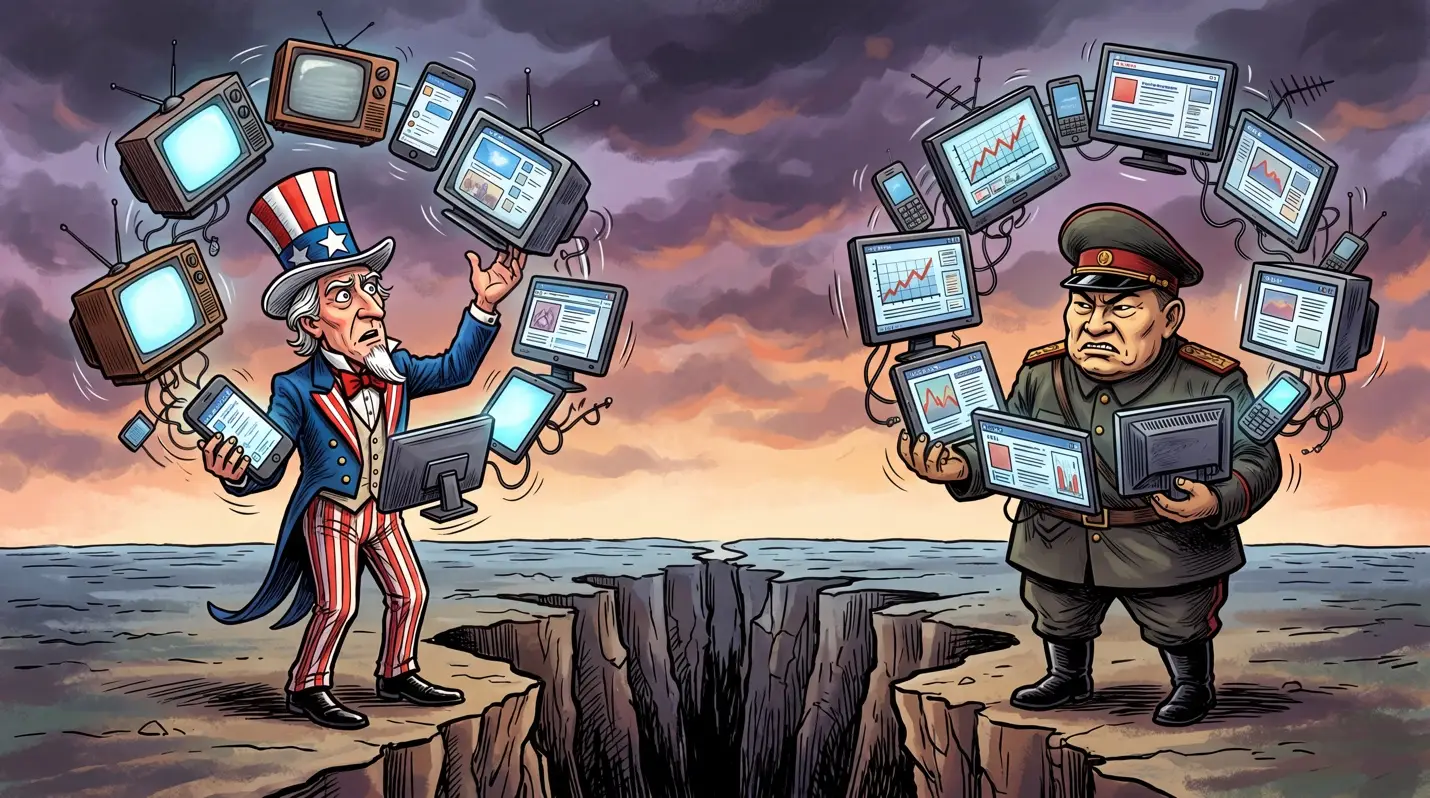

A Passage to India by E. M . Forster is a dramatic study of the inability of oral and intuitive oriental culture to meet with the rational, visual European patterns of experience. " Rational," of course, has for the West long meant "uniform and continuous and sequential." In other words, we have confused reason with literacy, and rationalism with a single technology. Thus in the electric age man seems to the conventional West to become irrational. In Forster's novel the moment of truth and dislocation from the typographic trance of the West comes in the Marabar Caves. Adela Quested's reasoning powers cannot cope with the total inclusive field of resonance that is India. After the Caves: " Life went on as usual, but had no consequences, that is to say, sounds did not echo nor thought develop. Everything seemed cut off at its root and therefore infected with illusion."
Understanding Media (1964), MIT/Routledge edition, p 15
Year: 1964
Chapters:
Acoustic Space | Between Two Ages
“The present tendency to involve all of the senses contrasted with an opposite trend in the orient. We’re orientalizing with new techniques… they are westernizing with old techniques.”
Quoted by Richard Shapard in a New York Times, October, 1967 reviewing the museum seminar headlined by McLuhan and Harley Parker, in The Museum as Large-Room Pinball Machine, Marshall McLuhan, Harley Parker, and Museum Professionals, 1967, full transcript, edited by William Buxton, published 2026, p 12
Year: 1967