Found 23 quotes (10 duplicates hidden).
Like our money, which is a "promise to pay", our advertising and P.R. only promise to pay promises.
“Foreword”, in Abortion in Perspective: The Rose Palace or the Fiery Dragon”, (1974), p iv
Year: 1974
Chapter:
Advertising
By repetition, an archetype can become a cliché again; or an individual man a crowd (with no private, but rather corporate, identity). Breakdown becomes breakthrough.
Laws of Media (1988), pp 107-108
Year: 1988
Chapter:
Breakdown as Breakthrough
Many people would rather die than defend themselves against these effects. The corresponding flip from "objective" to "immersion" techniques in politics presents itself in the form of a political shift from parties and policies to images and services.
“The End of the Work Ethic” (1973), in Essays Media Research Technology, Art, Communication (1997), p 107
Year: 1973
Chapters:
Chiasmus, Flips, Reversals | Politics and Government
↪ Also at #5589
The drastic flip from "objective" to "immersion" reporting has spawned a new genre of jokes which contrast to good news and bad news in a style represented by such stories as that of the doctor who reports to the patient: "I have some bad news for you. We cut off the wrong leg. But there is some good news. The withered limb is beginning to show some signs of life!"
“The End of the Work Ethic” (1973) in “Essays Media Research Technology, Art, Communication (1997), p. 107
Year: 1973
Chapter:
Chiasmus, Flips, Reversals
Clichés and stereotypes enacted a drama of social stability.
Through the Vanishing Point with Harley Parker (1968), p 107
Year: 1968
Chapter:
Cliché and Archetype
Communicating a truly new idea is always a miracle. It’s very rare. It’s not impossible.
Quoted in Who Was Marshall McLuhan? By Maurice McLuhan and Barrington Nevitt, 1994, p 107
Year: 1994
Chapter:
Communication
Mass education is a child of a mechanical age. It grew up along with the production line... [and it has] mastered the linear technique of stamping out products in mass.
“Learning in the Global Village” with George Leonard (1967), in Radical School Reform (1969), p 107
Year: 1967
Chapter:
Education
This danger signal is only one of many now flashing in school systems throughout the world. The signals say that something is out of phase, that most present-day schools may be lavishing vast and increasing amounts of time and energy preparing students for a world that no longer exists.
“Learning in the Global Village” with George Leonard (1967), in Radical School Reform (1969), p 107
Year: 1967
Chapter:
Education
Performers and singers of jazz and Rock are not specially happy or successful when using any language except English for these effects. It is quite impossible for any kind of song to exist apart from a linguistic ground or base, but there may prove to be a special component in English that favours the forms of jazz and Rock themes. The matter has not been studied.
“Sidebar”, in Explorations 20, 1971, p 107
Year: 1971
Chapters:
English Language | Music
↪ Also at #4884
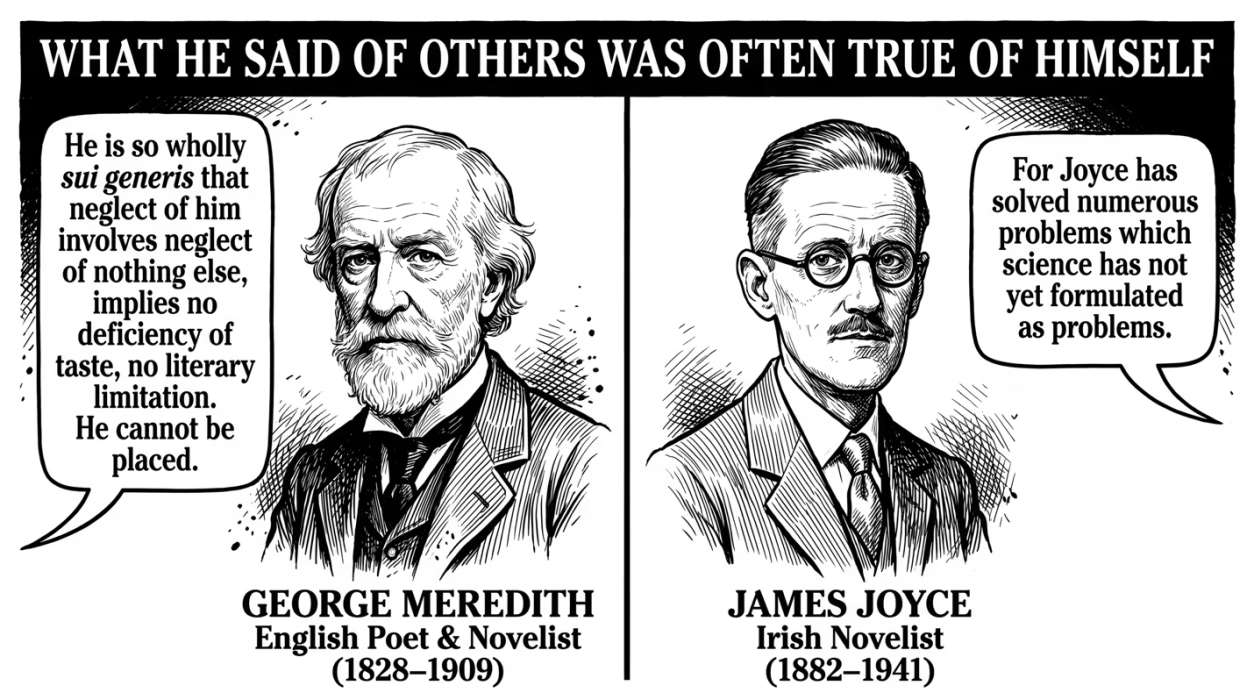
In our time the nature of technological change has been so rapid as to constitute a kind of recapitulation in a few years of all previous cultural evolution. That fact, fully apprehended by James Joyce, provided the matrix of Finnegans Wake.
“A Historical Approach to the Media” (1955), p 107
Year: 1955
Chapter:
History
It is Joyce's awareness of reason in this plenary sense that determines his attitude to the verbal universe.
“Compliment Accepted” Renascence (1958), p 107
Year: 1958
Chapter:
Joyce, James
Mathematics and the numerous non-verbal coding devices of science, today constitute the languages which support the structures of radio, TV, and the new visual culture of our age. With the advent of these rivals to verbal languages we can easily discern how traditional vernaculars are themselves the great mass media, that is, specialized frames and vehicles of experience.
“A Historical Approach to the Media” (1955), p 107
Year: 1955
Chapter:
Language
…traditional vernaculars are themselves the great mass media, that is, specialized frames and vehicles of experience.
A Historical Approach to the Media, 1955, p 107
Year: 1955
Chapter:
Language
These shapes [of an arch, a wall, a tower] express a huge preference, an enormous bias in the patterns of our awareness as much as does a new rhythm in poetry or music. And the very pre-existence of such biases in our culture naturally acts to channel all existing experience.
“A Historical Approach to the Media” (1955), p 107
Year: 1955
Chapter:
Language of Forms
The reversal aspect of the tetrad is succinctly exemplified in a maxim from information theory: data overload equals pattern recognition. Any word of process or form, pushed to the limit of its potential, reverses its characteristics and becomes a complementary form, just as the airplane, pushed to the limit of its potential, reverses its controls when it passes the “sound barrier.” Money (hardware), when pushed to its limit, reverses into the lack of money, that is credit (software or information), and the credit card. At high speed or in great quantity, the motor car reverts to nautical form, and traffic (or a crowd) “flows.”
Laws of Media: The New Science with Eric McLuhan, (1988), pp 107-108
Year: 1988
[Of his own mental vitality] The game keeps springing up like crazy.
Quoted from undated letter to John Wain, circa late 1950s, in “The Incidental Thoughts of Marshall McLuhan”; In Wain’s Dear Shadows (1986), p 107
Year: 1950
Chapter:
McLuhan on McLuhan
But his wit and his politics combined with that dropping of the puritan tendency, but retention of the puritan tone which marked his class and generation, lifted him into a sphere which was utterly opposite to that from which he came.
“The Marfleet Lectures”, March 16-17 (1967), reprinted in Understanding Me (2003), p 107
Year: 1967
Chapter:
Politics and Government
The corresponding flip from objective to immersion techniques in politics presents itself in the form of a political shift from parties and policies to images and services. That is, political parties and their explicit policies have simply been obsolesced by the images presented by the party leaders on the one hand, and the services taken for granted by the community, regardless of the party that happens to be in power, on the other hand.
"The End of the Work Ethic", reprinted in Marshall McLuhan Essays Media Research: Technology Art Communication (1997), p 107
Year: 1997
In such society, the separation of the individual from the group in space (privacy), and in thought ("point of view"), and in work (specialism), has had the cultural and technological support of literacy, and its attendant galaxy of fragmented industrial and political institutions.
Understanding Media, 1964, MIT/Routledge, p 107
Year: 1964
Chapters:
Privacy | Today’s Transition
↪ Also at #6937
Most human attention is allocated to the 90% area which is the area of problems. The 10% area is the area of irritation and also of opportunity. It was the genius of Harold Innis that he refused to be distracted by the 90% area of problems. He went straight to the 10% core of opportunity and sought insight into the causes that underlay the whole situation. For example, he writes: "We are perhaps too much a part of the civilization which followed the printing industry to be able to detect its characteristics. Education in the words of Laski became the art of teaching men to be deceived by the printed word.
“Introduction to The Bias of Communication” (1962), reprinted in Theories of Communication with Eric McLuhan (2011), p 107
Year: 1962
After Gutenberg the new visual intensity will require light on everything and its idea of space and time will change to regard them as containers to be filled with objects or activities. But in a manuscript age when the visual stood in close relation to the audio-tactile. Space was not a visual container. There was scarcely any furniture in a medieval room, as Sigfried Gidion explains in Mechanization Takes Command.
The Gutenberg Galaxy: The Making of Typographic Man, (1962), p 107
Year: 1962
Chapter:
Space
It was this civilization’s genius to manipulate matter, energy and human life by breaking every useful process down into its functional parts, then producing any required number of each. Just as shaped pieces of metal became components of a locomotive, human specialists became components of the great social machine.
“Learning in the Global Village” with George Leonard (1969), p 107
Year: 1969
Chapter:
Specialism
With satellites, television ceases to be environmental and becomes content, becomes art form. As long as [TV] has environmental power it is invisible, and as we notice only those characteristics of it which belong to the old technology, movies. When television becomes an old technology, we will really understand and appreciate its glorious properties.
“Television in a New Light,” The Meaning of Commercial Television, edited by Stanley Donner (1966), p 107
Year: 1966
Chapter:
Television
↪ Also at #6785