Found 23 quotes (13 duplicates hidden).
The steady trend in advertising is to manifest the product as an integral part of large social purposes and processes. With very large budgets the commercial artists have tended to develop the ad into an icon, and icons are not specialist fragments or aspects but unified and compressed images of [a] complex kind.
Understanding Media, MIT/Routledge edition, (1964), p 226
Year: 1964
Chapter:
Advertising
Thus the English and American cultures in particular were overwhelmed by print, since in the 16th century they had only rudimentary defences to set up against the new printed word. The rest of Europe, richer in plastic and oral culture, was less blitzed by the printing press. And the Orient has so far had many kinds of resistance to offer.
“Culture without Literacy”, in Explorations #1, December (1953), p 123 reprinted in Essential McLuhan, (1995), p 309, additional reprint in Media Research Technology, Art and Communication (1997), p 133. and McLuhan Unbound #6, (2017)
Year: 1953
Chapter:
America, North America
The printed page in rendering the language of the face and gesture illegible has also caused the abstract media of printed words to become the main bridge for the inter-awareness of spiritual and mental states.
“Culture without Literacy”, in Explorations #1, December (1953), p 122-123 reprinted in Essential McLuhan, (1995), p 308, additional reprint in Media Research Technology, Art and Communication (1997), p 132, and McLuhan Unbound #6, (2017)
Year: 1953
... for Coleridge his own acceptance of the theory of imagination and perception exemplified in the poetry of Wordsworth was a detriment to the continuance of poetic activity.
“Coleridge as Artist” (1957), in The Interior Landscape (1969), p 123
Year: 1957
Chapter:
Coleridge
But already in a [Coleridge] poem “written in very early youth” there is the opening line which fixes amid the picturesque techniques the mature vision: Calm is all nature as a resting wheel.
“Coleridge as Artist” (1957), in The Interior Landscape (1969), p 123
Year: 1957
Chapter:
Coleridge
As new technologies come into play, people become less and less convinced of the importance of self expression. Teamwork succeeds private effort.
The Medium is the Massage (1967), p 123
Year: 1967
Chapter:
Corporate
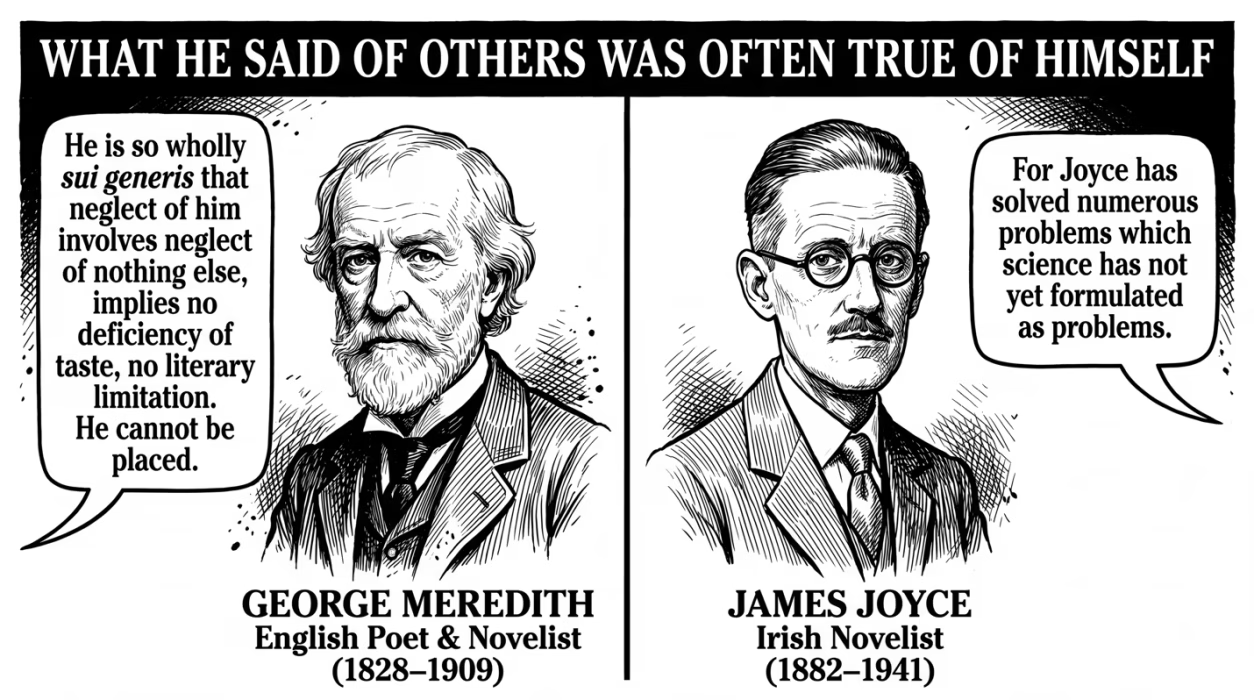
Poetry and Song are major means by which speech is purified and strengthened, and poetry and music are extensions of speech, so it is not by chance that most of the English poetry and song of the twentieth century have come out of Ireland and the American south. T. S. Eliot would have been the first to insist upon his debt to W. B. Yeats and James Joyce.
Liturgy And Media” in The Critic, Vol.31, No. 3, January-February (1973), p 18, reprinted in reprinted in The Medium and the Light: Reflections on Religion (1999), p 123
Year: 1973
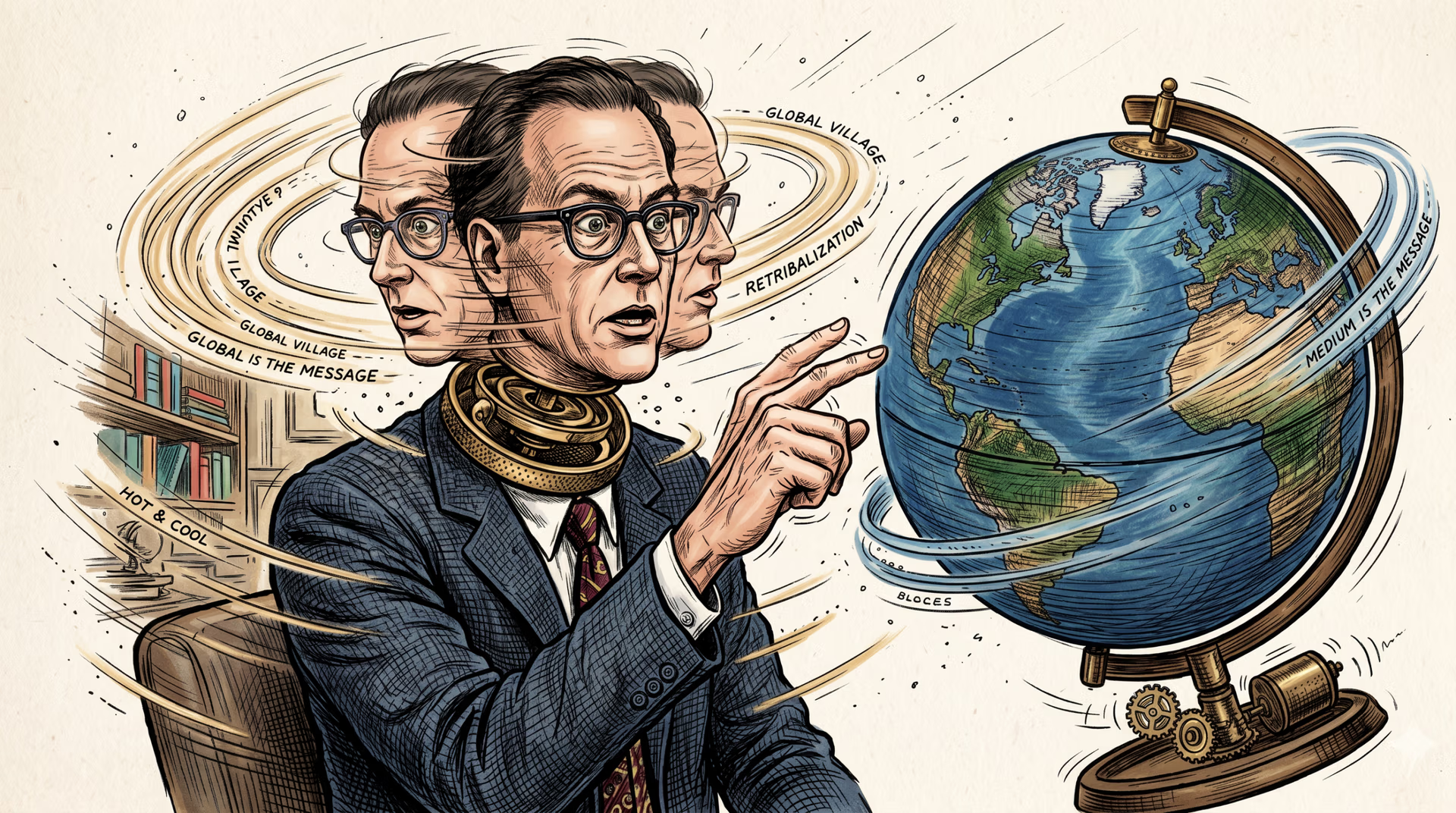
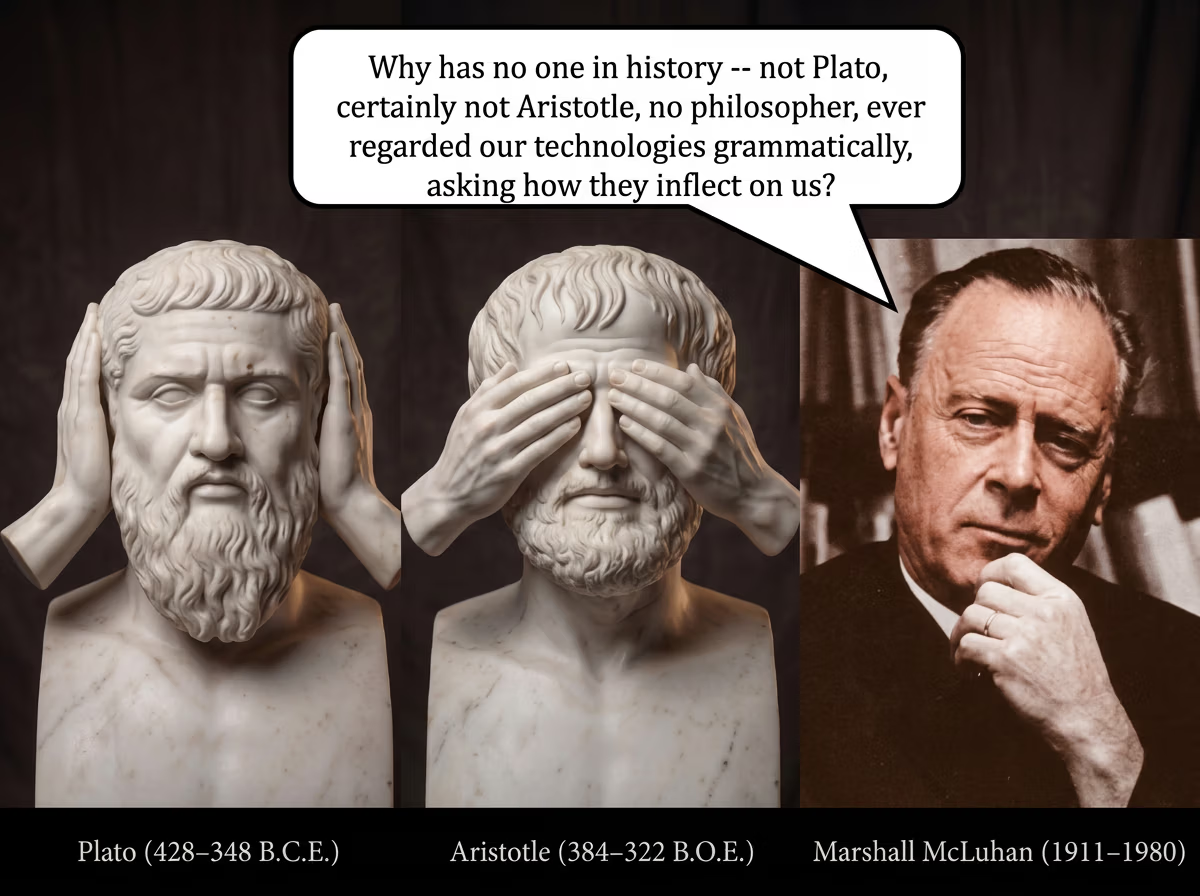
The ways of thinking implanted by electronic culture are very different from those fostered by print culture. Since the Renaissance most methods and procedures have strongly tended towards stress on the visual organization and application of knowledge. Our electronic world now calls for a unified global field of awareness; the kind of private consciousness appropriate to literate man can be viewed as an unbearable kink in the collective consciousness demanded by electronic information movement.
“The Agenbite of Outwit”, In Location Magazine, Vol.1, No.1, (1963), p 123; reprinted in Marshall McLuhan Essays Media Research: Technology Art Communication, (1997), p 125
Year: 1963
Let me suggest that it may be possible to write programs for changes, not only in consciousness but in the unconscious in the future.
“Environment: The Future of an Erosion”, 1967, in On the Nature of Media, 2016, p 123
Year: 1967
Chapters:
Future | Propaganda
↪ Also at #5840
The future of the child is changing beneath our gaze.
“Environment: The Future of an Erosion” (1967), in On the Nature of Media (2016), p 123
Year: 1967
Chapter:
Future
The future of city may be very much like a world's fair-- a place to show off new technology--rather than a place of work or residence. It is also fascinating to consider the future of language. We know right now some very important structural things about language that are new. The future of language will not be as a system of classified data or meanings.
“The Invisible Environment: The Future of an Erosion”, Perspecta, Vol.11, (1967), p 166, reprinted in On the Nature of Media, (2016), p 123
Year: 1967
Chapters:
Future | Predictions
↪ Also at #5666
Everything from politics to bottle-feeding, global landscape, and the subconscious of the infant is subject to the manipulation of conscious artistic control—the BBC carries the unrehearsed voice of the nightingale to the Congo, the Eskimo sits entranced by hill-billy music from West Tennessee.
“Culture without Literacy”, in Explorations #1, December (1953), p 123 reprinted in Essential McLuhan, (1995), p 308, additional reprint in Media Research Technology, Art and Communication (1997), p 133. and McLuhan Unbound #6, (2017)
Year: 1953
Chapter:
Global Village
The items of news and advertising that exist under a newspaper dateline are interrelated only by that dateline. They have no interconnection of logic or statement. Yet they form a mosaic or corporate image whose parts are interpenetrating.
“The Agenbite of Outwit”, In Location Magazine, Vol. 1, No. 1, (1963), reprinted in Marshall McLuhan Essays Media Research: Technology Art Communication, (1997), p 123
Year: 1963
Newton revolutionized the techniques of poetry and painting. Joyce encompasses Einstein but extends his pictographic formula to the entire world of language and consciousness. The tendency of the challengingly new to revoke and reinforce ancient disciplines never appeared more strikingly than in Joyce. Literature may have come to an end in 1870 but poetic, rhetoric and metaphysic have come increasingly alive since then.
“New Media as Political Forms,” Explorations 3, 1954, pp 123-124
Year: 1954
Chapter:
Joyce, James
Joyce organized Ulysses by assigning the various city forms of walls, streets, civic building and media to the various bodily organs… Baudelaire originally intended to call his Fleurs du Mal, Les Limbes, having in mind the city as corporate extensions of our physical organs. Our letting-go of ourselves, self-alienations, as it were, in order to amplify or increase the power of various functions, Baudelaire considered to be flowers of growths of evil.
Understanding Media (1964), MIT/Routledge edition, pp 123-124
Year: 1964
Chapter:
Joyce, James
We hear from all directions at once; this creates a unique unvisualizable space. The all-at-once-ness of auditory space is the exact opposite of lineality, of taking one thing at a time. It is very confusing to learn that the mosaic of a newspaper page is "auditory" in basic structure.
“The Agenbite of Outwit”, In Location Magazine, Vol. 1, No. 1, (1963), reprinted in Marshall McLuhan Essays Media Research: Technology Art Communication, (1997), p 123
Year: 1963
Chapter:
Linear and Nonlinear
This question highlights the difference between exposition and exploration. Anything that I know I can explain quite simply and directly. I can package it. Nearly everything I write is concerned with areas of exploration in which I am actively engaged in discovery. That is why I say, I have no point of view.
Text of an address to the Provincial Committee on the Aims and Objectives of Education of the Schools of Ontario, on January 19, (1967), p 11. Printed as “Education in the Electronic Age,” Interchange (Toronto: Ontario Institute for Studies in Education), Vol. 1, No. 4. (1970), reprinted as Chapter 12.3 in The Best of Times / The Worst of Times: Contemporary Issues in Canadian Education. (1972)
Year: 1967
Chapter:
McLuhan on McLuhan
To keep kids from pop culture? Put the hit parade on the examination and all the comic books and all the movies and all the TV shows… and you will find a total desertion of the whole enterprise. It works for Shakespeare; why shouldn’t it work for Bonanza?
“Education in the Electronic Age” " The text of an address to the Provincial Committee on the Aims and Objectives of Education of the Schools of Ontario, on January 19, 1967. Printed as Chapter 12.3 in The Best of Times /The Worst of Times: Contemporary Issues in Canadian Education, Editors., H. A. Stevenson, R. M. Stamp, and J. D. Wilson (1972)
Year: 1967
Chapter:
McLuhanisms & Zingers
Whereas science links the present to the past via concept, art leaps from the present to the future via percepts. Concepts isolate figures, while percepts relate figures and grounds as interplay.
Take Today with Barrington Nevitt (1972), p 123
Year: 1972
Chapter:
Percept
This is why, I said to myself, French dramatic poetry is so often rhetorical, for what is rhetoric but the will trying to do the work of the imagination?
Liturgy And Media” in The Critic, Vol.31, No. 3, January-February (1973), p 18, reprinted in reprinted in The Medium and the Light: Reflections on Religion (1999), p 123
Year: 1973
Chapter:
Poetry
So it is a very good point to begin the investigation [teaching kids sex education] by simply challenging the right of that word [sex] to exist except as a classification of male and female. Otherwise it probably has no right to exist.
“Education in the Electronic Age,” Interchange (Toronto: Ontario Institute for Studies in Education), Vol. 1, No. 4. Text of an address to the Provincial Committee on the Aims and Objectives of Education of the Schools of Ontario, on January 19, 1967. Printed as Chapter 12.3 in The Best of Times / The Worst of Times: Contemporary Issues in Canadian Education. Eds., H. A. Stevenson, R. M. Stamp, and J. D. Wilson. Toronto and Montreal: Holt, Rinehart and Winston of Canada Limited, 1972
Year: 1967
Chapter:
Sex and Love
The child as a separate social fact was an invention of the 17th century, according to the historian Philippe Ariès: historically the child came out of the 17th century and did not exist, so to speak, in Shakespeare's day. The child had, up until that time, been so completely merged in the adult world that there was nothing that could be called childhood in our sense at all. And so it is with the family, another 17th century discovery.
“Environment: The Future of an Erosion” (1967), in On the Nature of Media (2016), p 123
Year: 1967
Chapter:
Youth
That is, the major social effect of the telephone is to remove the identity of the caller. If he is not identified or chooses not to identify himself, he loses touch with a geographic location and a social function. He becomes truly discarnate and, in that psychic sense, uncontrollable—a phone poltergeist, as it were, who occasionally produces the obscene phone call.
The Global Village with Bruce Powers (1989), p 123
Year: 1989
Chapter:
Discarnate
↪ Also at #1534