Found 18 quotes (9 duplicates hidden).
Since [1910] the word has been used to effect a universal hypnosis. How are words to be used to unweave the spell of print? Of radio commercials and news-“casts”? I’m working on that problem.
Letter to Ezra Pound, June 22, 1951, in Letters of Marshall McLuhan (1987), p 227
Year: 1951
Chapters:
Advertising | Wake Them Up!
↪ Also at #7335
Ideally, advertising aims at the goal of a programmed harmony among all human impulses and aspirations and endeavors. Using handicraft methods, it stretches out toward the ultimate electronic goal of a collective consciousness.
Understanding Media, MIT/Routledge edition, (1964), p 227
Year: 1964
Chapters:
Advertising | Corporate Consciousness
↪ Also at #1410
Now an American not only does not like acting or putting on a public, but he does not put on a corporate or standard voice when he speaks. He uses his private voice, and this, of course, enables the Americans to have no class consciousness and no class structure.
“TV News as a New Mythic Form, 1970”, in Understanding Me, 2003, p 168
Year: 1970
Chapter:
America, North America
45 years ago things were like this, but less so.
Letter to Ezra Pound, June 22, 1951, in Letters of Marshall McLuhan (1987), p 227
Year: 1951
Chapter:
Change
It is the powerful mosaic and iconic thrust in our experience since TV that explains the paradox of the upsurge of TIME and NEWSWEEK and similar magazines. These magazines present the news in a compressed mosaic form that is a real parallel to the ad world.
Understanding Media (1964), MIT/Routledge edition, p 227
Year: 1964
Chapter:
Discontinuity
The future of government lies in the area of psychic ecology and can no longer be considered on a merely national or international basis.
Take Today with Barrington Nevitt, 1972, p 227
Year: 1972
But the ability to perceive media-induced extensions of man, once the province of the artist, is now being expanded as the new environment of electric information makes possible a new degree of perception and critical awareness by nonartists.
Playboy interview (1969), in Essential McLuhan (UK edition, 1997), p 227
Year: 1969
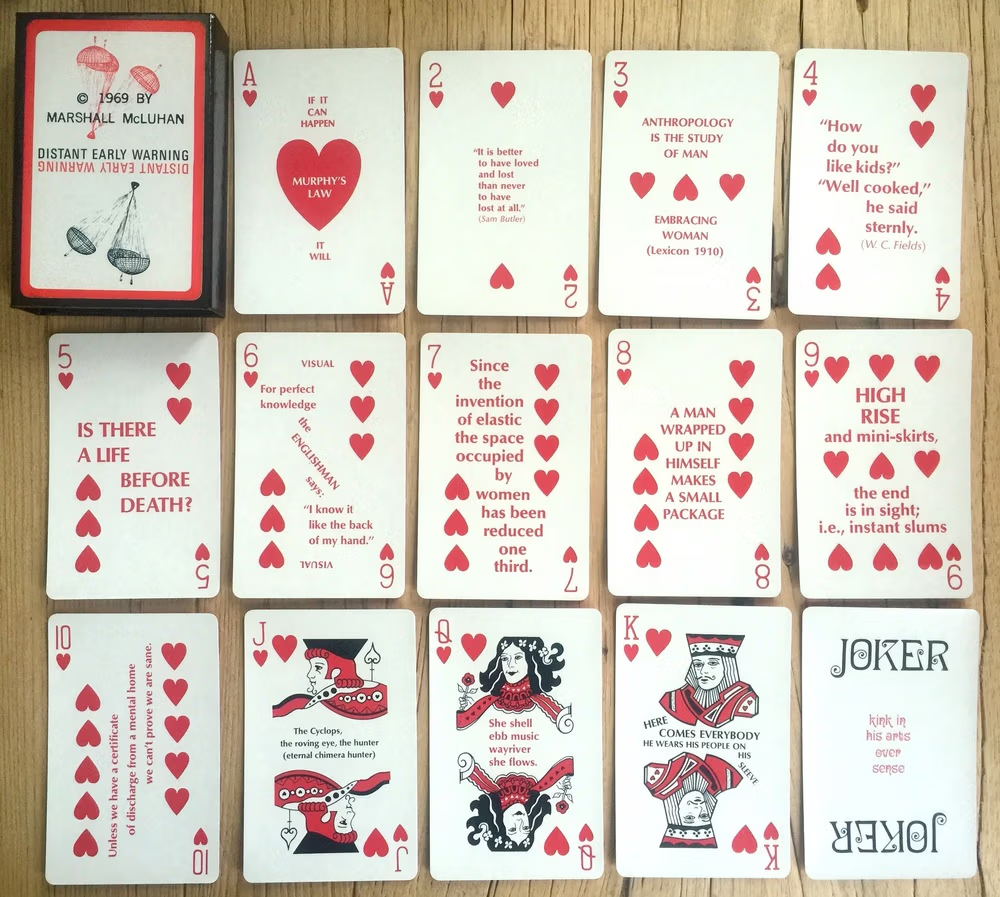
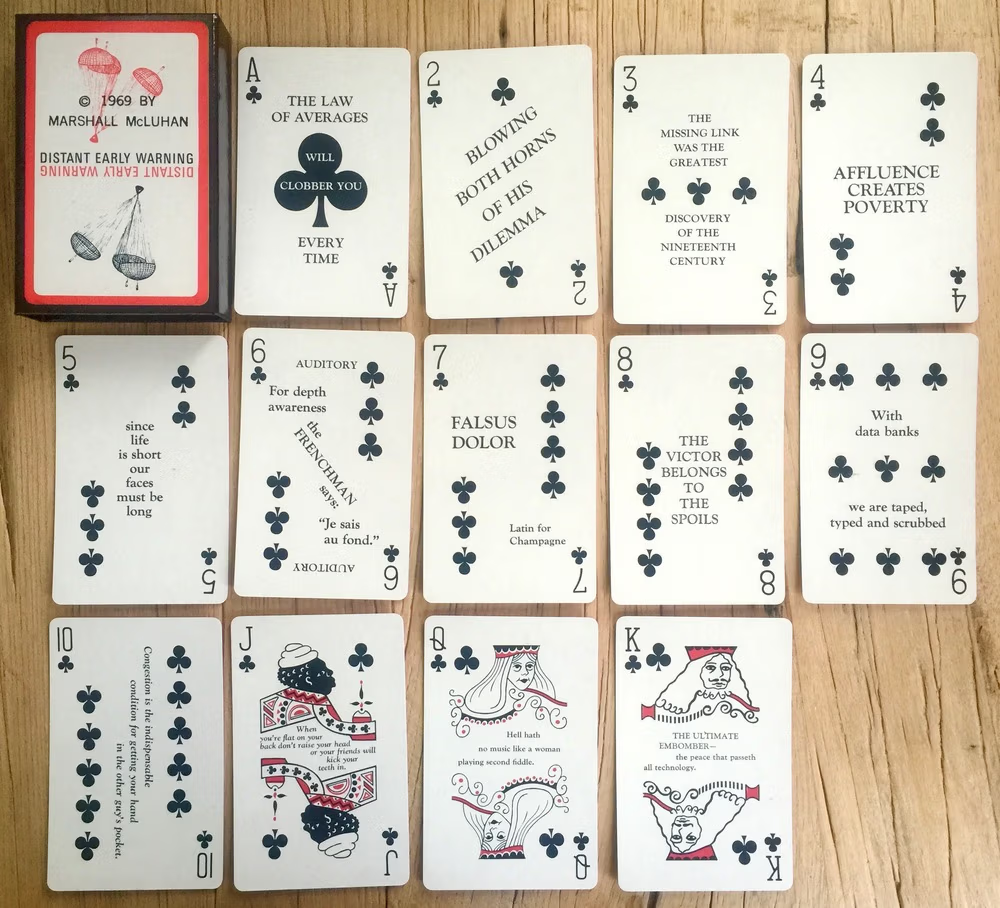
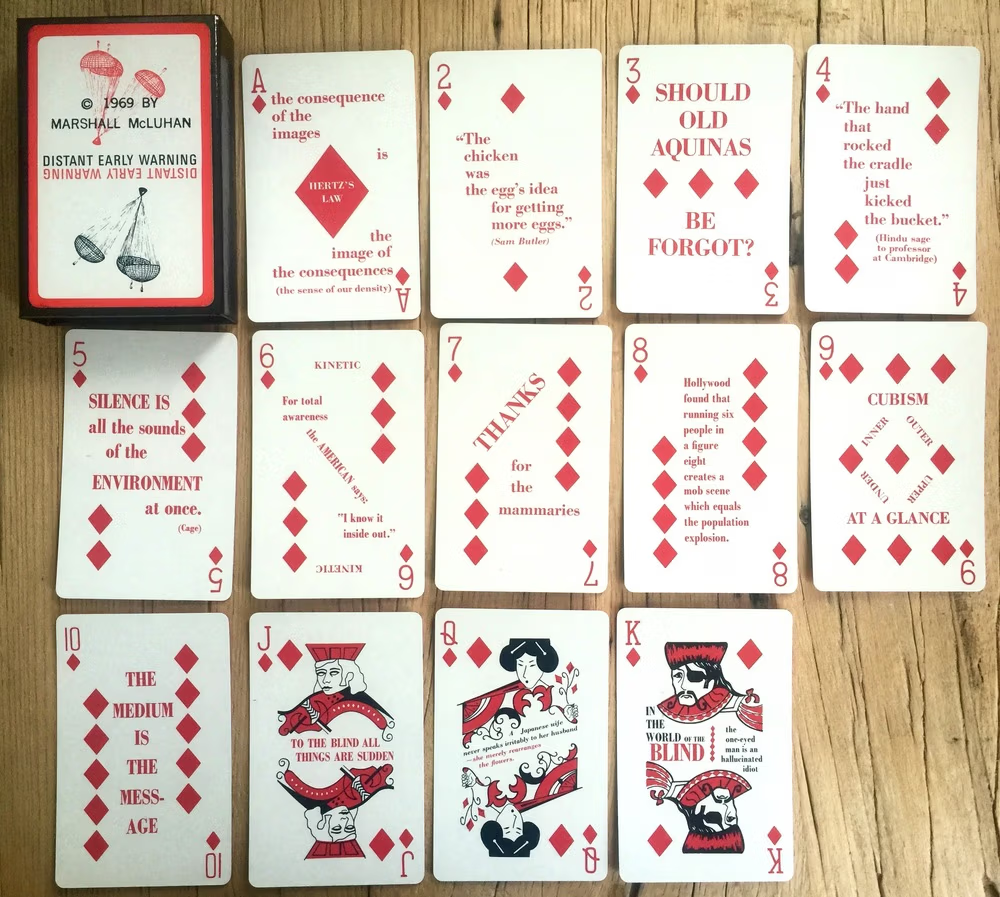
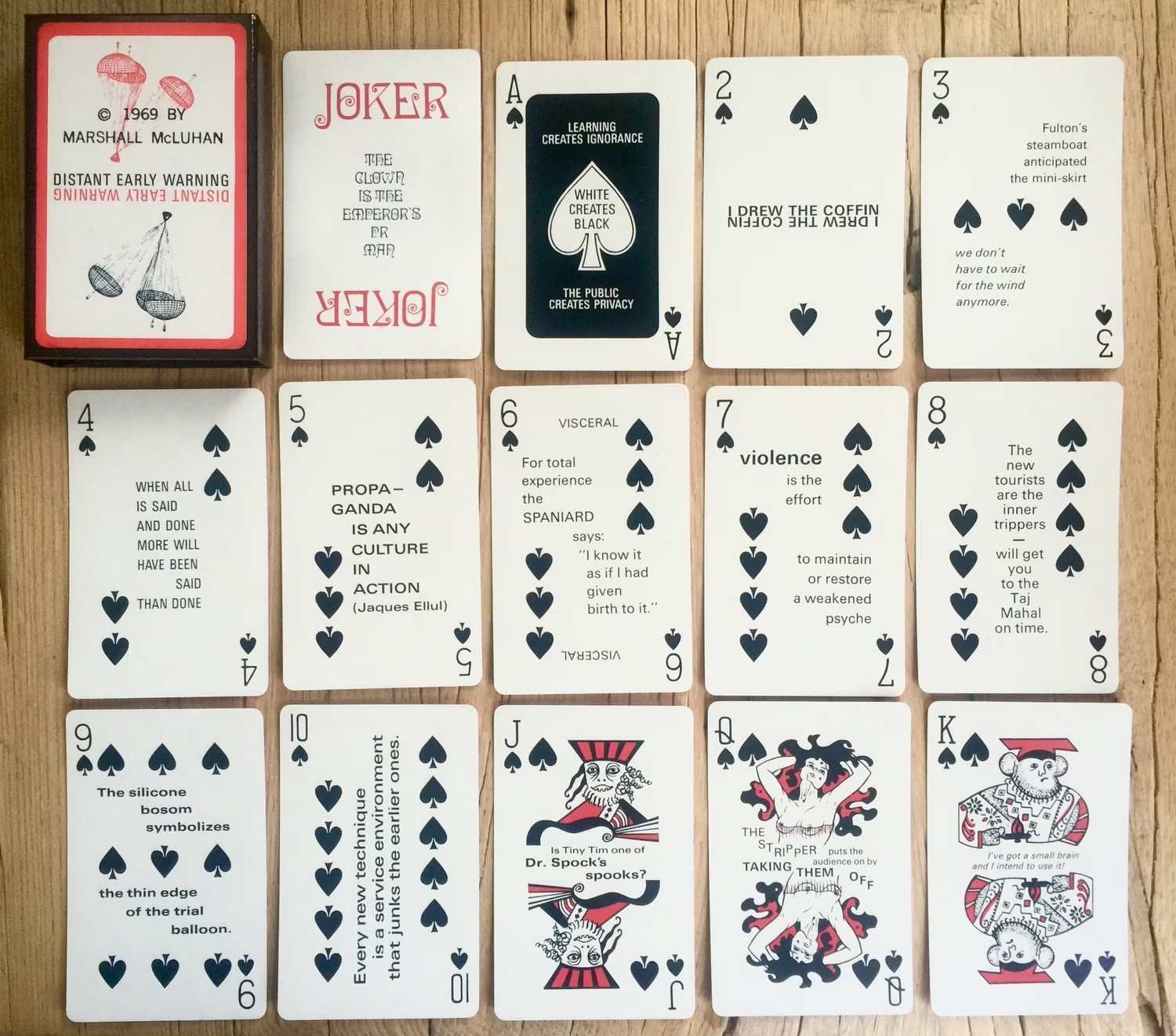
All of man’s artifacts, whether hardware or software, whether bulldozers or laws of chemistry, are alike linguistic in structure and intent. (227)
Quoted in: “The Canadian Journal of Communication”, December 1989, p 149
Year: 1989
Chapter:
Laws of Media
Lewis saw that years ago. His "America and Cosmic Man" was an H-bomb let off in the desert. Impact nil. We resent or ignore such intellectual bombs. We prefer to compose human beings into bombs and explode political and social entities. Much more fun. Lewis clears the air of fug. We want to get rid of people entirely.
Letter to Ezra Pound, June 22, 1951, in Letters of Marshall McLuhan, 1987, p 227
Year: 1951
Chapter:
Lewis, Wyndham
The word is now the cheapest and most universal drug.
Letter to Ezra Pound, June 22, (1951), in Letters of Marshall McLuhan, (1987) p 227
Year: 1951
Chapter:
McLuhan on McLuhan
I am an intellectual thug who has been slowly accumulating a private arsenal with every intention of using it.
Letter to Ezra Pound, June 22, (1951), in Letters of Marshall McLuhan, (1987) p 227
Year: 1951
Chapter:
McLuhan on McLuhan
I should prefer to de-fuse this gigantic human bomb by starting a dialogue somewhere on the side-lines to distract the trigger-men or to needle the somnambulists. In London 1910 you faced various undesirable states of mind.
Letter to Ezra Pound, June 22, (1951), in Letters of Marshall McLuhan, (1987), p 227
Year: 1951
Chapter:
McLuhan on McLuhan
In a mindless age every insight takes on the character of a lethal weapon.
Letter to Ezra Pound, June 22, 1951, in Letters of Marshall McLuhan (1987), p 227
Year: 1951
Chapter:
McLuhanisms & Zingers
Today we get inside the machine. It is inside us. We in it. Fusion. Oblivion. Safety. Now the human machines are geared to smash one another. You can't shout warnings or encouragement to these machines. First there has to be a retracing process. A reduction of the machine to human form. Circe only turned men into swine. Our problem is tougher.
Letter to Ezra Pound, June 22, 1951, in Letters of Marshall McLuhan, p 227
Year: 1951
Chapters:
Mechanization | Tools We Shape, Reshape Us
↪ Also at #6985
Mosaic news neither narrative, nor point of view, nor explanation, nor comment. It is a corporate image in depth of the community in action and invites maximal participation in the social process.
Understanding Media, 1964, MIT/ROUTLEDGE, p 227
Year: 1964
Chapter:
News
↪ Also at #5059
There is no "meaning" in the news except what we make — there is no connection between any of the items except the instant dimension of electric circuitry. News items are like the parts of the symbolist structure. The reader is the co-creator, in a newspaper as in a detective story, in which the reader has to make the plot as he goes. The detective story was one of the very first anticipations of electric technology. Edgar Allan Poe was a considerable innovator in the matter of antienvironments for the Electric Age.
“Address at Vision 65” (1966), in Essential McLuhan (1995), p 227
Year: 1966
Chapter:
Participation
↪ Also at #5237
These views are characteristic of a relatively oral culture but became less and less tenable under the conditions of the study of printed books. So that by the time of Coleridge the idea of the simultaneous order of all elements in a composition seemed novel and exciting. Yet this notion of the simultaneous interaction of all parts of any work has become the norm in twentieth-century study of literature and of society.
“Knowledge, Ideas, Information, and Communication”, 1958, p 227
Year: 1958
Chapter:
Simultaneity
Little Bo Peep wants to lose her B.O. She isn’t interested in her academic sheep no more no more. New deodorants fix you so’se your dog won’t recognize you again. The cube root of fug-all.
Letter to Ezra Pound, June 22, 1951, in Letters of Marshall McLuhan (1987) pp 227-228
Year: 1951
Chapter:
Wake Them Up!