Found 138 quotes (50 duplicates hidden).
The public is a number which is not only expressed in curves but which is bombarded with curves.
The Mechanical Bride ,(1951), p 79
Year: 1951
Chapter:
Advertising
Today the tyrant rules not by club or fist, but disguised as a market researcher, he shepherds his flocks in the ways of utility and comfort.
“Preface”, in The Mechanical Bride, (1951), p unnumbered between v & vii
Year: 1951
Chapters:
Advertising | McLuhanisms & Zingers
↪ Also at #4084
It would seem that there is some sense of compulsion among the marketeers to assume the appearance of Little Red Riding Hood's granny. But this fear of detection is groundless.
“Freedom to listen”, in The Mechanical Bride, (1951) p 21
Year: 1951
Chapter:
Advertising
Effective advertising gains its ends partly by distracting the attention of the reader from its presuppositions and by its quiet fusion with other levels of experience.
The Mechanical Bride, (1951), p 82
Year: 1951
Chapter:
Advertising
What happens when the ad makers take over all the popular myths and poetry? Are ads themselves the main form of industrial culture?
“Freedom-American Style” in The Mechanical Bride, (1951), p 117
Year: 1951
Chapters:
Advertising | Questions He Asks
The craving for intense individuality and attention merges with the opposite extreme of security through uniformity.
The Mechanical Bride, (1951), p 96
Year: 1951
Chapters:
Advertising | Individual
↪ Also at #2914
Since [1910] the word has been used to effect a universal hypnosis. How are words to be used to unweave the spell of print? Of radio commercials and news-“casts”? I’m working on that problem.
Letter to Ezra Pound, June 22, 1951, in Letters of Marshall McLuhan (1987), p 227
Year: 1951
Chapters:
Advertising | Wake Them Up!
↪ Also at #7335

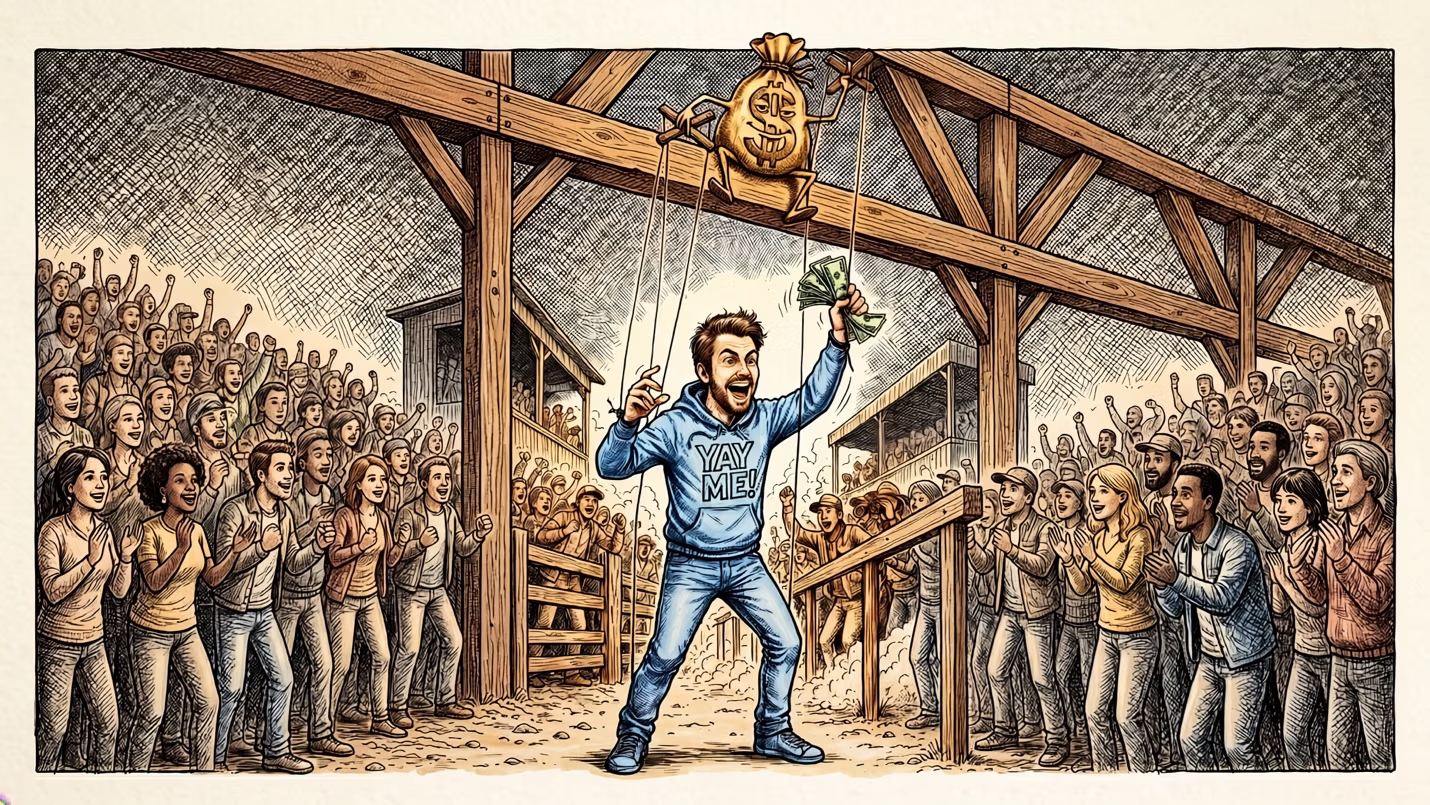





The objective of advertising is the manipulation, exploitation, and control of the individual.
The Mechanical Bride, (1951), p 21
Year: 1951
Chapter:
Advertising
The modern Little Red Riding Hood, reared on singing commercials, has no objection to being eaten by the wolf. "Freedom to Listen," in a world where effective expression via newspaper or radio is reserved only for a tiny minority, is freedom to put up or shut up.
The Mechanical Bride, (1951), p 21
Year: 1951
Chapter:
Advertising
With more and more products competing for attention, you need a selling medium with dramatic impact - films. And films are ready.
The Mechanical Bride, (1951), p 90
Year: 1951
Chapter:
Advertising
These magazines, carefully geared to both the purse and heartstrings of their respective reader groups, feature houses and rooms in which almost nobody ever lives-certainly not the readers.
The Mechanical Bride, (1951), p 112
Year: 1951
Chapter:
Advertising
Nobody has to be told that people who crave to be held tight, whether in somebody's arms or in a "foundation garment," are looking for extra security. And one of the paradoxes of modern feminine attire is the strange mixture of brevity and rigidity.
The Mechanical Bride, (1951), p 152
Year: 1951
Chapter:
Advertising
It is critical vision alone which can mitigate the unimpeded operation of the automatic.
The Mechanical Bride, 1951, p 87
Year: 1951
Chapters:
Advice | McLuhanisms & Zingers
↪ Also at #4400
Basic modes of cognition on this continent [are] not linguistic but technological.
“Letter to Ezra Pound, January 5, 1951”, in Letters of Marshall McLuhan (1987), p 218
Year: 1951
Chapter:
America, North America
As the unity of the modern world becomes increasingly a technological rather than a social affair, the techniques of the arts provide the most valuable means of insight into the real direction of our own collective purposes.
“Magic that changes mood”, in The Mechanical Bride (1951), p 87
Year: 1951
Chapters:
Anticipating Change | Living Unity
↪ Also at #3579
The arts both as storehouse of achieved values and as the antennae of new awareness and discovery make possible both a unified and an inclusive human consciousness in which there is easy commerce between old and new, between assured success and tentative inquiry and experiment.
The Mechanical Bride, (1951) p 87
Year: 1951
Chapters:
Art, Artists | Consciousness
↪ Also at #1321
The basic criterion for any kind of human excellence is simply how heavy a demand it makes on the intelligence. How inclusive a consciousness does it focus?
The Mechanical Bride, (1951), p 152
Year: 1951
Chapters:
Art, Artists | Consciousness
↪ Also at #1326
One major discovery of the symbolists which had the greatest importance for subsequent investigation was their notion of the learning process as a labyrinth of the senses and faculties whose retracing provided the key to all arts and sciences (basis of myth of Daedalus, basic for the dreams and schemes of Francis Bacon, and, when transferred by [Giovanni Battista] Vico to philology and history of culture, it also forms the basis of modern historiography, archaeology, psychology and artistic procedures alike.
Letter to Harold Adams lnnis, March 14, 1951, in Letters of Marshall McLuhan (1987), p 221
Year: 1951
Chapter:
Bacon, Francis
To the mind of the modern girl, legs, like busts, are power points which she had been taught to tailor, but as parts of the success kit rather than erotically or sensuously. She swings her legs from the hip with masculine drive and confidence. She knows that “a long-legged gal can go places.” As such, her legs are not intimately associated with her taste or with her unique self but are merely display objects like the grill work on a car. They are date-baited power levers for the management of the male audience.
The Mechanical Bride, (1951), p 98
Year: 1951
Chapter:
Body
Thus, for example, the legs “on a Pedestal” presented by the Gotham Hosiery company are one facet of our “replaceable parts” cultural dynamics. In a specialist world it is natural that we should select some single part of the body for attention. Al Capp expressed this ironically when he had L’il Abner fall desperately in love with the pictorial scrap of a woman’s knee, saying (January 21, 1950) “Why not? Some boys fall in love with the expression on a gal’s face. Ah is a knee man!” Four months and many lethal and romantic adventures later, ‘L’il Abner was closing in on the owner of the knee.
The Mechanical Bride, (1951), p 98
Year: 1951
Chapter:
Body
The brittle, self-conscious pose of the mannequin suggests the activities of competitive display rather than spontaneous sensuality. And the smartly turned-out girl walks and behaves like a being who sees herself as a slick object rather than is aware of herself as a person. “Ever see a dream walking?” asks a glamour ad. The Hiroshima bomb was named “Gilda” in honor of Rita Hayworth.
The Mechanical Bride, (1951), p 99
Year: 1951
Chapter:
Body
The Hiroshima bomb was named “Gilda” in honor of Rita Hayworth.
The Mechanical Bride, (1951), p 99
Year: 1951
Chapter:
Bomb
Instead of creeping into the bowels of the earth, science will enable us to hide out in some inaccessible time pocket until the atomic clouds have cleared and biological warfare has quieted down.
The Mechanical Bride, 1951, p 93
Year: 1951
Chapter:
Bomb
[Why serious critics should study popular culture]
In order to free the mind from the debilitating confusion, it is not enough to claim priority for excellence without considering the bulk which is inferior.
The Mechanical Bride, (1951), p152
Year: 1951
Chapter:
Cartoons, Comics
Why not study the comic strips as moral landscapes expressing local impulse and motive?
The Mechanical Bride, (1951), p 64
Year: 1951
Chapters:
Cartoons, Comics | Graphic Communication
↪ Also at #2524
Contradicting the maxim that "crime does not pay" is the fact that violence and crime in the comic-book industry alone is very big business.
The Mechanical Bride, (1951), p 151
Year: 1951
Chapter:
Cartoons, Comics
The comic book for example has been seen as a degenerate literary form instead of as a nascent pictorial and dramatic form which has sprung from the new stress on visual-auditory communication in the magazines, the radio and television. The young today cannot follow narrative but they are alert to drama. They cannot bear description but they love landscape and action.
Letter to Harold Adams Innis, March 14, 1951, in Letters of Marshall McLuhan (1987), p 222
Year: 1951
Chapters:
Cartoons, Comics | Graphic Communication
↪ Also at #2525
…when distinguished foreigners come to America they naturally seek the company of movie stars rather than of the wealthy. The stars have a personal symbolic relation to the currents of national life which the remote and anonymous figures of celestial finance do not. The stars are distinct individuals wearing human masks that represent some aspect of the collective dream. But the rich are dim and obscure, sharing the states and make-up of the very people above whom they have risen, and yet deprived of the satisfactions of mass solidarity in an egalitarian society.
The Mechanical Bride, (1951), p 56
Year: 1951
Chapter:
Celebrity and Fame
Closely associated with these cultural dynamics is the deep nostalgia of an industrial society, a nostalgia bred by rapid change. Obsolescence is a major reality in this kind of world of business turnover. Competitive machine processes are often out of date before they can be widely applied. Books are discarded before a fraction of the potential readers have heard of them. Hair, clothes, educational, and hit-parade patterns are switched faster than the young can grow into them. And record albums of the songs of 1930 or 1935 do a roaring trade as quaintly sentimental revivals of forgotten eras. A twenty-five-year-old can get wistful about reminiscences of ten years ago. In such a world the lasting qualities of horse opera with the fringe on top have great appeal.
The Mechanical Bride, (1951), p 156
Year: 1951
Chapter:
Change
How often do you change your mind, your politics, your clothes?
The Mechanical Bride, 1951, p 73
Year: 1951
Chapters:
Change | Questions He Asks
↪ Also at #5887
45 years ago things were like this, but less so.
Letter to Ezra Pound, June 22, 1951, in Letters of Marshall McLuhan (1987), p 227
Year: 1951
Chapter:
Change
[The] more equality there is in the race for inequality, the more intense the race and the less the inequality which results from the consequent rewards. That means less and less distinction for more and more men of distinction.
The Mechanical Bride, 1951, p 37
Year: 1951
Chapters:
Competition | Complementarities
↪ Also at #1230
One big business executive quoted in the ad said frankly, “I don’t like the idea of seeing all these things in print. There are some things I believe people should learn the hard way.” The unconscious irony in his argument is, perhaps, this: that the simpler and more available the technique for outsmarting your neighbors and colleagues, the more “democratic” it is. Yet the more equality there is in the race for inequality, the more intense the race and the less the inequality which results from the consequent rewards. That means less and less distinction for more and more men of distinction. And that makes for less incentive to enter the race
The Mechanical Bride (1951), p 37
Year: 1951
Chapter:
Competition
Notice, the electric surround of information that has tended to make man a superman at the same time reduces him into a pretty pitiable nobody by merging him with everybody. It has extended man in a colossal, superhuman way, but it has not made individuals feel very important.
The Mechanical Bride (1951), p 21
Year: 1951
Chapter:
Corporate
Why aren't you interested in the private lives of the strippers and pulp artists who upholster our desert landscape?
The Mechanical Bride, (1951), p 151
Year: 1951
Chapter:
Corporate
Working concepts of "collective consciousness" in advertising agencies have in turn given salience and practical effectiveness to these "magical" notions of language.”
Letter to Ezra Pound, January 5, 1951, in Letters of Marshall McLuhan (1987), p 219
Year: 1951
Chapter:
Corporate Consciousness
↪ Also at #1416
…the technique of Toynbee makes all civilizations contemporary with our own. The past is made immediately available as a working model for present political experiment. Margaret Mead’s Male and Female illustrates a similar method. The cultural patterns of several societies, quite unrelated to one another or to my own, are abruptly overlayered in cubist or Picasso style to provide a greatly enriched image of human potentialities. By this method the greatest possible detachment from our own immediate problems is achieved. The voice of reason is audible only to the detached observer.
The Mechanical Bride (1951), p 3
Year: 1951
Chapters:
Cubism | Pattern Recognition
↪ Also at #5273
[In the 18th century] Both the human body and the body politic soon came to be thought of as machines geared to the mathematical laws of the universe. The system of constitutional checks and balances hitched to the voting machine was the eighteenth-century contribution to political thought. For America it was decisive, since it coincided with her political origins.
The Mechanical Bride, 1951, p 134
Year: 1951
Chapter:
Democracy
In a tribal all-at-once culture, the idea of the “public” as a differentiated agglomerate of fragmented individuals, all dissimilar but all capable of acting in basically the same way, like interchangeable mechanical cogs in a production line, is supplanted by a mass society in which personal diversity is encouraged while at the same time everybody reacts and interacts simultaneously to every stimulus. The election as we know it today will be meaningless in such a society.
As long as concentrations of men and capital were avoided, Jefferson claimed, American democracy would automatically follow different laws from that of any previous human society, because all previous politics had grown up in consequence of a scarcity of land, and hence concentration of political power. But now all men could be free, he thought, just as long as they allowed their social and political lives to be the automatic expression of small ownership.
The Mechanical Bride, 1951, p 134
Year: 1951
Chapter:
Democracy
And the Jeffersonian dream of democracy was of a leveling-up rather than a leveling-down process. An aristocratic dream after all.
“John Dos Passos: Technique vs. Sensibility”, 1951, in The Interior Landscape (1969), p 51
Year: 1951
Chapter:
Democracy
We have seen how the Hearst press, employing the Jeffersonian arguments, really speaks for a great portion of America. Like the present ad of Revere Copper and Brass Incorporated, and with equal incoherence, unintelligibility, irrelevance, and total ignorance of the history of philosophy, politics, or economics, it rattles off the clichés and the postulates which were the intellectual currency of the philosophers of the Enlightenment of the eighteenth century.
The Mechanical Bride (1951), p 138
Year: 1951
Chapter:
Democracy
It is on its technical and mechanical side that the front page is linked to the techniques of modern science and art. Discontinuity is in different ways a basic concept both of quantum and relativity physics. It is the way in which a Toynbee looks at civilizations, or a Margaret Mead at human cultures.
The Mechanical Bride (1951), p 3
Year: 1951
Chapter:
Discontinuity
Orchestration permits discontinuity and endless variety without the universal imposition of any one social or economic system.
The Mechanical Bride (1951), p 34
Year: 1951
Chapter:
Discontinuity
But discontinuity, whether in cultures or physics, unavoidably invokes the ancient notion of harmony. And it is out of the extreme discontinuity of modern existence, with its mingling of many cultures and periods, that there is being born today the vision of a rich and complex harmony.
The Mechanical Bride (1951), p 97
Year: 1951
Chapters:
Discontinuity | Harmony
↪ Also at #2593
Our educational process is necessarily geared to eliminate all bone. The supple, well-adjusted man is the one who has learned to hop into the meat grinder while humming a hit-parade tune. Individual resistance to that process is labeled destructive and uncooperative.
The Mechanical Bride, (1951), p 128
Year: 1951
Chapter:
Education
It is easier to teach the arts (especially contemporary arts) to those who are participants in our technological culture than to those who sit on the sidelines registering distaste and incomprehension.
Letter to Norbert Wiener, May 28, 1951 (LAC)
Year: 1951
My object is to learn the grammar and general language of 20 major fields in order to help on an orchestra among the arts. cf. S. Giedion's Mechanization Takes Command [1948] as sample of how I should like to set up a school of literary studies. Basic modes of cognition on this continent not linguistic but technological. Artistic experience comes to the young only via that channel. Must work with that at first. Present procedure is to slap an alien culture over the actual one. The real one is killed and the alien one is worn as a party mask. You and Eisenstein have shown me how to make use of Chinese ideogram to elicit the natural modes of American sensibility. But I've just begun. Feeling my way.
Letter to Ezra Pound, January 5, 1951, in Letters (1987), p 218
Year: 1951
Chapters:
Giedion, Sigfried | McLuhan on McLuhan
↪ Also at #3853
Quite independently of good or bad editorial policies, the ordinary man is now accustomed to human-interest stories from every part of the globe. The sheer techniques of world-wide newsgathering has created a new state of mind which has little to do with local or national political opinion. So that even the frequent sensational absurdity and unreliability of the news cannot annul the total effect, which is to enforce a deep sense of human solidarity.
The Mechanical Bride (1951), p 3-4
Year: 1951
Chapter:
Global Village
Here is a major instance of how a by-product of industrial imagination, a genuine agency of contemporary folklore, led to radical artistic developments. To the alerted eye, the front page of a newspaper is a superficial chaos which can lead the mind to attend to cosmic harmonies of a very high order. Yet when these harmonies are more sharply stylized by a Picasso or a Joyce, they seem to give offence to the very people who should appreciate them most.
The Mechanical Bride (1951), p 4
Year: 1951
Technology is an abstract tyrant that carries its ravages into deeper recesses of the psyche than did the sabre-toothed tiger or the grizzly bear.
The Mechanical Bride, 1951, p 4
Year: 1951
And the ideas people have of themselves are put on and put off with the same celerity as their clothes.
The Mechanical Bride (1951), p 7
Year: 1951
Chapter:
Identity
"Superman" is not only a narrative of the conquests, actual or imagined, of a technological age; it is also a drama of the psychological defeat of technological man. In ordinary life Superman is Clark Kent, a nobody.
The Mechanical Bride (1951), p 102
Year: 1951
Chapter:
Identity
As Easterbrook may have told you I have been considering an experiment in communication which is to follow the lines of this letter in suggesting means of linking a variety of specialized fields by what might be called a method of esthetic analysis of their common features. This method has been used by my friend Sigfried Giedion in Space, Time and Architecture and in Mechanization Takes Command. What I have been considering is a single mimeographed sheet to be sent out weekly or fortnightly to a few dozen people in different fields, at first illustrating the underlying unities of form which exist where diversity is all that meets the eye. Then, it is hoped there will be a feedback of related perception from various readers which will establish a continuous flow.
Letter to Harold Innis, March 14, 1951, in Letters (1988), p 223
Year: 1951
Chapter:
Innis, Harold Adams
Dear Innis
Thanks for the lecture re-print. This makes an opportunity for me to mention my interest in the work you are doing in communication study in general. there are lines appearing in Empire and Communications [1950], for example, which suggest the possibility of organizing an entire school of studies. Many of the ancient language theories of the Logos type which you cite in Empire and Communication for their bearings on government and society have recurred and amalgamated themselves today under the auspices of anthropology and social psychology.
Letter to Harold Innis, March 14, 1951, in Letters of Marshall McLuhan (1987) p 224
Year: 1951
Chapter:
Innis, Harold Adams
Joyce was a real high-brew, a man of real distinction; that is to say, he was a man who took an intelligent interest in everybody and everything. He occupied simultaneously every corner of Life’s big consumer chart for helping its readers to find their own isolated cultural category. He was very high-brow, very middle-brow, and especially very low-brow. To write his epic of the modern Ulysses he studied all his life the ads, the comics, the pulps, and popular speech. Nobody who had read Homer or Joyce could be taken in by the chart hoax.
he Mechanical Bride, (1951), p 59
Year: 1951
Chapter:
Joyce, James
Often noted from Montaigne onward is the growing interest in the anatomy of states of mind which in Giambattista Vico reached the point of stress on the importance of reconstructing by vivisection the inner history of one’s own mind. A century separates Vico’s Autobiography and Wordsworth’s Prelude, but they are products of the same impulse. Another century, and Joyce’s Portrait carries the same enterprise a stage further. Vico generalized the process as a means of reconstructing the stages of human culture by the vivisection and contemplation of language itself.
“The Aesthetic Moment in Landscape Poetry”, 1951, reprinted in The Interior Landscape (1969)
Year: 1951
↪ Also at #5485
Most of the exhibits in this book have been selected because of their typical and familiar quality. They represent a world of social myths or forms and speak a language we both know and do not know.
“Preface”, in The Mechanical Bride (1951), p V
Year: 1951
Chapter:
Language of Forms
Obsolescence is a major reality in this kind of world of business turnover.
The Mechanical Bride (1951), p 156
Year: 1951
Chapter:
LOM 2 - Obsolesce
Naturally, therefore, they are the conditions of planned obsolescence, which are fostered, consciously and unconsciously, by every commercial agency of production, publicity, and entertainment.
The Mechanical Bride (1951), p 92
Year: 1951
Chapter:
LOM 2 - Obsolesce
Accelerated change and planned obsolescence constitute the basic principle of an industrial power-economy built on applied science. Production for use? Yes. But for the briefest possible use consistent with the rigging of the market for the pyramiding of profits.
The Mechanical Bride (1951), p 128
Year: 1951
Chapter:
LOM 2 - Obsolesce
Lewis saw that years ago. His "America and Cosmic Man" was an H-bomb let off in the desert. Impact nil. We resent or ignore such intellectual bombs. We prefer to compose human beings into bombs and explode political and social entities. Much more fun. Lewis clears the air of fug. We want to get rid of people entirely.
Letter to Ezra Pound, June 22, 1951, in Letters of Marshall McLuhan, 1987, p 227
Year: 1951
Chapter:
Lewis, Wyndham
I’m interested in such analogies with modern poetry as that provided by the vacuum tube. The latter can tap a huge reservoir of electrical energy, picking it up as a very weak impulse. Then it can shape it and amplify it to major intensity. Technique of allusion as you use it (situational analogies) seems comparable to this type of circuit. Allusion not as ornament but as precise means of making available total energy of any previous situation or culture. Shaping and amplifying it for current use.
Letter to Ezra Pound June 12 (1951), in Letters of Marshall McLuhan (1987) p 224
Year: 1951
Chapter:
Living Unity
…there can be symbolic unity among the most diverse and externally unconnected facts or situations.
The Mechanical Bride (1951), p 80
Year: 1951
Chapter:
Living Unity
My object is to learn the grammar and general language of 20 major fields in order to help on an orchestra among the arts. cf. S.Giedion's Mechanization Takes Command [1948] as sample of how I should like to set up a school of literary studies.
Letter to Ezra Pound, January 5, 1951, in Letters of Marshall McLuhan (1987) p 215
Year: 1951
Chapters:
Living Unity | Uncompleted and “Dream” Projects
↪ Also at #7177
The stars are distinct individuals wearing human masks.
The Mechanical Bride, 1951, p 56
Year: 1951
Chapter:
Masks
The face of the [Wurlitzer] machine, with its garish cascade of lights, is like the phosphorescent mask of a tribal witch doctor.
The Mechanical Bride (1951), p 85
Year: 1951
Chapter:
Masks
Ours is the first age in which many thousands of the best-trained individual minds have made it a full-time business to get inside the collective public mind. To get inside in order to manipulate, exploit, control is the object now. And to generate heat not light is the intention. To keep everybody in the helpless state engendered by prolonged mental rutting is the effect of many ads and much entertainment alike. Since so many minds are engaged in bringing about this condition of public helplessness, and since these programs of commercial education are so much more expensive and influential than the relatively puny offerings sponsored by schools and colleges, it seemed fitting to devise a method for reversing the process. Why not use the new commercial education as a means to enlightening its intended prey? Why not assist the public to observe consciously the drama which is intended to operate upon it unconsciously?As this method was followed, "A Descent Into The Maelstrom" by Edgar Poe kept coming to mind. Poe's sailor saved himself by studying the action of the whirlpool and by co-operating with it. The present book likewise makes few attempts to attack the very considerable currents and pressures set up around us today by the mechanical agencies of the press, radio, movies, and advertising. It does attempt to set the reader at the center of the revolving picture created by these affairs where he may observe the action that is in progress and in which everybody is involved. From the analysis of that action, it is hoped, many individual strategies may suggest themselves.
suggest themselves.
The Mechanical Bride (1951), Preface
Year: 1951
Chapter:
Mastering Technology
As this method was followed, "A Descent Into The Maelstrom" by Edgar Poe kept coming to mind. Poe's sailor saved himself by studying the action of the whirlpool and by co-operating with it. The present book likewise makes few attempts to attack the very considerable currents and pressures set up around us today by the mechanical agencies of the press, radio, movies, and advertising. It does attempt to set the reader at the center of the revolving picture created by these affairs where he may observe the action that is in progress and in which everybody is involved. From the analysis of that action, it is hoped, many individual strategies may suggest themselves. But it is seldom the business of this book to take account of such strategies. Poe's sailor says that when locked in by the whirling walls and the numerous objects which floated in that environment :
[Quoting E.A. Poe] "I must have been delirious, for I even sought amusement in speculating upon the relative velocities of their several descents toward the foam below."
It was this amusement born of his rational detachment as a spectator of his own situation that gave [Poe’s mariner] the thread which led him out of the Labyrinth. And it is in the same spirit that this book [The Mechanical Bride] is offered as an amusement. Many who are accustomed to the note of moral indignation will mistake this amusement for mere indifference. But the time for anger and protest is in the early stages of a new process. The present stage is extremely advanced. Moreover, it is full, not only of destructiveness but also of promises of rich new developments to which moral indignation is a very poor guide.
The Mechanical Bride (1951), Preface, p v.
Year: 1951
Chapters:
Mastering Technology | Dropout
The word is now the cheapest and most universal drug.
Letter to Ezra Pound, June 22, (1951), in Letters of Marshall McLuhan, (1987) p 227
Year: 1951
Chapter:
McLuhan on McLuhan
I am an intellectual thug who has been slowly accumulating a private arsenal with every intention of using it.
Letter to Ezra Pound, June 22, (1951), in Letters of Marshall McLuhan, (1987) p 227
Year: 1951
Chapter:
McLuhan on McLuhan
I should prefer to de-fuse this gigantic human bomb by starting a dialogue somewhere on the side-lines to distract the trigger-men or to needle the somnambulists. In London 1910 you faced various undesirable states of mind.
Letter to Ezra Pound, June 22, (1951), in Letters of Marshall McLuhan, (1987), p 227
Year: 1951
Chapter:
McLuhan on McLuhan
This book reverses that process by providing typical visual imagery of our environment and dislocating it into meaning by inspection.
“Preface”, The Mechanical Bride, (1951), p vi
Year: 1951
Chapter:
McLuhan on McLuhan
To win more and more attention for the best work it is necessary to demonstrate what constitutes the inevitably second-rate, third-rate, and so on.
The Mechanical Bride (1951), p 15
Year: 1951
Chapter:
McLuhan on McLuhan
And evangelical zeal is now centered in the department of sales and distribution rather than in preaching. But the scientific structure and moral patterns of the monastic discipline are still intact, so that anybody seeking to understand or modify the religious inte4nsity of modern technology and business has to look closely into these antecedents.
The Mechanical Bride (1951), p 33
Year: 1951
Chapters:
McLuhan on McLuhan | Roles
↪ Also at #6224
…it could be argued that Superman is the comic-strip brother of the medieval angels.
The Mechanical Bride, 1951, p 103
Year: 1951
Chapters:
McLuhanisms & Zingers | Myth, Mythic
↪ Also at #4893
Want to know where you fit in so you can be outstanding?
The Mechanical Bride, 1951, p 46
Year: 1951
Chapters:
McLuhanisms & Zingers | Satirist
↪ Also at #6234
Do you feel a need to be distinctive and mass-produced?
The Mechanical Bride, 1951, p 46
Year: 1951
Chapter:
McLuhanisms & Zingers
…[An assumption is] an idea that outlives its uselessness…
Quoted by Edmund Carpenter in “That Not So Silent Sea” in The Virtual McLuhan by Donald Theall (2001), p 245
…it could be argued that Superman is the comic-strip brother of the medieval angels.
The Mechanical Bride, 1951, p 103
Year: 1951
Chapter:
McLuhanisms & Zingers
Are you in the groove? That is, are you moving in ever-diminishing circles?
The Mechanical Bride (1951), p 73
Year: 1951
Chapters:
McLuhanisms & Zingers | Satirist
↪ Also at #6245
In a mindless age every insight takes on the character of a lethal weapon.
Letter to Ezra Pound, June 22, 1951, in Letters of Marshall McLuhan (1987), p 227
Year: 1951
Chapter:
McLuhanisms & Zingers
Know-how has obliterated the why, what, and when.
The Mechanical Bride (1951), p 31
Year: 1951
Chapter:
McLuhanisms & Zingers
Time is still loaded with a thousand decisions and indecisions which terrify a society that has yielded so much of its autonomy to merely automatic processes and routines. The problem, therefore, is to control panic by “killing time” or by shredding it into “ragtime.” To reduce it to an imbecilic bebop point. We seek to hide it in the tight bebop moment, as the tribesman hid in the squat spatial unit.
The Mechanical Bride: Folklore of Industrial Man, (1951), p 85
Year: 1951
These two ads help us see one of the most peculiar features of our world -- the interfusion of sex and technology. It is not a feature created by the ad men, but it seems rather to be born of a hungry curiosity to explore and enlarge the domain of sex by mechanical technique on the one hand, and, on the other, to possess machines in a sexually gratifying way.
The Mechanical Bride, 1951, p 94
Year: 1951
Chapters:
Mechanization | Sex and Love
Today we get inside the machine. It is inside us. We in it. Fusion. Oblivion. Safety. Now the human machines are geared to smash one another. You can't shout warnings or encouragement to these machines. First there has to be a retracing process. A reduction of the machine to human form. Circe only turned men into swine. Our problem is tougher.
Letter to Ezra Pound, June 22, 1951, in Letters of Marshall McLuhan, p 227
Year: 1951
Chapters:
Mechanization | Tools We Shape, Reshape Us
↪ Also at #6985
Why has it never occurred to Dr. [Robert] Hitchens that the only practical answer to the “storm of triviality and propaganda” is that it be brought under control by being inspected. Its baneful effects are at present entirely dependent on its being ignored. In launching such a pastime program of uninhibited inspection of popular and commercial culture Dr. Hutchins would find himself on a radical task at last.
The Mechanical Bride, 1951, p 45
Year: 1951
Chapters:
Media Effects | Training of Perception
↪ Also at #7044
[Of his book The Mechanical Bride] Where visual symbols [in ads] have been employed in an effort to paralyze the mind, they are here used as a method of energizing it.
The Mecahnical Bride, 1951, p v
Year: 1951
Chapter:
Media Study
As mechanical media have popularized and enforced the presence of the arts on all people it becomes more and more necessary to make studies of the function and effect of communication on society.
Letter to Harold Adams lnnis, March 14, 1951, in Letters of Marshall McLuhan, 1987, p 222
Year: 1951
Chapter:
Media Study
[Theodore] [1851-1914] is of special importance for an understanding of Joyce, Pound, and Eliot: “The simple clang represents to a certain extent all music. The clang is a rhythmical system built up on a fundamental rhythm. This fundamental rhythm is more or less richly differentiated in the rhythm of the single tones.
“The Aesthetic Moment in Landscape Poetry” 1951, reprinted in The Interior Landscape (1969)
Year: 1951
Chapter:
Music
[Le Corbusier] sees Manhattan as “hot jazz in stone,” offering a focus of attention like that which the Negroes have fixed in a music that is “the equivalent of a beautiful turbine running in the midst of human conversations.”
The Mechanical Bride (1951), p 85
Year: 1951
Chapters:
Music | Sculpture, Sculptural
↪ Also at #6279
What remains to be recognized is that a very able person may often choose to freeze or anesthetize large areas of his mind and experience for the sake of social and practical success or the pleasures of group solidarity.
The Mechanical Bride (1951), p 10
Year: 1951
Chapter:
Narcissus, Denial of Media Effects
An amplifying system hitched to one’s own heartbeat can, the Russians have found, break down the strongest morale. And the press used as a means of thrill and excitement produces a general emotional situation which leads to a crescendo and crescendo calls for a catharsis – a blood-bath. The actual outbreak of the Second World War was a relief to many after the years of tense waiting.
The Mechanical Bride (1951), p 7
Year: 1951
Chapter:
News
Headlines means street sales. It takes emotion to move merchandise. And wars and rumors of wars are the merchandise and also the motion of the popular press.
The Mechanical Bride (1951), p 7
Year: 1951
The headline is a primitive shout of rage, triumph, fear, or warning, and newspapers have thrived on wars ever since.
The Mechanical Bride (1951), p 7
Year: 1951
Chapter:
News
Quite independently of good or bad editorial policies, the ordinary man is now accustomed to human interest stories from every part of the globe... [T]he total effect [is] to enforce a deep sense of human solidarity.
The Mechanical Bride, 1951, pp 3-4
Year: 1951
Chapter:
News
Industrial man is not unlike the turtle that is quite blind to the beauty of the shell which it has grown on its back. In the same way, the modern newspaper isn't seen by the reporter except from the point of view of its mushy sensual content, its pulsating, romantic glamour. The reporter doesn't even know there's a beautiful shell above him. He grows the shell, unwittingly, subhumanly, biologically. This is not even the voice, but only the feel, of the turtle.
The Mechanical Bride (1951), p 4
Year: 1951
Chapters:
News | Tools We Shape, Reshape Us
↪ Also at #7013
The business of art is no longer the communication of thoughts or feelings which are to be conceptually ordered, but a direct participation in an experience. The whole tendency of modern communication...is towards participation in a process, rather than apprehension of concepts.
“Letter to Harold Adam Innis, March 14 1951”, in Letters of Marshall McLuhan (1987), p 221
Year: 1951
Chapter:
Participation
[Of P.T. Barnum’s style of news] As the noisy champion of the ordinary man, this kind of newspaper invites reader participation in its triumphs. It appeals to the Jeffersonian enmity toward federal centralization and corporations while being itself a vast bureaucratic corporation. It consolidates its Hamiltonian practice of centralism by folksy, Frank Capra scenes and columnists. This urgent appeal to have the cake and eat it, too, is widely prevalent in the myth patterns of emotional tensions of industrial society. It is perfectly expressed in Henry Ford’s dream of a rural-village Utopia to be achieved by mass production – the nostalgia for a past which evades the inner logic of the inventions of the world to which it has contributed so much.
The Mechanical Bride (1951), p 5
Year: 1951
Chapter:
Participation
Machiavelli stands at the gate of the modern age, divorcing technique from social purpose.
The Mechanical Bride (1951), p 87
Year: 1951
Chapter:
Philosophy
Did Whitman give America the poetry of the open road?
The Mechanical Bride (1951), p 117
Year: 1951
Chapter:
Poetry
That, for example, is the way T.S. Eliot composes his poems. Each is slanted to a different effect. So that it is not something his poems say but something they do that is essential about them. And the same is true of most significant painting and poetry since Poe and Baudelaire.
The Mechanical Bride (1951), p 106
Year: 1951
Chapter:
Poetry
A generation earlier Edgar Allan Poe hit upon this principle of "reconstruction," or reasoning backwards, and made of it the basic technique of crime fiction and symbolist poetry alike.
The Mechanical Bride (1951), p 106
Year: 1951
Chapter:
Poetry
Crowds are intoxicating. Statistics and production charts are part of the dithyrambic poetry of industrial man.
The Mechanical Bride (1951), p 96
Year: 1951
Chapter:
Poetry
The frontier as presented to the contemporary child is a world full of lessons in citizenship and business enterprise. Roy Rogers portrays a combination of Quaker Oats salesman and Mr. District Attorney. On the other hand, the idea of the West that appealed to the patrons of 1894 and still lives on the imagination of French, German, and English boys is the West not of Gary but James Fenimore Cooper; that is, a world of fantastic adventures and noble savages. It was directly related to the romantic ideals of revolutionary Frenace and the attack on feudal civilization.
The Mechanical Bride (1951), p 156
Year: 1951
Chapter:
Popular Culture
[In a letter to Pound] You and Eisenstein have shown me how to make use of the Chinese ideogram to elicit the natural modes of American sensibility. But I‘ve just begun. Feeling my way.
Letter to Ezra Pound, January 5, 1951
Year: 1951
Chapter:
Pound, Ezra
[Commenting on the Lord Calvert’s whiskey “Men of Distinction” ad]
Is it what’s in the jigger that makes them bigger?
The Mechanical Bride, (1951) p 56
Year: 1951
Chapter:
Questions He Asks
How much behaviorism is needed to make a big mental proletariat behave?
The Mechanical Bride (1951), p 26
Year: 1951
Chapter:
Questions He Asks
Life Jan 1/51 War assets issue. Pin-up girls featured as major asset. I have in forthcoming (March) Mechanical Bride to devise a technique for elucidating this scene. It can't be satirized. Trouble with duffers like Geo. Orwell is that they satirize something that happened 50 yrs ago as a threat of the future! Effect is narcotic. Regards.
Letter to Ezra Pound, January, 1951, in Letters of Marshall McLuhan (1987) p 219
Year: 1951
Chapter:
Rear View Mirror
The misleading effect of books like George Orwell's 1984 is to project into the future a state of affairs that already exists. Such books distract attention from the present actuality. In the same way spoof books like Science Is a Sacred Cow by Anthony Standen provide entertainment rather than insight into the processes by which science gets onto the liability side of the social ledger. That's why Life saw fit to give it a big spread.
The Mechanical Bride, 1951, p 93
Year: 1951
Chapter:
Rear View Mirror
It is perfectly expressed in Henry Ford's dream of a rural-village Utopia to be achieved by mass production-- the nostalgia for a past which evades the inner logic of the inventions of the world to which it has contributed so much.
The Mechanical Bride, 1951, p 5
Year: 1951
Chapter:
Replay
The very name “Wurlitzer” with its telescoping of “waltz” and “whirl,” conveys the idea of vertigo. The face of the machine, with its garish cascade of lights, is like the phosphorescent mask of a tribal witch doctor. And the squat massive bulk of the box resembles those figures of African sculpture in which terror has retracted the limbs, leaving only a torso for contemplation. Also, there is real propriety in applying “magic” to the ensemble of emotions and activities evoked by the machine, whose voodoo spells are hooked mechanically to the nickel slug.
The Mechanical Bride (1951), p 85
Year: 1951
Chapter:
Retribalizing
But the vacuum cleaner's introduction coincided almost precisely with the virtual disappearance of the domestic servant. For the most economically comfortable segment of the population, this meant one thing: The female head of the household was doing more housework than she had ever done before. What Maggie had once done with a broom, Mrs. Smith was now doing with a vacuum cleaner.
The Mechanical Bride (1951), p 78
Year: 1951
Chapters:
Roles | Tools We Shape, Reshape Us
↪ Also at #7010
The iceman, in other words, no longer cometh. Nor doth the baker, the butcher, the grocer, the knife sharpener, the seamstress, nor the doctor. Thus a new category has been added to the homemaker's job description: chauffeur…
The Mechanical Bride (1951), pp 78-79
Year: 1951
Chapters:
Roles | Tools We Shape, Reshape Us
↪ Also at #7011
It would be a mistake, therefore, to equate the intensity of the current glamour campaigns and techniques with any corresponding new heights of man-woman madness. Sex weariness and sex sluggishness are, in measure at least, both the cause and increasingly the outcome of these campaigns. No sensitivity of response could long survive such a barrage. What does survive is the view of the human body as a sort of love-machine capable merely of specific thrills. This extremely behavioristic view of sex, which reduces sex experience to a problem in mechanics and hygiene, is exactly what is implied and expressed on all sides. It makes inevitable both the divorce between physical pleasure and reproduction and also the case for homosexuality. In the era of thinking machines, it would be surprising, indeed, if the love-machine were not thought of as well.
The Mechanical Bride (1951), p 99
Year: 1951
Chapter:
Sex and Love
[the mechanical bride] . . is a popular dream art which works trance-like inside a situation that is never grasped or seen, And this trance seems to be what perpetuates the widely occurring cluster image of sex, technology, and death which constitutes the mystery of the mechanical bride.
The Mechanical Bride (1951), p 99
Year: 1951
Chapter:
Sex and Love
The method of “glorifying the American girl” associated with Ziegfeld, was to assemble them in a line that was then regularly broken up into a dynamic floral vortex. The basic reason for breaking the line was, and is, to form a giant flower, which is choreographed to open and close in a seductive way. But the “line” itself, with its smooth, clicking routines, is even more basic than the sex symbol of the flower. There is nothing very human about twenty painted dolls rehearsing a series of clockwork taps, kicks, and swings. When this very frigid aspect of the beauty chorus was being discussed, Ring Lardner is reported to have made the famous remark: “Some like ‘em cold.”
The Mechanical Bride (1951), p 94
Year: 1951
Chapter:
Sex and Love
“Baseball is a spectator sport, with much of its inner drama depending on close attention to league standings and complex batting and other averages. The mixture of gamble and skill, so necessary to spectator satisfaction, is kept within specific limits by a precise code.
The Mechanical Bride, 1951, p 135
Year: 1951
Chapter:
Sports and Games
The discontinuous juxtaposition of unrelated items made necessary by the influx of news stories from every quarter of the world, created, [Mallarmé saw, a symbolic landscape of great power and importance... He saw at once that the modern press was not a rational form but a magical one.
Letter to H.A. Innis, March 14, 1951, in Letters of Marshall McLuhan (1987) p 224 [confirm page]
Year: 1951
Chapter:
Symbolists
"Cubist perspective"... renders, at once, a diversity of views with the spectator always in the center of the picture.
“Tennyson and Picturesque Poetry”, 1951, republished in The Interior Landscape (1969)
Year: 1951
Chapter:
Symbolists
The modern mind, whether in its subconscious collective dream or in its intellectual citadel of vivid awareness, is a stage on which is enacted the entire experience of the human race. There are no more remote and easy perspectives, either artistic or national. Everything is present in the foreground. That fact is stressed equally in current physics, jazz, newspapers, and psychoanalysis.
The Mechanical Bride (1951), p 85
Year: 1951
Chapter:
Today’s Transition
In a pre-industrial world, a great swordsman, horseman, or animal-breeder was expected to take on some of the character of his interests. But how much more is this the case with great crowds of people who spend their waking energies on using and improving machines with powers very much greater than theirs.
The Mechanical Bride, 1951, p 99
Year: 1951
Chapter:
Tools We Shape, Reshape Us
↪ Also at #7025
As early as 1872, Samuel Butler’s Erewhon explored the curious ways in which machines were coming to resemble organisms not only in the way they obtained power by digestion of fuel but in their capacity to evolve every new type of themselves with the help of the machine tenders. This organic character of the machines, he saw, was more than matched by the speed with which people who minded them were taking on the rigidity and thoughtless behaviorism of the machine. In a pre-industrial world a great swordsman, horseman, or animal-breeder was expected to take on some of the character of his interests. But how much more is this the case with great crowds of people who spend their waking energies on using and improving machines with powers so very much greater than theirs.
The Mechanical Bride, 1951, p 99
Year: 1951
Chapter:
Tools We Shape, Reshape Us
↪ Also at #7028
The Bergen-McCarthy “myth” is typical of industrial folklore in that it centers and organizes a variety of thoughts and feelings born of the relations between man and machines he has made. But there is a wide range of mental states engendered in the same man-machine relationship – mental states not embraced in the Bergen-McCarthy “myth” – which have found equally popular expression in unexpected ways. Many of them, naturally, are prone to overlap.
The Mechanical Bride (1951), p 16
Year: 1951
Chapter:
Tools We Shape, Reshape Us
The throbbing of the gasoline motor and the rhythm of printing presses have much to do with the everyday thoughts and feelings of ordinary people, whether in Tokyo or New York.
The Mechanical Bride (1951), p 7
Year: 1951
Chapter:
Tools We Shape, Reshape Us
And Samuel Butler in Erewhon pointed out how very biological modern machines had become: “The stoker is almost as much a cook for his engine ass our own cooks for ourselves.” And as a result of our obsessional care for these objects, he goes on, they daily acquire “more of that self-regulating, self-acting power which will be better than any intellect.” Consequently we have no arrived near the day of the automatic factory, when we shall find it as natural for an unaided factory to produce cars as for the liver to secrete bile or the plant to put forth leaves.
The Mechanical Bride (1951), p 34
Year: 1951
Chapter:
Tools We Shape, Reshape Us
It is observable that the more illusion and falsehood needed to maintain any given state of affairs, the more tyranny is needed to maintain the illusion and falsehood.
The Mechanical Bride (1951), Preface
Year: 1951
Chapter:
Truth
But the time for anger and protest is in the early stages of a new process. The present stage is extremely advanced. Moreover, it is full, not only of destructiveness but also of promises of rich new developments to which moral indignation is a very poor guide.
Preface, The Mechanical Bride, (1951), p v
Year: 1951
Chapter:
Values & Value Judgments
How persistently the face of murderous violence associates itself with know-how! It is hard to say why the public target of such a factory should be any happier than the recipient of a bomb or shell.
The Mechanical Bride (1951), p 34
Year: 1951
Chapter:
Violence
Little Bo Peep wants to lose her B.O. She isn’t interested in her academic sheep no more no more. New deodorants fix you so’se your dog won’t recognize you again. The cube root of fug-all.
Letter to Ezra Pound, June 22, 1951, in Letters of Marshall McLuhan (1987) pp 227-228
Year: 1951
Chapter:
Wake Them Up!
"The ordinary person senses the greatness of the odds against him even without thought or analysis, and he adapts his attitudes unconsciously. A huge passivity has settled on industrial society. For people carried about in mechanical vehicles, earning their living by waiting on machines, listening much of the waking day to canned music, watching packaged movie entertainment and capsulated news, for such people it would require an exceptional degree of awareness and an especial heroism of effort to be anything but supine consumers of processed goods."
The Mechanical Bride, 1951, p 21
Year: 1951
Chapter:
Wake Them Up!
↪ Also at #7346
[Let it not be supposed] that it has been argued here that there is value in merely attacking vulgarity and stupidity. Because today there is far too much of these commodities intermixed with valuable articles to make such a course desirable. What is needed is not attacks on obvious imbecility but a sharp eye for what supports and is now involved in it. It is from this habit of dissociation that the means of recreating shopworn values can come. As said earlier… our situation is very like that of Poe’s sailor in “The Maelstrom”, and we are now obliged not to attack or avoid the STORM but to study its operation as providing a means of release from it.
The Mechanical Bride (1951), p 148
Year: 1951
Chapter:
Wake Them Up!
Facing this unrivalled sophistication and self-awareness of metaphysical landscape in modern poetry, it is easier to observe what the eighteenth century was striving for as well as what effects Wordsworth, Coleridge and their successors were interested in obtaining. Hitherto the eighteenth century has been examined in retrospect from Wordsworth and Coleridge rather than from Keats and Tennyson.
“Tennyson and Picturesque Poetry” (1955), in Essays in Criticism, Vol 1, No 3, July (1951), p 271, reprinted in The Interior Landscape The Literary Criticism of Marshall McLuhan, (1969), p 271
Year: 1955
Chapter:
Coleridge
It naturally follows for the early Wordsworth and Coleridge that the best mirrors of the radiant universe of life are those simple, spontaneous natures who have received the least admixture of social artifice and corruption.”
“Tennyson and Picturesque Poetry” (1955), in Essays in Criticism, Vol 1, No 3, July (1951), p 273, reprinted in The Interior Landscape The Literary Criticism of Marshall McLuhan, (1969), p 273
Year: 1955
Chapter:
Coleridge
That Burke's treatise had the greatest effect on the later "eighteenth century is admitted by historians. Its influence on Coleridge and Poe, and through them on Baudelaire and the Symbolists, still deserves to be traced very carefully.
“Tennyson and Picturesque Poetry” (1955), in Essays in Criticism, Vol 1, No 3, July (1951), p 275, reprinted in The Interior Landscape The Literary Criticism of Marshall McLuhan, (1969), p 275
Year: 1955
Chapter:
Coleridge
From the dream of universal social therapy and regeneration which Wordsworth and Coleridge had at first accepted as a necessary consequence of submission of the heart to the pure messages of the external world, Coleridge awakened with his 'Dejection: An Ode' in 1802.
“Tennyson and Picturesque Poetry” (1955), in Essays in Criticism, Vol 1, No 3, July (1951), p 276, reprinted in The Interior Landscape The Literary Criticism of Marshall McLuhan, (1969), p 276
Year: 1955
Chapter:
Coleridge
So that when landscape was no longer supported by Newtonian physics for Coleridge and Keats, it was reinforced by botany, biology and geology for Tennyson, Ruskin and the Pre-Raphaelites. Science remained as an important prop for interests which were primarily aesthetic.
“Tennyson and Picturesque Poetry” (1955), in Essays in Criticism, Vol 1, No 3, July (1951), p 278, reprinted in The Interior Landscape The Literary Criticism of Marshall McLuhan, (1969), p 278
Year: 1955
Chapter:
Coleridge
The interior landscape, however, moves naturally towards the principle of multiple perspectives as in the first two lines of The Waste Land, where the Christian Chaucer, Sir James Frazer, and Jessie Weston are simultaneously present. This is “cubist perspective” which renders, at once, a diversity of views with the spectator always in the center of the picture, whereas in picturesque art the spectator is always outside. The cubist perspective of interior landscape typically permits an immediacy, a variety and solidity of experience denied in the picturesque and to Tennyson.
“Tennyson and Picturesque Poetry” (1955), in Essays in Criticism, Vol 1, No 3, July (1951), p 281-282, reprinted in The Interior Landscape The Literary Criticism of Marshall McLuhan, (1969), p 155
Year: 1955
Electric speeds tends to abolish time and space in human awareness. There is no delay in the effect of one event upon another. The electric extension of the nervous system creates the unified field of organically interrelated structures that we call the present Age of Information.
“The Role of the Media in Social Change” (1964), p 1
Year: 1964
Chapters:
Electric, Electronic | Present [The]
↪ Also at #5687
The subject of nationalism and print has been held back until now lest it usurp the entire book. It will be the easier to handle the complex of issues now that we have encountered similar groupings of issues in quite different areas of experience. The present volume to this point might be regarded as a gloss on a single text of Harold Innis: “The effect of the discovery of printing was evident in the savage religious wars of the sixteenth and seventeenth centuries. Application of power to communication industries hastened the consolidation of vernaculars, the rise of nationalism, revolution, and new outbreaks of savagery in the twentieth century.”
The Gutenberg Galaxy: The Making of Typographic Man, (1962), p 216 *Quote mentioned: The Bias of Communication, (1951), p. 29,
Year: 1962
Chapter:
Print